To manufacture a polyethlene film a wide band is pulled over rollers at `v = 15 m//s`. During this process the film's surface acquires a uniformly distibuted charge `sigma`, mainly because of friction. An electric field of strength 20 kV/cm can cause a discharge in air. Taking into account this fact, maximum possible magnetic field flux density B near the film's surface will be :
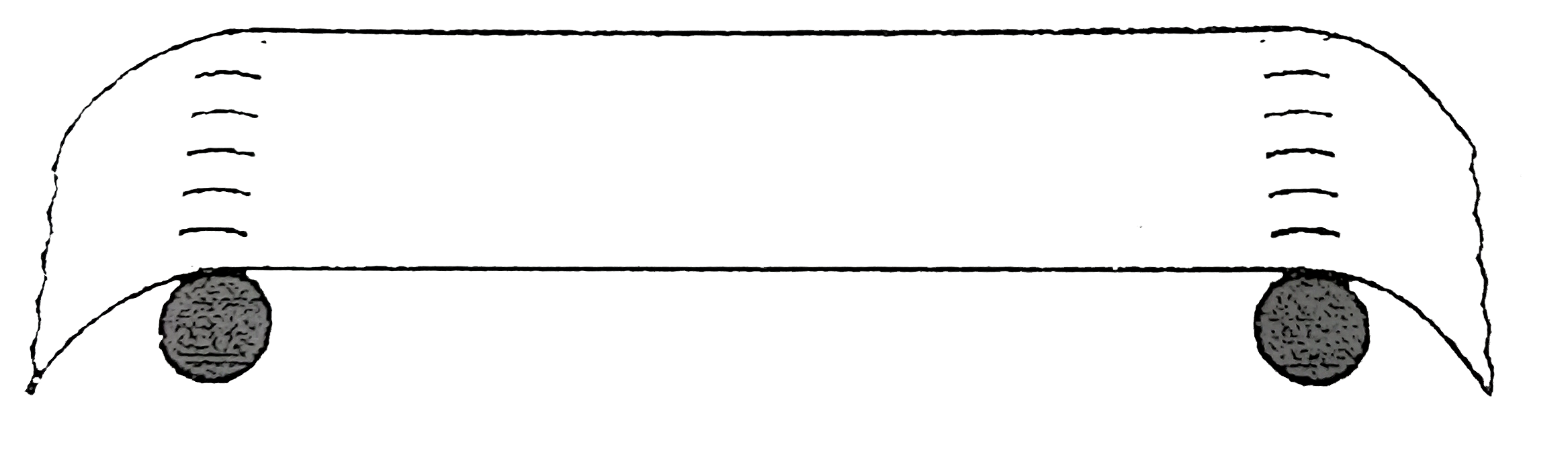
To manufacture a polyethlene film a wide band is pulled over rollers at `v = 15 m//s`. During this process the film's surface acquires a uniformly distibuted charge `sigma`, mainly because of friction. An electric field of strength 20 kV/cm can cause a discharge in air. Taking into account this fact, maximum possible magnetic field flux density B near the film's surface will be :



Similar Questions
Explore conceptually related problems
a. The top of the atmosphere is at about 400 kV with respectto the surface of the earth, corresponding to an electric field that decreases with altitude. Near the surface of the earth, the field is about 100 Vm^(-1). Why then do we not get a electric shock as we step out of our house into the openy (Assume the house to be a steel cage so there is no field inside!) b. A man fixes outside his house one evening a two metre high insulating slab carrying on its top a large aluminium sheet of area 1m^(2) . Will he get an electric shock if he touches the metal sheet next morning? c. The discharging current in the atmosphere due to the small conductivity of air is known to be 1800A on an average over the globe. Why then does the atmosphere not discharge itself completely in due course and become electrically neutral? In other words, what keeps the atmosphere charged? d. What are the forms of energy into which the electrical energy of the atmosphere is dissipated during a lightning? (Hint: The earth has an electric field of about 100 Vm^(-1) at its surface in the downward direction, corresponding to a surface charge density =-10^(-9) Cm^(-2) ?.
Answer the following: (a) The top of the atmosphere is at about 400 kV with respect to the surface of the earth, corresponding to an electric field that decreases with altitude. Near the surface of the earth, the field is about 100 Vm^(-1) . Why then do we not get an electric shock as we step out of our house into the open? (Assume the house to be a steel cage so there is no field inside!) (b) A man fixes outside his house one evening a two metre high insulating slab carrying on its top a large aluminium sheet of area 1m^(2) . Will he get an electric shock if he touches the metal sheet next morning? (c) The discharging current in the atmosphere due to the small conductivity of air is known to be 1800 A on an average over the globe. Why then does the atmosphere not discharge itself completely in due course and become electrically neutral? In other words, what keeps the atmosphere charged? (d) What are the forms of energy into which the electrical energy of the atmosphere is dissipated during a lightning? (Hint: The earth has an electric field of about 100 Vm^(-1) at its surface in the downward direction, corresponding to a surface charge density = 10^(-9)C m^(-2) . Due to the slight conductivity of the atmosphere up to about 50 km (beyond which it is good conductor), about + 1800 C is pumped every second into the earth as a whole. The earth, however, does not get discharged since thunderstorms and lightning occurring continually all over the globe pump an equal amount of negative charge on the earth.)
A long cylinder with uniformly charged surface and crosssectional radius a = 1.0 cm moves with a constant velocity v = 10 m//s along its axis. An electric field strength at the surface of the cylinder is equal to E = 0.9 kV/cm . Find the resultign concection current , that is, the current caused by mechanical transfer of a charge.
Photons emitted by a gas consisting of excited hydrogen like atoms (A) during a transition from a higher quantum state (quantum no. n) to a lower quantum state (quantum no :m ) are incident on a metallic surface (B) causing the emission of photoelectrons . The fastest photoelectrons pass undeviated through a region consisting of electric field E_0 =3.7 V/cm and magnetic field B_0 =10^3 T , oriented in perpecdicular directions and the photoelctrons enter the region perpendicular to both the electric and magnetic field The threshold wavelength for the metal B equal 830 nm. the spectrum of radiations emitted by the excited hydrogen -like atoms (A) consists of 15 different wavelengths . Find the quantum numbers of the states n,m and atomic number (Z) of the element (A) . (Take 1.89//13.6~~1//7)
When a current through the medium, an electric field exists as well as a potential which varies in space. Suppose that there is a break in a high - voltage transmission line and the free end of a wire of length L is lying on the ground. An electric current flows through the regions of soil adjoining the conductor. If a man happens to be walking near by a potential difference, which is called the step voltage appears between the points where his feet touch the ground, Consequently, an electric current whose strength depends on this potential difference flows through the man. Let us calculate the step voltage. Since the conductor is quite long, we assume that the current flows from it to the ground in a direction perpendicular to the conductor. The equipotential surfaces are the surfaces of semi-cylinders whose axes coincide with the conductor. Suppose that the man is walking in a direction perpendicular to the conductor with a step of length 'b' the distance between the conductor and the foot closer to it being d. Assuming that the current flows uniformly from the conductor over the semi cylindrical region we obtain the following expression for the current density at a distance from the conductor: j=i/(pirL) In this case , the field strength along the radii perpendicular to the conductor is E_r=j/sigma=l/(pirLsigma) Consequently , the step voltage is V_(st)=int_d^(d+b) Edr =1/(pisigmaL)ln((d+b)/d) For example , If l=500A , d=1 m , b=65 cm and L=30 m we find that V_(st) =270 V. Much higher voltages may appear under other conditions and other shapes of conductors. When a part of a high- voltage transmission line falls on the ground, it creates a hazard
Recommended Questions
- To manufacture a polyethlene film a wide band is pulled over rollers a...
Text Solution
|
- Electric charge are distributed in a small vouume. The flux of the ele...
Text Solution
|
- The surface density on a copper sphere is sigma . The electric field s...
Text Solution
|
- Find the electric field potentail and strength at the centre of a hemi...
Text Solution
|
- A long cylinder with uniformly charged surface and crosssectional radi...
Text Solution
|
- To manufacture a polyethlene film a wide band is pulled over rollers a...
Text Solution
|
- The electric charges are distributed in a small volume. The flux of th...
Text Solution
|
- Electric charges are distributed in a small volume. The flux of the el...
Text Solution
|
- Electric charge are distributed in a small volume. The flux of the ele...
Text Solution
|