

Home
Class 11
PHYSICS
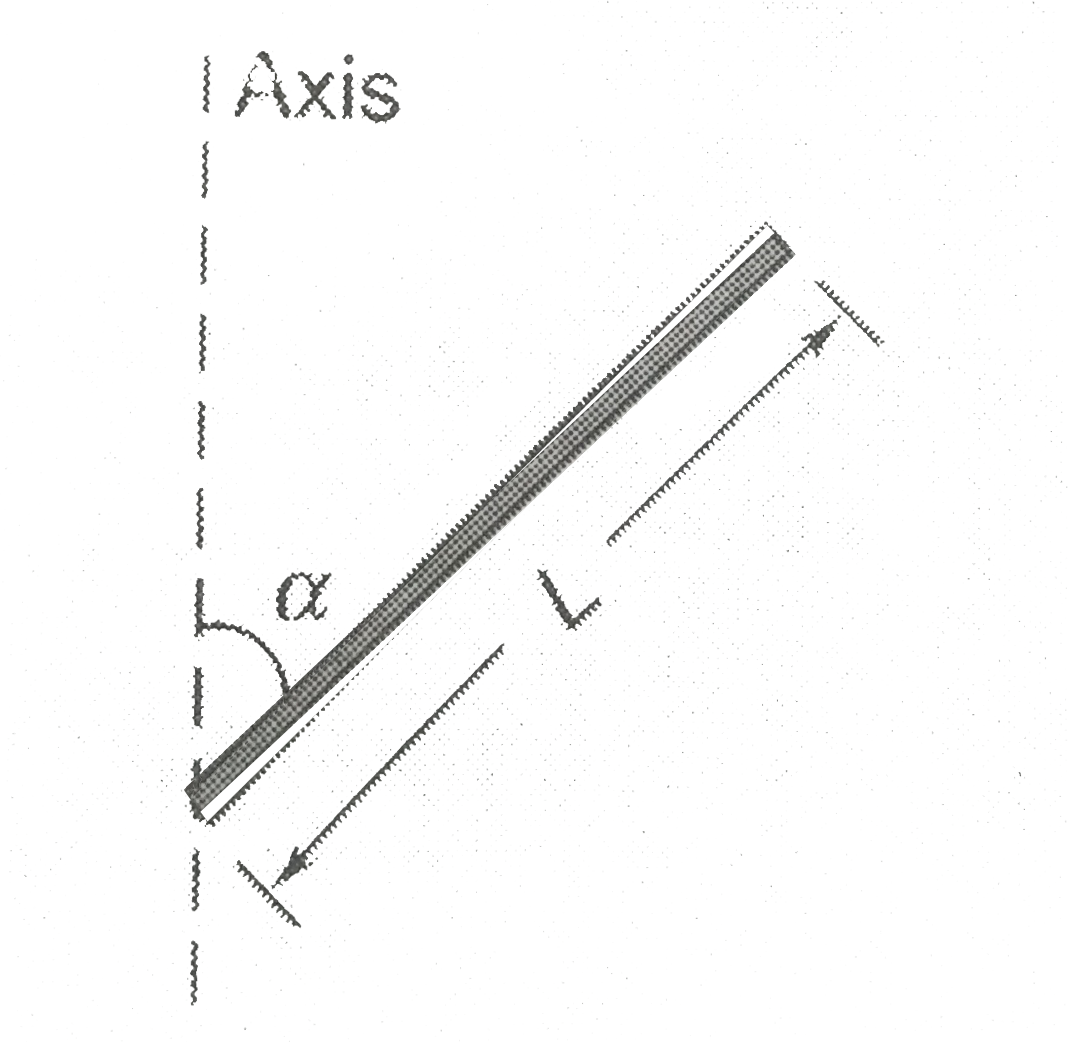
Find the M.I. of thin uniform rod of mas...

Find the `M.I.` of thin uniform rod of mass `M` and length `L` about the axis as shown.

Promotional Banner

Similar Questions

Explore conceptually related problems

The M.I. of thin uniform rod of mass 'M' and length 'l' about an axis passing through its centre and perpendicular to its length is

Calculate the moment of inertia of a uniform rod of mass M and length l about an axis passing through an end and perpendicular to the rod. The rod can be divided into a number of mass elements along the length of the rod.

Calculate the moment of inertia of a uniform rod of mass M and length l about an axis passing through an end and perpendicular to the rod. The rod can be divided into a number of mass elements along the length of the rod.

The moment of inertia of a thin uniform rod of mass M and length L about an axis perpendicular to the rod, through its centre is I . The moment of inertia of the rod about an axis perpendicular to rod through its end point is

The moment of inertia of a thin uniform rod of mass M and length L about an axis perpendicular to the rod, through its centre is I. The moment of inertia of the rod about axis perpendicular to the rod through its end point is

Calculate the radius of gyration of a uniform thin rod of mass M and length L about an axis of rotation perpendicular to its length and passing through its centre.

The moment of inertia of a thin uniform rod of mass M, length L, about an axis passing through its centre and making an angle theta with the rod is

Figure shows a thin, uniform rod of mass M and length L, on an x axis with the origin at the rod's center. (a) What is the rotational inertia of the rod about the perpendicular rotation axis through the center? (b) What is the rod's rotational inertia I about a new rotation axis that is perpendicular to the rod and through the left end?

Three thin uniform rods each of mass M and length L and placed along the three axis of a Cartesian coordinate system with one end of each rod at the origin. The M.I. of the system about z-axis is