

Home
Class 11
PHYSICS
If two conducting slabs of thickness d1 ...

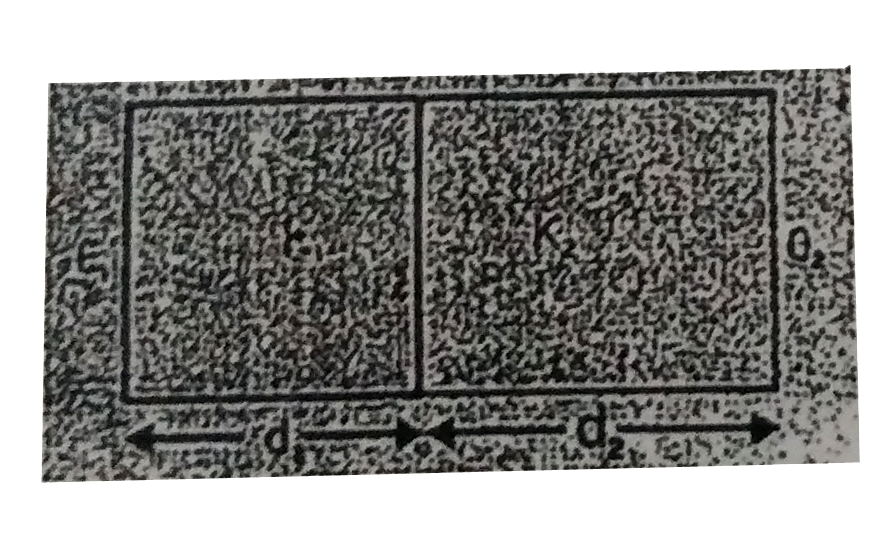
If two conducting slabs of thickness `d_1` and `d_2`, and thermal conductivity `K_1` and `K_2` are placed together face to face as shown in figure in the steady state temperature of outer surfaces are `theta_1` and `theta_2`. The temperature of common surface is-

Promotional Banner

Similar Questions

Explore conceptually related problems

Two walls of thickness d_(1) and d_(2) and thermal conductivites K_(1) and K_(2) are in contact. In the steady state, if the temperature at the outer surfaces are T_(1) and T_(2) the temperature at the common wall is

Two walls of thicknes l_(1) and l_(2) and ther-mal condctivities K_(1) and K_(2) are in contact In the steady state, if the temperature at the outer faces are T_(1) and T_(2) find the temperature at the common wall .

If two metallic plates of equal thickness and thermal conductivities K_1 and K_2 ​are put together face to face and a common plate is constructed, then the equivalent thermal conductivity of this plate will be

Two walls of thickness d and d and thermal conductivities k and k are in contact. In the steady state, if the temperature at the outer T_(1) and T_(2) , the temperature at the common wall is

If two metallic plates of equal thickness and thermal conductivities K_(1) and K_(2) are put together face to face and a common plate is constructed, then the equivalent thermal conductivity of this plate will be

IF two metallic plates of equal thickness and thermal conductivities K_(1) and K_(2) are put together face to face anda common plate is constructed, then the equivalent thermal conductivity of this plate will be

Two plates each of area A thickness L_(1) and L_(2) thermal conductivities K_(1) and K_(2) respectively are joined to from a single plate of thickness (L_(1)+L_(2)) If the temperatures of the free surfaces are theta_(1) and theta_(2) Calculate (a) Rate of flow of heat (b) Temperature of interface .

Two materials having coefficients of thermal conductivity ‘3 K’ and ‘K’ and thickness ‘d’ and ‘3 d’, respectively, are joined to form a slab as shown in the figure. The temperatures of the outer surfaces are theta_(2) and theta_(1) respectively, (theta_(2) gt theta_(1)) The temperature at the interface is: