Home
Class 12
PHYSICS
Two particles, 1 and 2, move with consta...

Two particles, 1 and 2, move with constant velocities `v_1` and `v_2`. At the initial moment their radius vectors are equal to `r_1` and `r_2`. How must these four vectors be interrelated for the particles to collide?

A

`vecr_(1)-vecr_(2)=vecv_(1)-vecv_(2)`

B

`(vecr_(1)-vecr_(2))/(|vecr_(1)-vecr_(2)|)=(vecv_(2)-vecv_(1))/(|vec_(2)-vecv_(1)|)`

C

`vecr_(1)*vecv_(1)=vecr_(2)*vecv_(2)`

D

`vecr_(1)xxvecv_(1)=vecr_(2)xxvecv_(2)`

Text Solution

Verified by Experts

The correct Answer is:
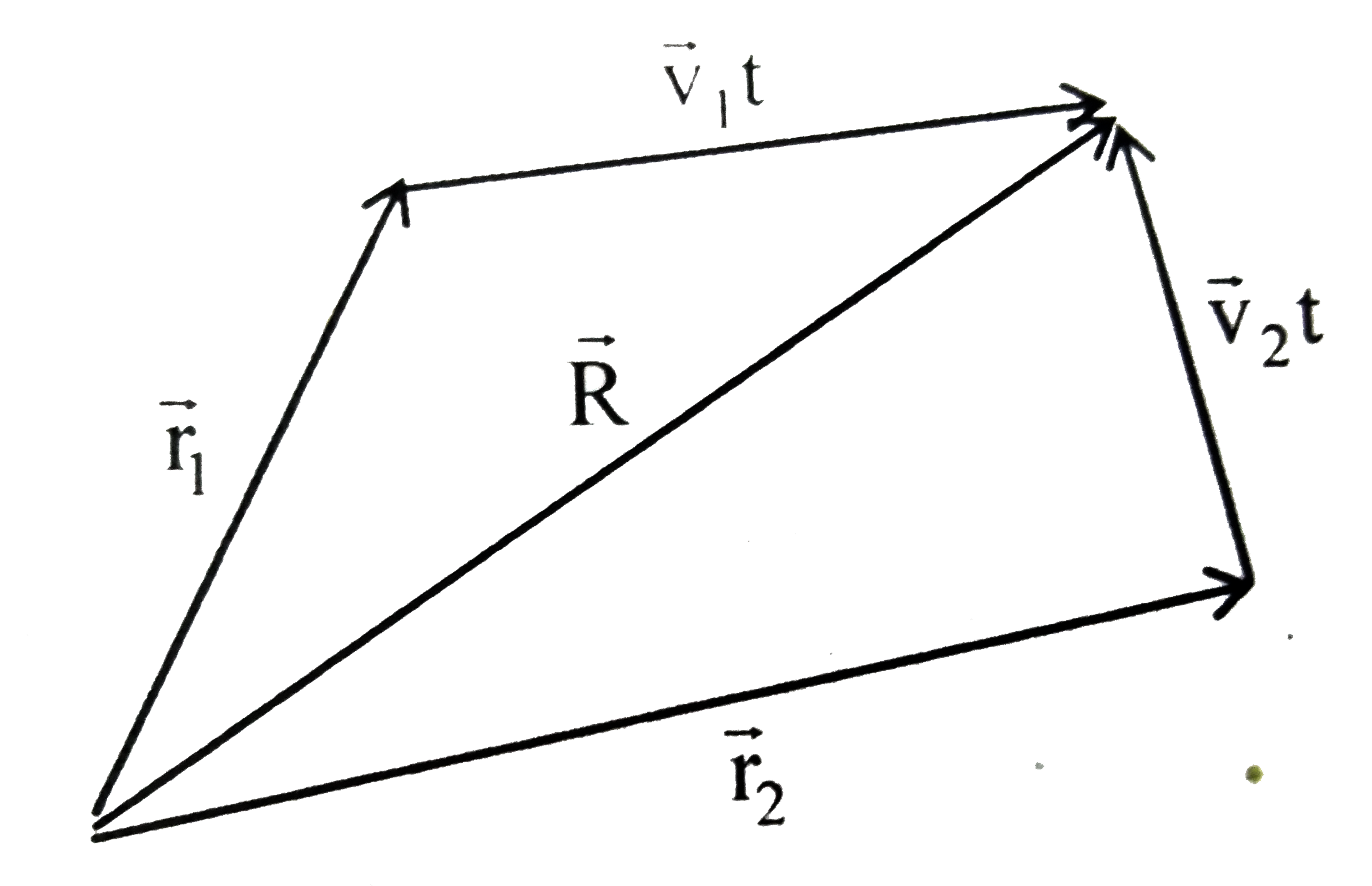
B


`vecR=vecr_(1)+vecv_(1)t=vecr_(2)+vecv_(2)t`
`vecr_(1)-vecr_(2)=(vecv_(2)-vecv_(1))t`
`(vecr_(1)-vecr_(2))/(|vecr_(1)-vecr_(2)|)=((vecv_(2)-vecv_(1))t)/(|vecv_(2)-vecv_(1)|t)`
`(vecr_(1)-vecr_(2))/(|vecr_(1)-vecr_(2)|)=(vecv_(2)-vecv_(1))/(|vecv_(2)-vecv_(1)|)`
Promotional Banner

Topper's Solved these Questions

  • NEET

    NEET PREVIOUS YEAR (YEARWISE + CHAPTERWISE)|Exercise PHYSICS|157 Videos
  • NEET

    NEET PREVIOUS YEAR (YEARWISE + CHAPTERWISE)|Exercise QUESTION|95 Videos
  • MOTION IN TWO AND THREE DIMENSION

    NEET PREVIOUS YEAR (YEARWISE + CHAPTERWISE)|Exercise All Questions|47 Videos
  • NEET 2020

    NEET PREVIOUS YEAR (YEARWISE + CHAPTERWISE)|Exercise All Questions|45 Videos

Similar Questions

Explore conceptually related problems

Two particles A and B, move with constant velocities vec(v_(1))" and "vec(v_(2)) . At the initial moment their position vectors are vec(r_(1))" and "vec(r_(2)) respectively. The condition for particle A and B for their collision is

Two particles, 1 and 2, move with constant velocities v_1 and v_2 along two mutually perpendicular straight lines toward the intersection point O. At the moment t=0 the particles were located at the distances l_1 and l_2 from the point O. How soon will the distance between the particles become the smallest? What is it equal to?

Two particles are moving with velocities v_(1) and v_2 . Their relative velocity is the maximum, when the angle between their velocities is

Two particles 1 and 2 move with velocities vec v_1 and vec v_2 making the angles theta_1 and theta_2 with the line joining them, respectively. Find angular velocity of relative to 1 . .

Two point masses 1 and 2 move with uniform velocities vec(v)_(1) and vec(v)_(2) , respectively. Their initial position vectors are vec(r )_(1) and vec(r )_(2) , respectively. Which of the following should be satisfied for the collision of the point masses?

Two particles A and B are moving with constant velocities v_1 and v_2 . At t = 0 , v_1 makes an angle theta_0 with the line joining A and B and v_2 makes an angle theta_2 with the line joining A and B . Find their velocity of approach. .

A closed system consists of two particles of masses m_1 and m_2 which move at right angles to each other with velocities v_1 and v_2 . Find: (a) the momentum of each particle and (b) the total kinetic energy of the two particles in the reference frame fixed to their centre of inertia.

Two particles of mass m and 2 m moving in opposite directions collide elastically with velocities v and 2v. Find their velocities after collision.

NEET PREVIOUS YEAR (YEARWISE + CHAPTERWISE)-NEET-MCQ
  1. Two particles, 1 and 2, move with constant velocities v1 and v2. At th...

    Text Solution

    |

  2. The damping force on an oscillator is directly proportional to the vel...

    Text Solution

    |

  3. The motion of a particle along a straight line is described by equatio...

    Text Solution

    |

  4. The horizontal range and the maximum height of a projectile are equal....

    Text Solution

    |

  5. A particle has initial velocity (2 vec(i)+3 vec(j)) and acceleration (...

    Text Solution

    |

  6. A car of mass 1000kg negotiates a banked curve of radius 90m on a fict...

    Text Solution

    |

  7. A solid cylinder of mass 3 kg is rolling on a horizontal surface with ...

    Text Solution

    |

  8. The potential energy of a particle in a force field is: U = (A)/(r^(...

    Text Solution

    |

  9. Two sphere A and B of masses m(1) and m(2) respectivelly colides. A is...

    Text Solution

    |

  10. Two persons of masses 55 kg and 65 kg respectively are at the opposite...

    Text Solution

    |

  11. ABC is an equilateral triangle with O as its centre vec(F(1)),vec(F(2)...

    Text Solution

    |

  12. When a mass is rotating in a plane about a fixed point, its angular mo...

    Text Solution

    |

  13. A spherical planet far out in space has a mass M(0) and diameter D(0)....

    Text Solution

    |

  14. A geostationary satellite is orbiting the earth at a height of 5R abov...

    Text Solution

    |

  15. The height a which the weight of a body becomes 1//16th its weight on ...

    Text Solution

    |

  16. Two sources of sound placed close to each other are wmitting progressi...

    Text Solution

    |

  17. When a string is divided into three segments of length l1,l2 and l3 th...

    Text Solution

    |

  18. One mole of an ideal gas goes from an initial state A to final state B...

    Text Solution

    |

  19. A thermodynamics system is taken trough the cycle ABCD as shown in fig...

    Text Solution

    |

  20. Liquid oxygen at 50 K is heated to 300 K at constant pressure of 1 atm...

    Text Solution

    |

  21. If the radius of a star is R and it acts as a black body, what would b...

    Text Solution

    |

