Home
Class 11
CHEMISTRY
Enthalpies of solution of BaCI(2). 2H(2)...

Enthalpies of solution of `BaCI_(2). 2H_(2)O` and `BaCI_(2)` are 8.8 and `-20.6 kJ mol^(-1)` respectively.Calculate the heat of hydration of `BaCI_(2). 2H_(2)O`

Text Solution

Verified by Experts
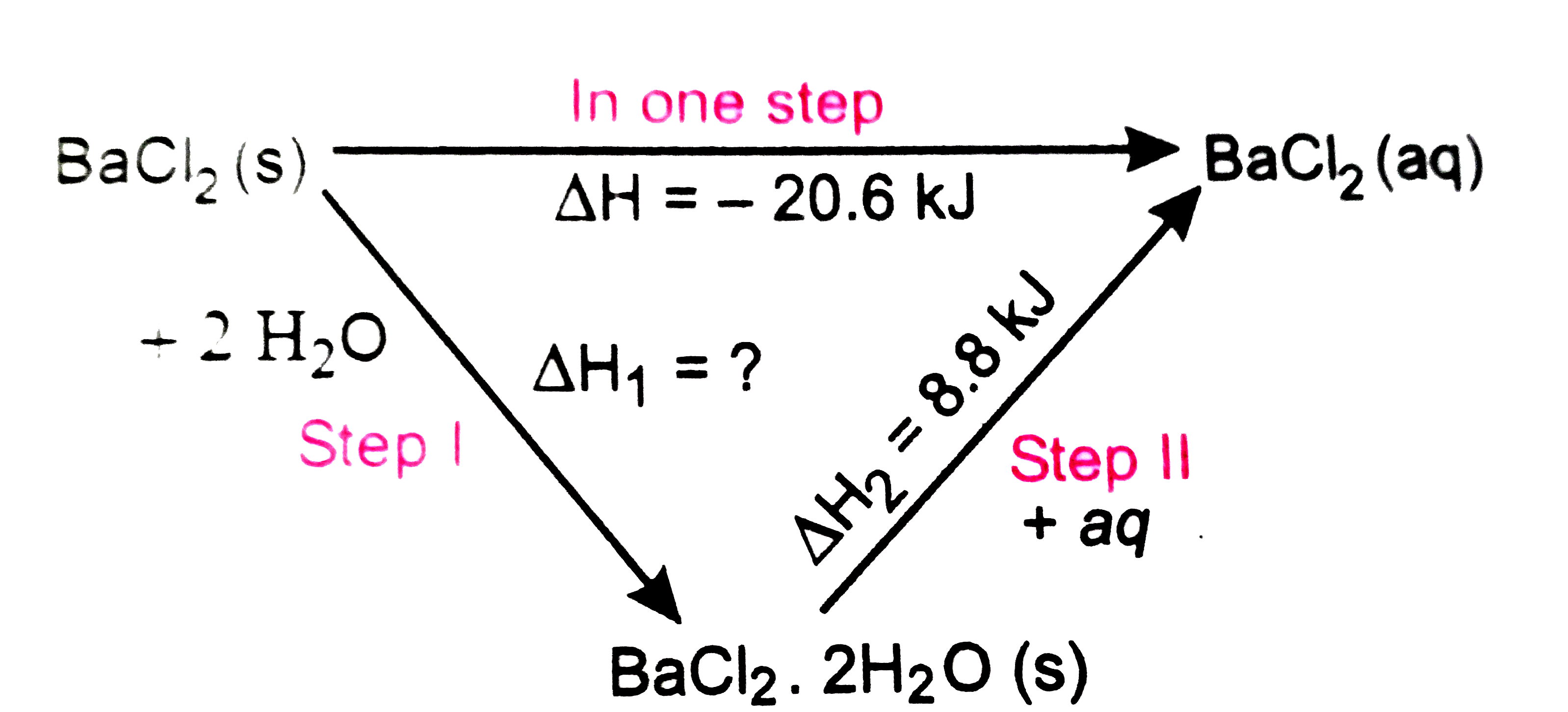
We are given
(i) `BaCl_(2).2H_(2)O(s) +aq rarr BaCl_(2)(aq), Delta_(sol) H^(@) = 8.8 kJ mol^(-1)`
(ii) `BaCl_(2)(s)+aq rarr BaCl_(2)(aq),Delta_(sol) H^(@) = - 20.6kJ mol^(-1)`
We aim at `BaCl_(2) (s) + 2H_(2)O rarr BaCl_(2).2H_(2)O(s) ,Delta _(hyd) H^(@) = ? ` ....(iii)
Equation (ii) may be written in two steps as
`BaCl_(2) (s) + 2H_(2)O rarr BaCl_(2).2H_(2)O(s), DeltaH= Delta_(r)H_(1)^(@)(say) ` ....(iv)
`BaCl_(2).2H_(2)O(s) +aq rarr BaCl_(2)(aq), DeltaH = Delta _(r) H_(2)^(@) ` (say) .....(v)
Then according to Hess's law, `Delta_(r) H_(1)^(@)+Delta_(r)H_(2)^(@)= 20.6kJ`
But `Delta_(r) H_(2)^(@) = 8.8 kJ mol^(-1)` `[ :'` Equation (i) `=`Equation (v) ]
`:. Delta_(r) H_(10^(@)) = - 20.6 - 8.8 = - 29.4 kJ mol^(-1)`
But Equation (iii) `=` Equation (iv)
Hence, the heat of hydration of `BaCl_(2)`
`Delta_(hyd) H^(@) =- 29.4 kJ mol^(-1)`

Alternativly, the dissolution in one step or in two stepsmay be represented as shown in the Fig.
Applying Hess's law, `Delta H = Delta H_(1) + Delta H _(2)`
`- 20.6 = Delta H_(1) = 8.8`
or ` Delta H _(1) = -20.6 - 8.8 kJ = - 29.4 kJ`
Promotional Banner

Topper's Solved these Questions

  • THERMODYNAMICS

    PRADEEP|Exercise Sample Problem 3|1 Videos
  • THERMODYNAMICS

    PRADEEP|Exercise Sample Problem 4|1 Videos
  • THERMODYNAMICS

    PRADEEP|Exercise Sample Problem 1|6 Videos
  • STRUCTURE OF ATOM

    PRADEEP|Exercise Competition Focus (JEE (Main and Advanced)/Medical Entrance (IX. Assertion And Reason Type Questions (Type II))|12 Videos

Similar Questions

Explore conceptually related problems

Enthalpy of solution for BaCI_(2). 2H_(2)O and BaCI_(2) are 18.8 and -30.6 kL mol^(-1) respectively. Calculate the enthalpy of hydration of BaCI_(2) to BaCI_(2). 2H_(2)O .

Enthalpies of solution of BaCl_(2)(s) and BaCl_(2).2H_(2)O(s) are -20 kJ//"mole" and 8.0kJ//"mole" respectively. Calculate heat of hydration of BaCl_(2)(s) .

Ethalpies of solution of BaCI_(2)(s) and BaCI_(2).2H_(2)O(s) are -20.0kJ mol^(-1) and 8.0 kJ mol^(-1) , respectively. Calculate Delta_(hyd)H^(Theta) of BaCI_(2) to BaCI_(2).2H_(2)O .

The enthalpy of dissolution of BaCl_(2)(s) and BaCl_(2).2H_(2)O are -20.6 and 8.8 KJ mol^(-1) respectively . Calculate enthalpy of hydration forgiven reaction: BaCl_(2)(s)+2H_(2)OtoBaCl_(2).2H_(2)O(s)

The enthalpies of solution of anhydrous CuSO_(4) and hydrated CuSO_(4). 5H_(2)O are -66.5 and 11.7 kJ mol^(-1) respectively.Calculate the enthalpy of hydration of CuSO_(4) to CuSO_(4).5H_(2)O .

The heat of solution of BaCl_(2) .2H_(2) O_((s)) and anhydrous BaCl_(2(s)) are 8.37" kJ mol"^(–1) and –20.62" kJ mol"^( –1) respectively then heat of hydration of BaCl_(2(s)) will be :-

From the following data, calculate the enthalpy change for the combustion of cyclopropane at 298K . The enthalpy of formation of CO_(2(g)),H_(2)O_((l)) and Propen e_((g)) are -393,-285.8 and 20.42 kJ mol^(-1) respectively. The enthalpy of isomerisation of cyclopropane to propene is -33.0kJ mol^(-1)

