Home
Class 11
CHEMISTRY
Two moles of a perfect gas undergo the f...

Two moles of a perfect gas undergo the following processes:
a. A reversible isobaric expansion from `(1.0 atm, 20.0L)` to `(1.0 atm, 40.0L)`.
b. A reversible isochroic change of state from `(1.0 atm, 40.0L)` to `(0.5 atm, 40.0 L)`
c. A reversible isothermal expansion from `(0.5 atm, 40.0 L) to(1.0 atm, 20.0 L)`.
i. Sketch with lables each of the processes on the same `P -V` diagram.
ii. Calculate the total work `(w)` and the total heat change `(q)` involved in the above process.
iii. What will be the values of `DeltaH` for the overall process?

Text Solution

Verified by Experts
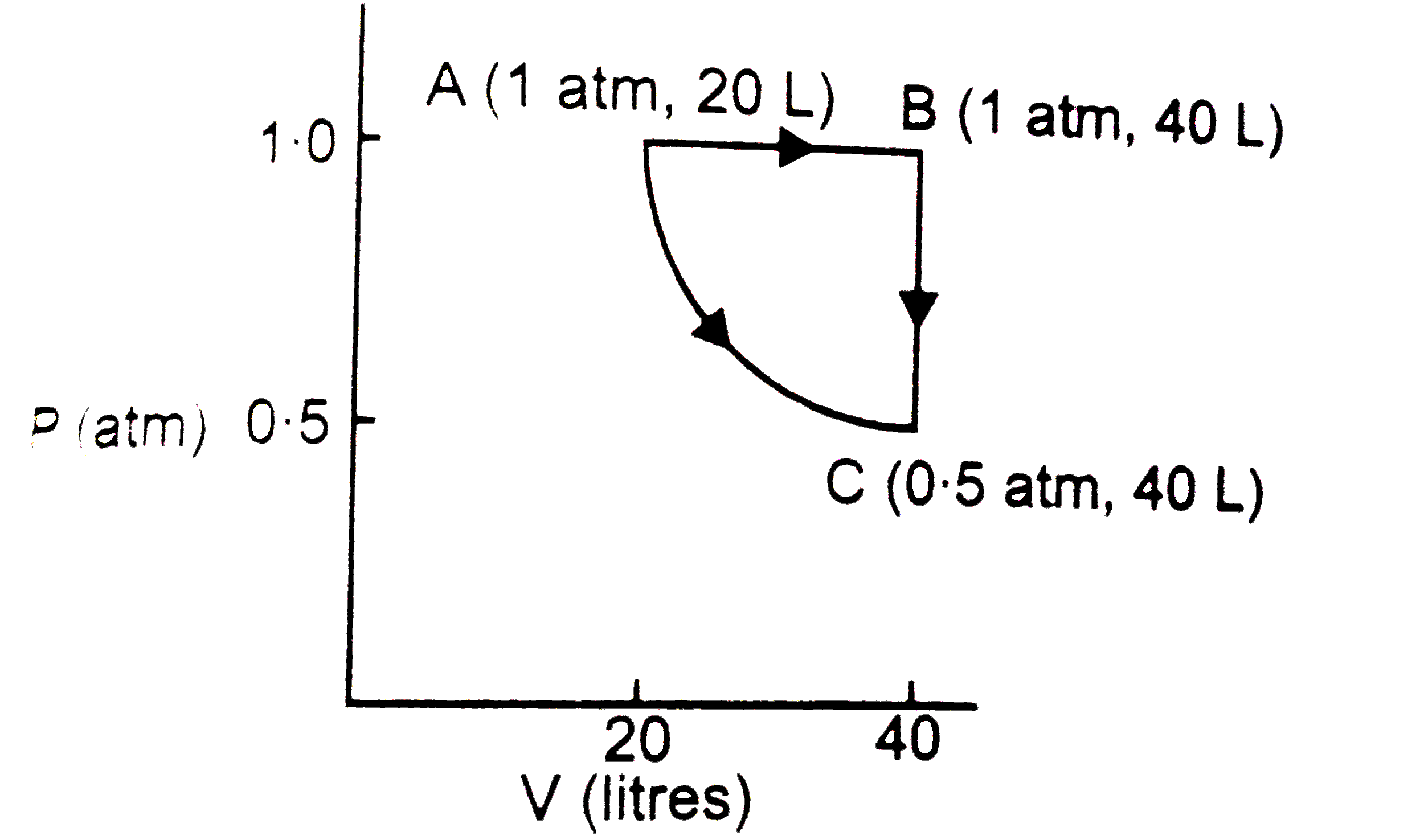

(ii)Total work `(w) = w_(1)+w_(2)+w_(3) =- P DeltaV+ 0 + 2.303 nRT log .(V_(1))/(V_(2))`
`= -1 xx 20+2.303 xx 2 xx 0.082 xx 121.95 log 2 (T =(PV)/(nR) = ( 1 xx 20)/( 2 xx 0.082) = 121.95 K) `
`= -20 + 13.86 = - 6.13L atm=-6.13 xx 101.3 J = - 621.0 J `
(In a cyclic process,heat abosorbed is completely converted into work)
(iii) As U, H and S are state functions and the system has returned to its original state, `DeltaU =0, DeltaH=0,` and`Delta S=0`.
Promotional Banner

Similar Questions

Explore conceptually related problems

Two moles of a perfect gas undergo the following processes: a. A reversible isobaric expansion from (1.0 atm, 20.0L) to (1.0 atm, 40.0L) . b. A reversible isochroic change of state from (1.0 atm, 40.0L) to (0.5 atm, 40.0 L) c. A reversible isothermal expansion from (0.5 atm, 40.0 L) to(1.0 atm, 20.0 L) . i. Sketch with lables each of the processes on the same P -V diagram. ii. Calculate the total work (w) and teh total heat change (q) involved in the above process. iii. What will be the values of DeltaG and DeltaH for the overall process?

Two moles of a perfect gas undergo the following processes: (a) a reversible isobaric expansion from (1.0 atm , 20.0 L) to (1.0 atm, 40.0 L) (b) a reversible isochroic change of state from (1.0 atm , 40.0L) to (0.5 atm , 40.0 L) (c) a reversible isothermal compression from (0.5 atm,40.0 L ) to (1.0atm, 20.0L) Calculate the magnitude of work (W) done in L.atm

Two moles of a perfect gas undergo the following process: (a) A reversible isobaric expansion from ( 1.0 atm, 20.0 litre) to ( 1.0 atm, 40.0 litre). (b) A reversible isochoric change of state from ( 1.0 atm, 40.0 litre) to ( 1.0 atm, 40.0 litre). (b) A reversible isochoric change of state from ( 1.0 atm, 40.0 litre) to ( 0.5 atm, 40.0 litre). (c) A reversible isothermal compression from ( 0.5 atm, 40.0 litre) to ( 1.0 atm, 20.0 litre). (i) Sketch with labels each of the process on the same P-V diagram. (ii) Calculate the total work (W) and the total heat change (q) involved in the above process. (iii) What will be the value of DeltaU, DeltaH and DeltaS for the overall process?

Two moles of an ideal gas undergo the following process : (a) a reversible isobaric expansion from ( P atm, V L) to ( P atm , 2V L) . (b) a reversible isochoric change of state from ( P atm , 2V,L) to (P//2 atm, 2V L) (c ) a reversible isothermal compression from (P//2 atm, 2V L) to (P atm, V L) . Sketch with labels each of the processes on the same P-V diagram.

Maximum heat absorbed during isothermal expansion of an ideal gas from (10 atm, 1 L) to (1 atm, 10 L) is :

One mole of an ideal gas undergoes a change of state (2.0) atm, 3.0 L) to (2.0 atm, 7.0 L) with a change in internal energy (DeltaU) = 30 L-atm. The change in enthalpy (DeltaH) of the process in L-atm :

One mole of a non-ideal gas undergoes a change of state (2.0 atm, 3.01, 95K) to (4.0 atm, 5.01, 245K) with a change in internal energy, DeltaU=30.0L atm. The change in enthalpy DeltaH of the process in L atm is.

