Home
Class 12
CHEMISTRY
Two moles of a perfect gas undergo the f...

Two moles of a perfect gas undergo the following processes:
a. A reversible isobaric expansion from `(1.0 atm, 20.0L)` to `(1.0 atm, 40.0L)`.
b. A reversible isochroic change of state from `(1.0 atm, 40.0L)` to `(0.5 atm, 40.0 L)`
c. A reversible isothermal expansion from `(0.5 atm, 40.0 L) to(1.0 atm, 20.0 L)`.
i. Sketch with lables each of the processes on the same `P -V` diagram.
ii. Calculate the total work `(w)` and the total heat change `(q)` involved in the above process.
iii. What will be the values of `DeltaH` for the overall process?

Text Solution

Verified by Experts
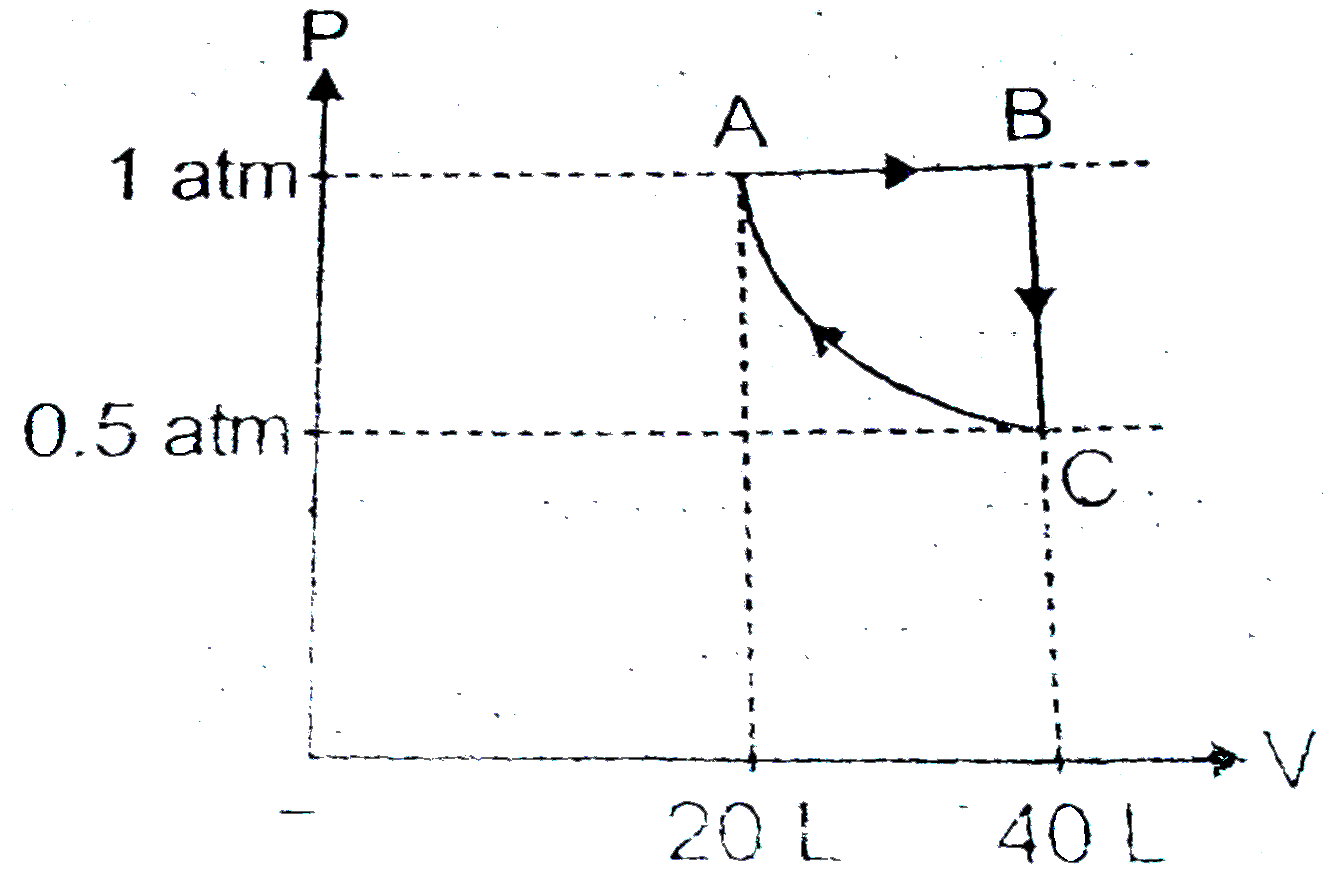
(i)
(ii) Total work (W) = `W_(A rarr B) + W_(B rarr C) + W_(C rarr A)`
`W_(A rarr B) = -P(V_(B)-V_(A)) = -1(40 - 20) = - 20` atm.L
`W_(B rarr C)` = isochoric change `Delta V = 0`
`W_(C rarr A)` (isothermal compression)
`=-"2.303 nRT log"((V_(A))/(V_(C)))" "(PV = nRT)`
`=-2.303 xx 0.5 xx "40 log"(20)/(40)`
= + 13.864 atm.L
Total work done = (-20 + 13.864) atm.L
= -6.136 atm.L
Since the process is cyclic, `Delta E - 0` (because E is state function)
`Delta Q = Delta E - Delta W`
`Delta Q = - Delta W` = + 6.136 atm.L
(iii) `Delta E, Delta H, Delta S` will be zero for overall process because E, H and S are state functions.
Promotional Banner

Topper's Solved these Questions

  • THERMODYNAMICS

    AAKASH INSTITUTE|Exercise TRY YOURSELF|67 Videos
  • THERMODYNAMICS

    AAKASH INSTITUTE|Exercise SECTION-A|45 Videos
  • THE SOLID STATE

    AAKASH INSTITUTE|Exercise Assignment (SECTION - D) (ASSERTION-REASON TYPE QUESTION)|20 Videos

Similar Questions

Explore conceptually related problems

Two moles of a perfect gas undergo the following processes: a. A reversible isobaric expansion from (1.0 atm, 20.0L) to (1.0 atm, 40.0L) . b. A reversible isochroic change of state from (1.0 atm, 40.0L) to (0.5 atm, 40.0 L) c. A reversible isothermal expansion from (0.5 atm, 40.0 L) to(1.0 atm, 20.0 L) . i. Sketch with lables each of the processes on the same P -V diagram. ii. Calculate the total work (w) and teh total heat change (q) involved in the above process. iii. What will be the values of DeltaG and DeltaH for the overall process?

Two moles of a perfect gas undergo the following processes: (a) a reversible isobaric expansion from (1.0 atm , 20.0 L) to (1.0 atm, 40.0 L) (b) a reversible isochroic change of state from (1.0 atm , 40.0L) to (0.5 atm , 40.0 L) (c) a reversible isothermal compression from (0.5 atm,40.0 L ) to (1.0atm, 20.0L) Calculate the magnitude of work (W) done in L.atm

Two moles of a perfect gas undergo the following process: (a) A reversible isobaric expansion from ( 1.0 atm, 20.0 litre) to ( 1.0 atm, 40.0 litre). (b) A reversible isochoric change of state from ( 1.0 atm, 40.0 litre) to ( 1.0 atm, 40.0 litre). (b) A reversible isochoric change of state from ( 1.0 atm, 40.0 litre) to ( 0.5 atm, 40.0 litre). (c) A reversible isothermal compression from ( 0.5 atm, 40.0 litre) to ( 1.0 atm, 20.0 litre). (i) Sketch with labels each of the process on the same P-V diagram. (ii) Calculate the total work (W) and the total heat change (q) involved in the above process. (iii) What will be the value of DeltaU, DeltaH and DeltaS for the overall process?

Two moles of an ideal gas undergo the following process : (a) a reversible isobaric expansion from ( P atm, V L) to ( P atm , 2V L) . (b) a reversible isochoric change of state from ( P atm , 2V,L) to (P//2 atm, 2V L) (c ) a reversible isothermal compression from (P//2 atm, 2V L) to (P atm, V L) . Sketch with labels each of the processes on the same P-V diagram.

Maximum heat absorbed during isothermal expansion of an ideal gas from (10 atm, 1 L) to (1 atm, 10 L) is :

One mole of an ideal gas undergoes a change of state (2.0) atm, 3.0 L) to (2.0 atm, 7.0 L) with a change in internal energy (DeltaU) = 30 L-atm. The change in enthalpy (DeltaH) of the process in L-atm :

AAKASH INSTITUTE-THERMODYNAMICS-ASSIGNMENT (Section -D) Assertion-Reason Type Questions
  1. Two moles of a perfect gas undergo the following processes: a. A rev...

    Text Solution

    |

  2. A : C("diamond") rightarrow C("graphite") Delta H and Delta U are sam...

    Text Solution

    |

  3. A: Specific heat is an intensive property R: Heat capacity is an ext...

    Text Solution

    |

  4. A: All reactions which are exothermic are spontaneous R: All reactio...

    Text Solution

    |

  5. A: Enthalpy of neutralisation of 1 equivalent each of HCI and H(2)SO(...

    Text Solution

    |

  6. A: q and w are path function R: q + w is a state function

    Text Solution

    |

  7. A : Dissolution of sugar in water proceed via increases in entropy R...

    Text Solution

    |

  8. A : For an isolated system Delta G = - TDeltaS("total") R: For an i...

    Text Solution

    |

  9. A: Combustion is an exothermic process. R: Combustion is a spontaneo...

    Text Solution

    |

  10. A: Total enthalpy change of a multistep process is sum of Delta H(1) ...

    Text Solution

    |

  11. A : Bond energy is equal to enthalpy of formation with negative sign. ...

    Text Solution

    |

  12. A: Delta H is positive for endothermic reactions. R : If total entha...

    Text Solution

    |

  13. A : The energy of the universe is constant, whereas the entropy of the...

    Text Solution

    |

  14. A: A non- spontaneous process becomes spontaneous when coupled with a ...

    Text Solution

    |

  15. A: An ideal crystal has more entropy than a real crystal. R: An idea...

    Text Solution

    |

  16. A: Work done in an irreversible isothermal process at constant volume ...

    Text Solution

    |

