Home
Class 12
CHEMISTRY
NiCI(2) in the presence of dimethy1 glyo...

`NiCI_(2)` in the presence of dimethy1 glyoxime` (DMG)` gives a complex which precipitates in the presence of `NH_(4)OH` giving a bright red colour .
(a) Draw its structure and show `H` bonding
(b) Give the oxidation state of Ni and its hybridisation
(c ) Predict whether it is paramagnetic or dimagnetic .

Text Solution

Verified by Experts
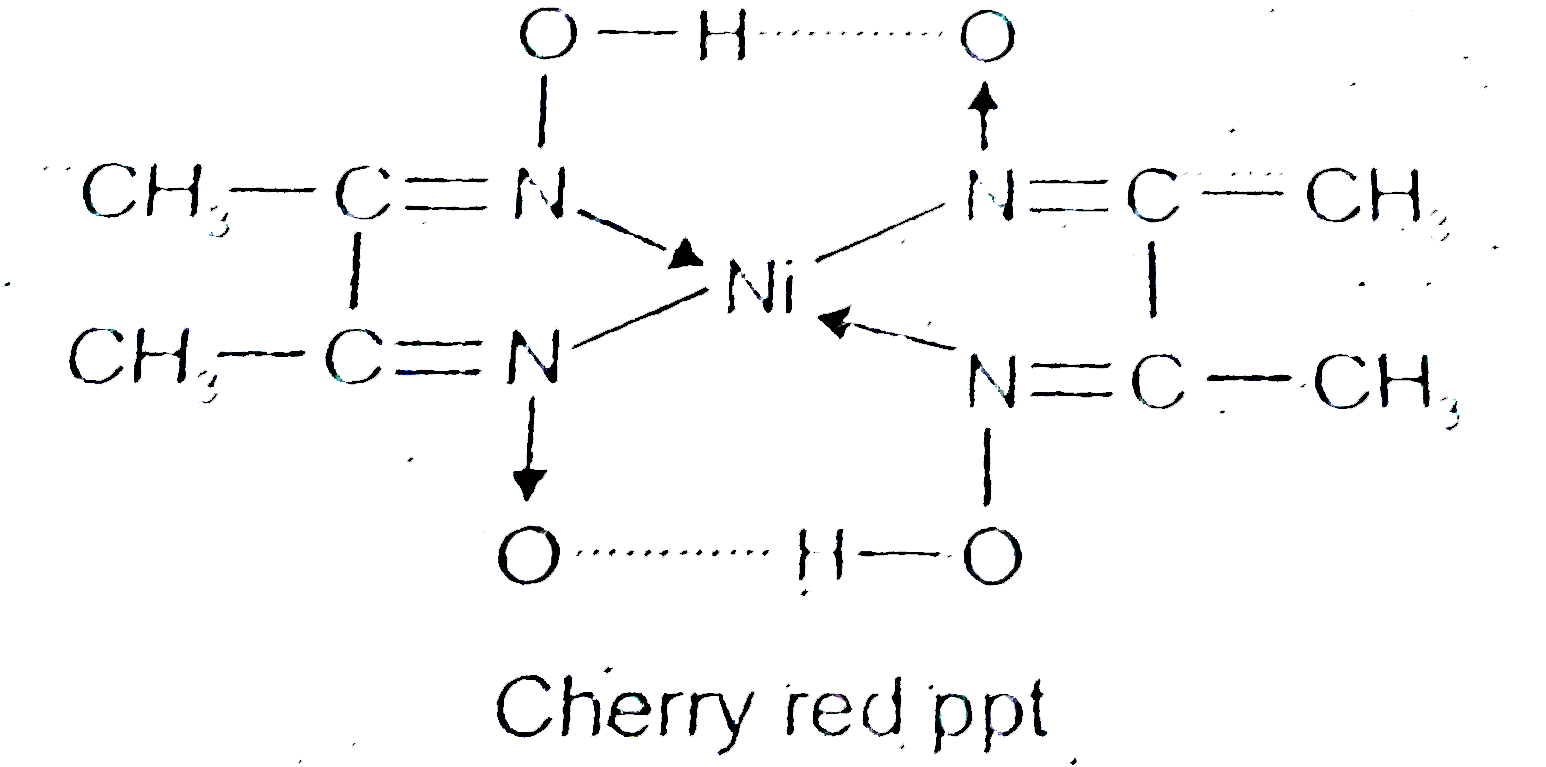

Oxidation state of nickel is +2 and hybridisation is `dsp^(2)` .
`mu_(s)=sqrt(n(n+2)) B.M.`
`n=0`
`:. mu_(s)=0`
Promotional Banner

Topper's Solved these Questions

  • COORDINATION COMPOUNDS

    AAKASH INSTITUTE|Exercise Assignment (Section-J Aakash Challenger Questions )|10 Videos
  • COORDINATION COMPOUNDS

    AAKASH INSTITUTE|Exercise Assignment (Section-H Multiple True-False Type Questions )|5 Videos
  • CLASSIFICATION OF ELEMENTS AND PERIODICITY IN PROPERTIES

    AAKASH INSTITUTE|Exercise Assignment (Section - J Aakash Challengers Questions)|6 Videos
  • ELECTROCHEMISTRY

    AAKASH INSTITUTE|Exercise Assignment (SECTION - J) (Aakash Challengers Questions)|10 Videos

Similar Questions

Explore conceptually related problems

When diemethyl glyoxime is added to the aqueous solution of nickel (II) chloride in presence of dilute ammonia solution, a bright red coloured precipitate is obtained . (a) Draw the structure of bright red substance . (b) Write the oxidation state of nickel in the substance and hybridisation. (c ) State whether the substance is paramagnetic or diamagnetic.

Nickel chloride, when treated with dimethyl gyloxime in presence of ammonium hydroxide, a bright red precipitate is obtained Answer the following (a) Draw the structure of the complex showing H-bonds (b) Give oxidation state of nickel and its hybridization (c) Predict the magnetic behaviour of the complex

Dimethyl glyoxime gives a red precipitate with Ni^(2+) , which is used for its detection. To get this precipitate readily the best pH range is

Benzene reacts with CH_(3)I in the presence of AlCl_(3) to give compound (A) (C_(7) H_(8)) which undergas oxidation with alkaline KMnO_(4) to give an acidic compound (B).(B) reacts with SOCl_(2) to give (C) which gives (D) with ammonia. The compound (D) on reaction with bromine and alkali froms (E) which reacts with bromnine water to give (F) (C_(6) H_(4) NBr_(3)). (F) reacts with NaNO_(2) adn HCl and forms (G) (C_(6) H_(2) N_(2) Br_(3) Cl) . Additiaon of Kl froms (H) Indenitify the compounds (A) to (H) .

A non-metal A which is the largest constituent of air, when heated with H2 in 1 : 3 ratio in the presence of catalyst (Fe) gives a gas B. 0n heating with O_(2) it gives an oxide C. If this oxide is passed into water in the presence of air, it gives an acid D which acts as a strong oxidising agent. (a) Identify A, B, C and D. (b) To which group of the periodic table does this non-metal belongs?

A white crystalline compound (X) swells open heating and gives violet-coloured flame. Its aqueous solution gives the following reactions : (a) A white precipitate is formed, with BaCl_(2) in presence of HCl . (b) When treated with excess of NH_(4) OH , it gives white gelatinous precipitate. the white precipitate dissolves in NaOH and reappears on boiling with concentrated solution of NH_(4) Cl . ( c) It gives yellow precipitate with cobaltinitrite solution. Identify (X) and explain the reaction at steps a, b and c .

