Strategy: Let u' be velocity of the object while crossing point a and v' be its velocity while crossing point b. As shown P is the highest point of vertical motion of object. The time taken by the object in going a to `P=t_(a//2)` the time taken by the object in going from b to `P=(t_(0))/(2)`
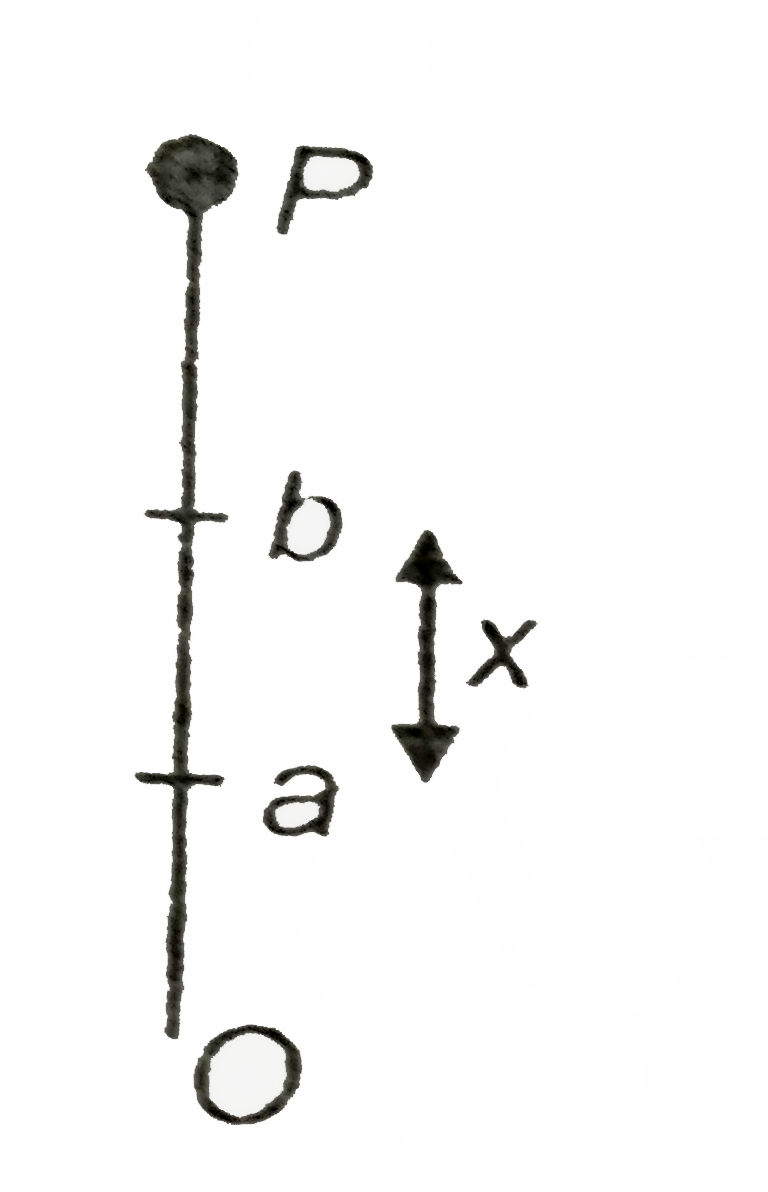
Taking vertical upward motion of object from a to P we have
`u=v', v=0, a = -g, t=(t_(a))/(2)`
As, `v=u+at`
`therefore" "0=u'+(-g)(t_(a))/(2)" or "u'=(g t_(a))/(2)" ...(i)"`
Taking vertical upward motion of object from b to P, we have
`u=v', v=0, a=-g, t=(t_(b))/(2)`
As, `v=u+at`
`0=v'(-g)(t_(b))/(2)" or "v'=(g t_(b))/(2)" ...(ii)"`
Taking vertical upward motion of object from a to b, we have
`u=u', v=v',a=-g,s=x`
As, `v^(2)=u^(2)+2as`
`therefore" "v'^(2)=u'^(2)+2(-g)(x)`
`"or "2gx=u'^(2)-v'^(2)=(g^(2)t_(a)^(2))/(4)-(g^(2)t_(b)^(2))/(4)`
`2gx=(g^(2))/(4)[t_(a)^(2)-t_(b)^(2)]`
`x=(g)/(8)[t_(a)^(2)-t_(b)^(2)]`


