Home
Class 12
PHYSICS
Consider the previous problem (a) When...

Consider the previous problem
(a) When does the particle reach A again?
(b) Locate the point where the particle reverses its direction of motion.
(c) Find the distance travelled by the particle in the first 15 seconds.

Text Solution

Verified by Experts

(a) When the particle reaches the point A again, say at time t, its displacement is zero.
`rArr 0=ut+(1)/(2)at^(2)`
`rArr 0=12t+(1)/(2)(-1)t^(2)`
`rArr t=0 and =24s`
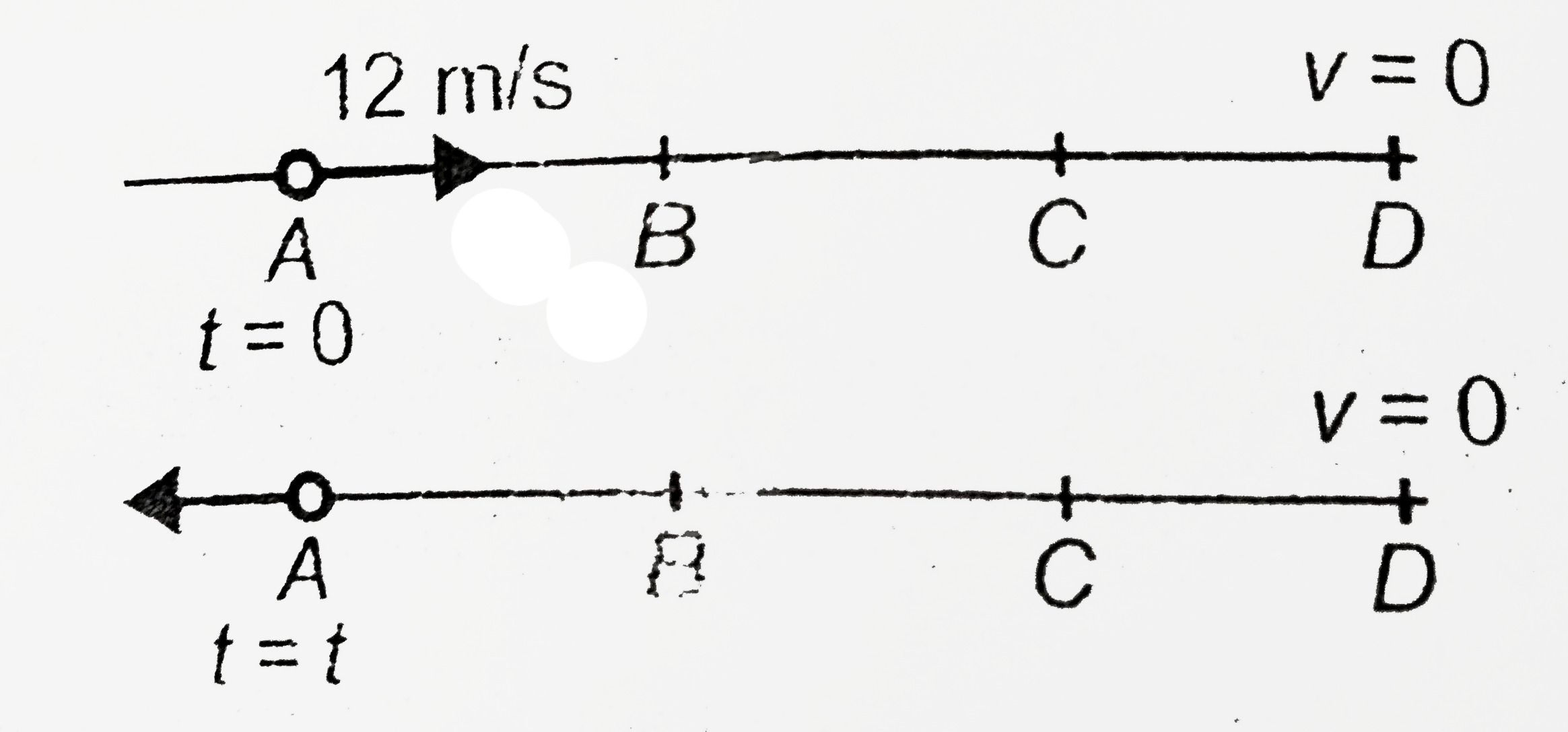
As t = 0 is the initial moment, t = 24 s is the moment when the particle reaches. A again
(b) Let the particle reverse its direction of motion at D, then the speed of particle at D will be zero. For the interval A to D
`u=12m//s, a=-1m//s^(2), AD=s, v=0`
`rArr 0^(2)=(12)^(2)+2(-1)(s)" "["from "v^(2)=u^(2)+2as]`
Ypu can also calculate the time taken by the particle to reach D from `v=u+at,0=12+(-1)t_(D)` and then from `s=12dt_(D)+(1)/(2)(-1)t_(D)^(2)`, you can find s. But then again you must be interested in optimizing the steps of calulation and must not proceed in the above manner.
(c) Can you use the equation `s=ut+(1)/(2)at^(2)` to find the distance travelled in the interval?
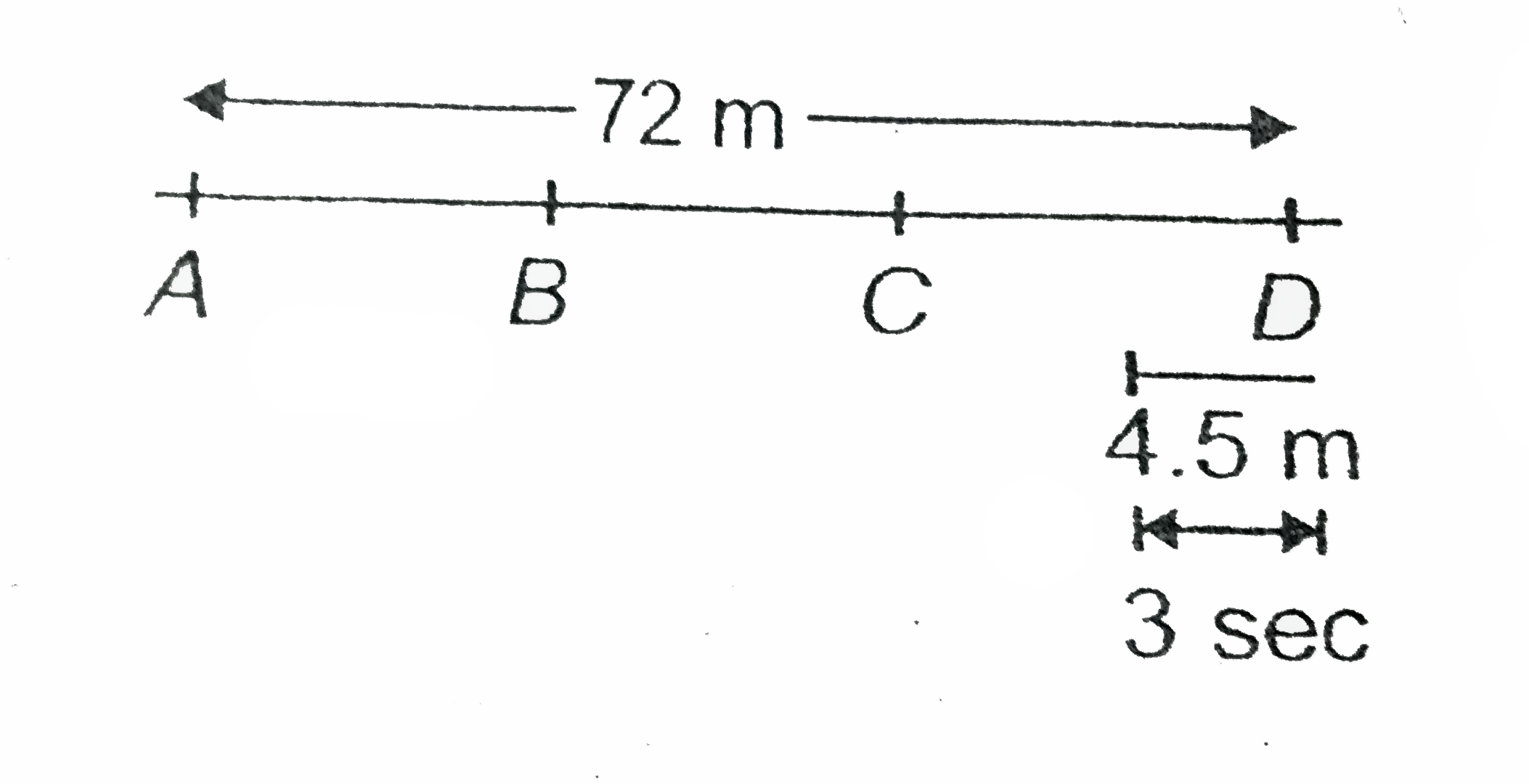
The answer will be ''Yes'' if the particle moves without reversing its direction of motion in the specified interval but the answer will be ''No'' if the particle reverses its direction of motion in the specified interval of time.
In the present problem, in the interval of 15 s the particle reverses its direction of motion at t = 12 s.
Here, first find the distance travelled in 12 s and then the distance travelled in subsequent 3 s, then add them up. We have already found AD = 72 m. Now for the subsequent 3 s interval,
`u=0, a=-1m//s^(2),t=3s`
Distance `=|s|=|0xx3+(1)/(2)xx(-1)xx3^(2)|=4.5m`
`rArr" Distance covered in 15 s "=72+4.5=76.5m`

Promotional Banner

Topper's Solved these Questions

  • MOTION IN STRAIGHT LINE

    AAKASH INSTITUTE|Exercise Try Yourself|40 Videos
  • MOTION IN STRAIGHT LINE

    AAKASH INSTITUTE|Exercise Assignment (SECTION - A)|50 Videos
  • MOTION IN A STRAIGHT LINE

    AAKASH INSTITUTE|Exercise ASSIGNMENT (SECTION - D)|15 Videos
  • MOVING CHARGE AND MAGNESIUM

    AAKASH INSTITUTE|Exercise SECTION D|16 Videos

Similar Questions

Explore conceptually related problems

A particle moving with uniform acceleration along a straight line ABC rosses point A at t=0 with a velocity 12 m s^(-1) . is 40 m away from A and C is 64 m away from A . The particle passes B at t=4 s . a. After what time will the particle be at C ? b. What is its velocity at C ? c. What does the particle reach A again? d. Locate the point where the particle reverses its direction of motion. e. Find the distance covered by the particle in the first 15 s .

The motion of a particle is described by the equation at u = at .The distance travelled by the particle in the first 4 seconds

A particle is thrown with any velocity vertically upward, the distance travelled by the particle in first second of its decent is

If S =3t^(3)+9t^(2)+2t+7 , then distance travelled by the particle during the first second of its motion is

Speed time graph of a particle shown in figure. Find distance travelled by particle in 5 second .

The po9sition of aparticle is given by the equation. s=f(t)=t^(3)-6t^(2)-9t where r is is measure in seconds and s in meters. (a). Find the velocity at the t (b). What is thhe velocity after 2s ? After 4 s ? (c). When is the particle at rest ? (d). When is the particle moving formward that is, ini the positive direction)? (e). Find the total distance traveled by the particle during the first five sec.?

x - t equation of a particle in SHM is x = (4 cm)cos ((pi)/(2)t) Here , t is in seconds. Find the distance travelled by the particle in first three seconds.

The position of a particle moving rectilinearly is given by x = t^3 - 3 t^2 - 10 . Find the distance travelled by the particle in the first 4 seconds starting from t = 0 .

From the v versus t graph of figure (a) the time (s) at which the particle is at rest (b) at what time, if any does the particle reverse the direction of its motion? (c) The distance and displacement of the particle from t=0 s to t=6 s.
