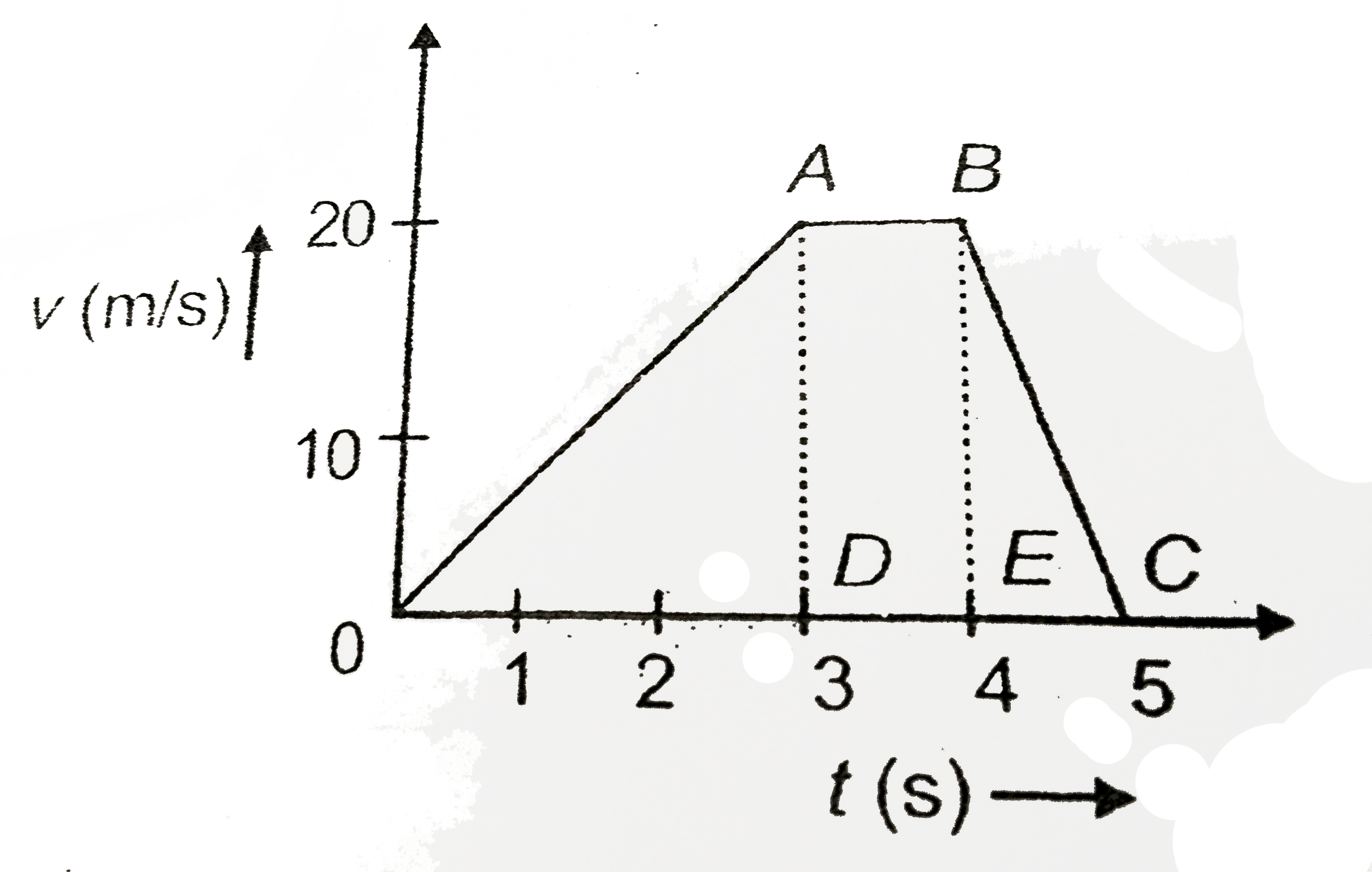
A
B
C
D
Text Solution
Verified by Experts
The correct Answer is:



Topper's Solved these Questions
MOTION IN STRAIGHT LINE
AAKASH INSTITUTE|Exercise Assignment (SECTION - B)|19 VideosMOTION IN STRAIGHT LINE
AAKASH INSTITUTE|Exercise Assignment (SECTION - C)|7 VideosMOTION IN STRAIGHT LINE
AAKASH INSTITUTE|Exercise Try Yourself|40 VideosMOTION IN A STRAIGHT LINE
AAKASH INSTITUTE|Exercise ASSIGNMENT (SECTION - D)|15 VideosMOVING CHARGE AND MAGNESIUM
AAKASH INSTITUTE|Exercise SECTION D|16 Videos
Similar Questions
Explore conceptually related problems
AAKASH INSTITUTE-MOTION IN STRAIGHT LINE-Assignment (SECTION - A)
- The displacement-time graph of two moving objects A and B are shown in...
Text Solution
|
- The position-time graph of a moving particle is a shown. The instantan...
Text Solution
|
- The variation of velocity of a particle moving along a straight line i...
Text Solution
|
- A body moving with uniform retardation covers 3 km before its speed is...
Text Solution
|
- The velocity-time graph of an object is shown below. The part of the g...
Text Solution
|
- The velocity-time graph of a particle moving along a straight line is ...
Text Solution
|
- The velocity-time graph of an object is shown below. The acceleration ...
Text Solution
|
- The ratio of velocity of two objects A and B is 1:3. It the position-t...
Text Solution
|
- If the upward direction is taken as positive then, which of the follow...
Text Solution
|
- The area under the acceleration-time (a-t) graph gives
Text Solution
|
- A ball is thrown vertically upward with a velocity u from the top of a...
Text Solution
|
- The displacement of a body is given by s=(1)/(2)g t^(2) where g is acc...
Text Solution
|
- The displacement 'x' of a particle moving along a straight line at tim...
Text Solution
|
- A ball is thrown vertically upward from the top of a tower with a spee...
Text Solution
|
- Which of the following x-t graphs represents the distance-time variati...
Text Solution
|
- A particle starting from rest moves along a straight line with constan...
Text Solution
|
- A ball falls freely from rest. The ratio of the distance travelled in ...
Text Solution
|
- A ball is thrown vertically upward attains a maximum height of 45 m. T...
Text Solution
|
- A car travelling with a velocity of 80 km/h slowed down to 44 km/h in ...
Text Solution
|
- The distance covered by a moving body is directly proportional to the ...
Text Solution
|