Home
Class 12
PHYSICS
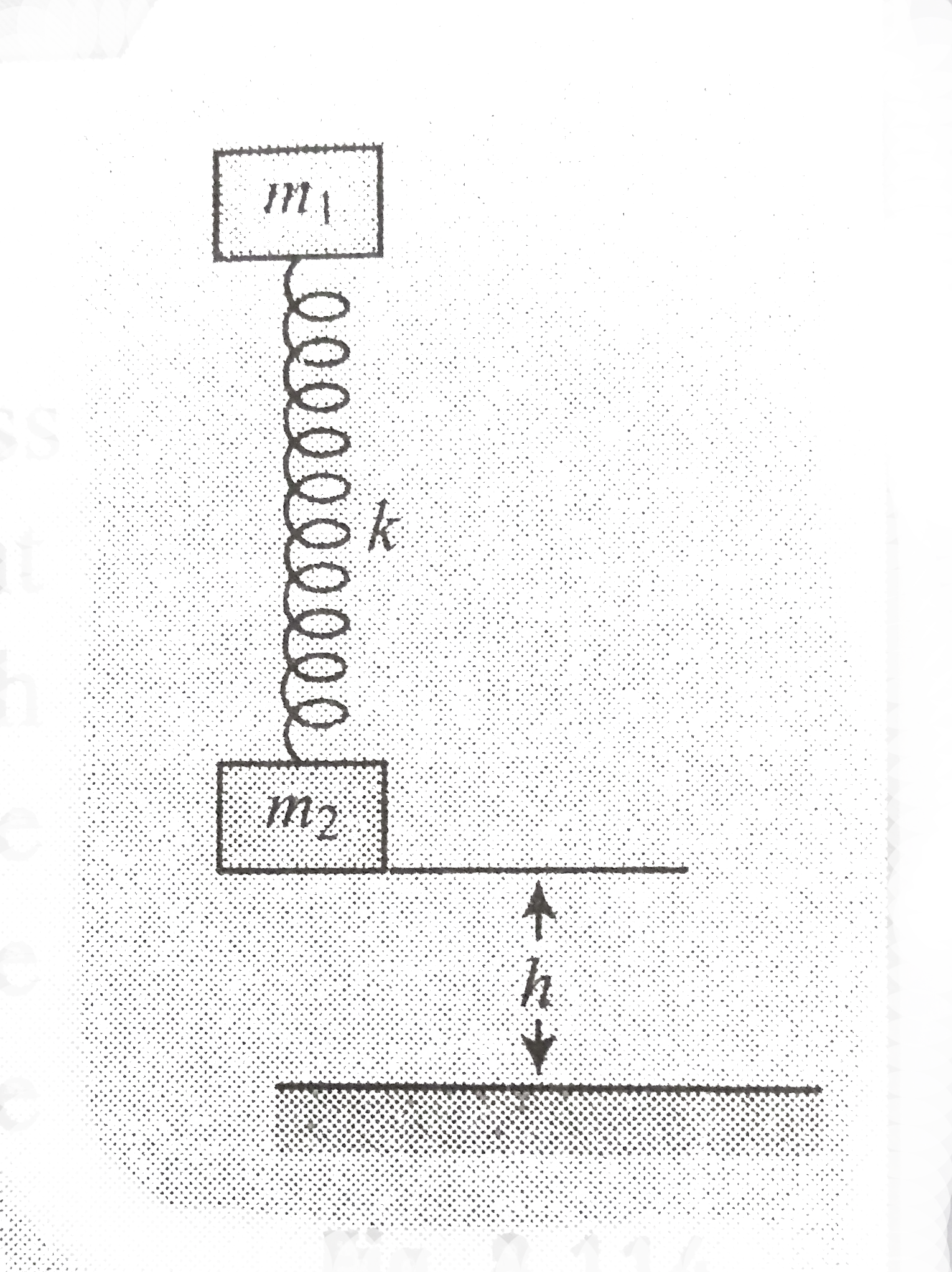
A spring-mass system ( m1 + massless spr...

A spring-mass system ( `m_1` + massless spring + `m_2`) fall freely from a height `h` before `m_2` colliding inelastically with the ground. Find the minimum value of `h` so that block `m_2` will break off the surface. Assume k=stiffness of the spring.

Text Solution

Verified by Experts

`(m_(2)(2m_(1)+m_(2)))/(2m_(1)k)`
Promotional Banner

Topper's Solved these Questions

  • WORK, ENERGY AND POWER

    AAKASH INSTITUTE|Exercise EXERCISE|40 Videos
  • WORK, ENERGY AND POWER

    AAKASH INSTITUTE|Exercise Assignment (SECTION - A)|67 Videos
  • WORK, ENERGY AND POWER

    AAKASH INSTITUTE|Exercise SECTION-I (SUBJECTIVE TYPE QUESTIONS)|6 Videos
  • WAVES

    AAKASH INSTITUTE|Exercise ASSIGNMENT ( SECTION-D ( Assertion - Reason Type Questions ))|12 Videos

Similar Questions

Explore conceptually related problems

A spring-mass system ( m_1 + massless spring + m_2 ) fall freely from a height h before m_2 colliding inelastically with the ground. Find the maximum value of h so that block m_2 will break off the surface. Assume k=stiffness of the spring.

A block of mass m is dropped onto a spring of constant k from a height h . The second end of the spring is attached to a second block of mass M as shown in figure. Find the minimum value of h so that the block M bounces off the ground. If the block of mass m sticks to the spring immediately after it comes into contact with it.

A spring mass system is held at rest with the spring relaxed at a height (h) above the ground. Determine the minimum value of (H) so that the systen has a tendency to rebound after hitting the ground. Given that the coefficient of restitution between (m_(2)) and ground is zero. .

Two spherical bodies of mass m_(1) and m_(2) fall freely through a distance h . before the body m_(2) collides with the ground. If the coefficient of restitution of all collisions is e , find the velocity of m_(1) just after it collides with m_(2)

A block of mass 'm' collides perfectly inelastically with another identical block connected to a spring of of force constant 'K'. The amplitude of resulting SHM will be

Two blocks of masses m and M connected by a light spring of stiffness k, are kept on a smooth horizontal surface as shown in figure. What should be the initial compression of the spring so that the system will be about to break off the surface, after releasing the block m_1 ?

In figure, the stiffness of the spring is k and mass of the block is m . The pulley is fixed. Initially, the block m is held such that the elongation in the spring is zero and then released from rest. Find: a. the maximum elongation in the spring. b. the maximum speed of the block m . Neglect the mass of the spring and that of the string. Also neglect the friction.

A block of mass 180 g is placed on a spring (spring constant k = 120 N//m ) fixed from below. A ball of mass 20 g is dropped from height 20 m and the collision is completely inelastic. Find the maximum compression of the spring. Neglect the initial compression of the spring due to the block.

Two blocks A and B each of mass m are connected by a massless spring of natural length L and spring constant k. The blocks are initially resting on a smooth horizontal floor with the spring at its natural length. A third identical block C also of mass m moves on the floor with a speed v along the line joining A and B and collides with A. Then The kinetic energy of the A-B system at maximum compression of the spring is mv^(2)//4 The maximum compression of the spring vsqrt(m//3k) The kinetic energy of the A-B system at maximum compression The maximum coppression of the spring is vsqrt(m//k)

A block of mass m strikes a light pan fitted with a vertical spring after falling through a distance h. If the stiffness of the spring is k, find the maximum compression of the spring.
