Home
Class 12
PHYSICS
Three bodies A, B and C having masses 10...

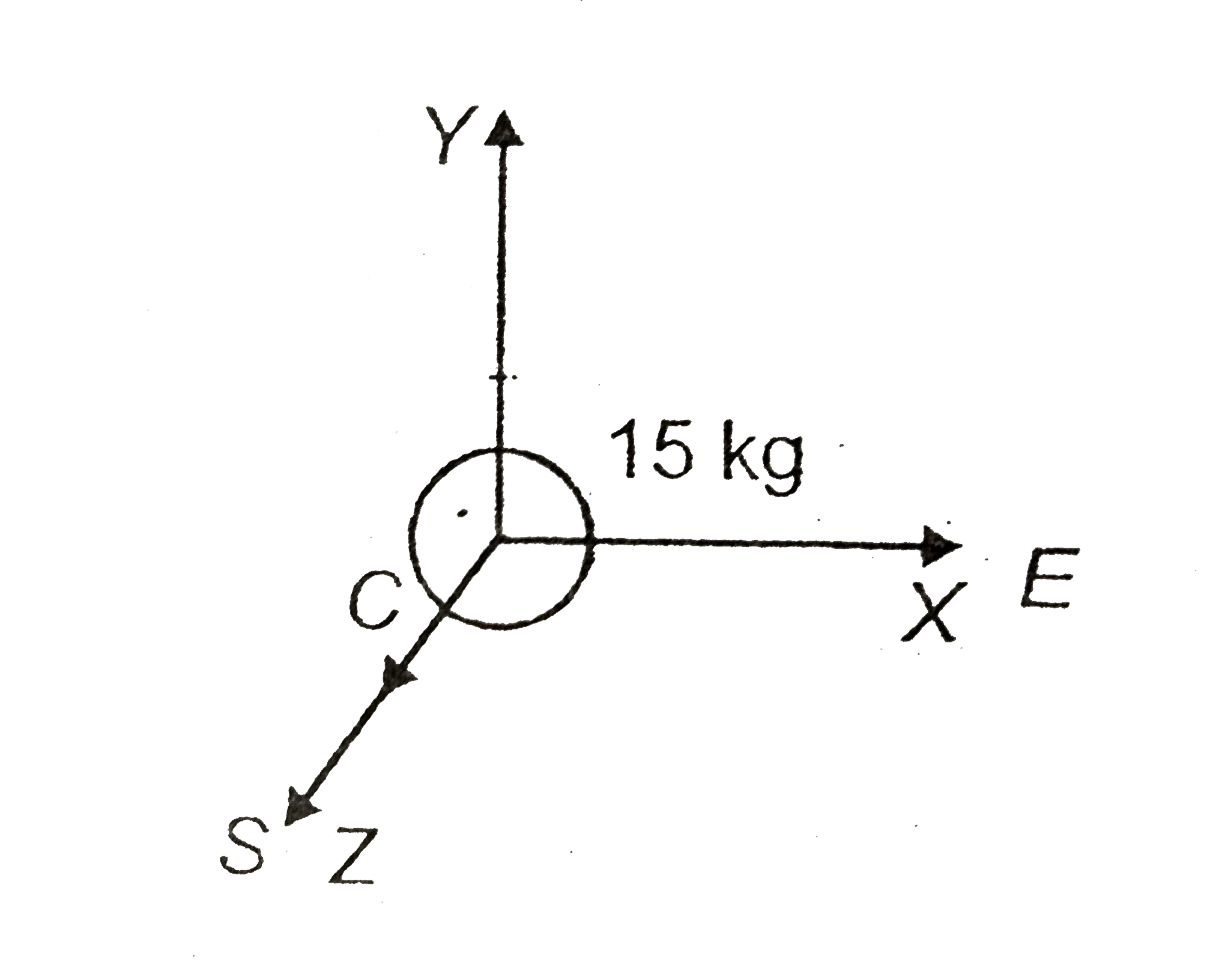
Three bodies `A`, `B` and `C` having masses `10kg`, `5kg` and `15kg` respectively are projected from top of a tower with `A` vertically upward with `10m//s`, `B` with `20m//s 53^(@)` above east horizontal and `C` horizontally southward with `15m//s`. Find
`(a)` Velocity of centre of mass of the system.
`(b)`Acceleration of centre of mass of the system.

Text Solution

Verified by Experts
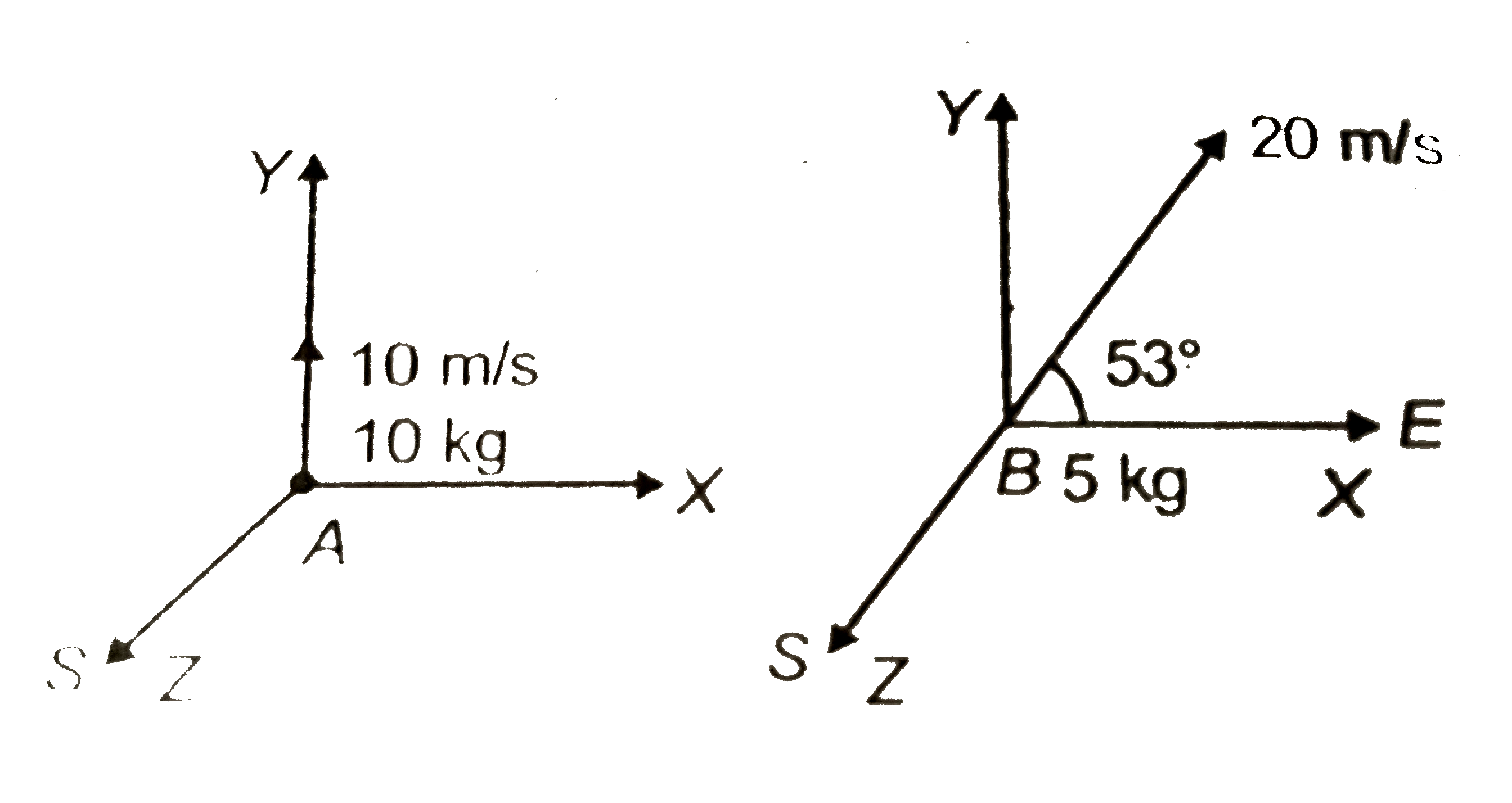
Consider horizontally East direction as positive `X`-axis, vertically upward direction as positive `Y`-axis and horizontally south as positive `Z`-axis.

`(a) vecv_(1)=10hatj`
`vecv_(2)=20cos53hati+20sin53hatj`
`=12hati+16hatj`
`vecv_(3)=15hatk`
`vecv_(CM)=(m_(1)vecv_(1)+m_(2)vecv_(2)+m_(3)vecv_(3))/(m_(1)+m_(2)+m_(3))`
`=(100hatj+60hati+80hatj+225hatk)/(30)`
`=(60hati+180hatj+225hatk)/(30)`
`vecv=2hati+6hatj+7.5hatk`
Magnitude of velocity of `CM`, `v=sqrt(2^(2)+6^(2)+7.5^(2))`
`=9.8m//s`
`cos alpha=(2)/(sqrt(2^(2)+6^(2)+(7.5)^(2)))=(2)/(9.8)=(10)/(49)`
Direction with east `alpha=cos^(-1)((10)/(49))`
Direction with upward vertical `beta=cos^(-1)((30)/(49))`
Direction with south `gamma=cos^(-1)((75)/(98))`
`(b) veca_(1)=-9.7hatj`, `veca_(2)=-9.8hatj`, `veca_(3)=-9.8hatj`
`bar(a_(CM))=(m_(1)bar(a_(1))+m_(2)bara_(2)+m_(3)bara_(3))/(m_(1)+m_(2)+m_(3))`
`=((m_(1)+m_(2)+m_(3))(-9.8hatj))/(m_(1)+m_(2)+m_(3))`
`=-9.8hatj`
Promotional Banner

Topper's Solved these Questions

  • SYSTEM OF PARTICLES AND ROTATIONAL MOTION

    AAKASH INSTITUTE|Exercise Illustration|4 Videos
  • SYSTEM OF PARTICLES AND ROTATIONAL MOTION

    AAKASH INSTITUTE|Exercise Assignment (Section - A) Objective Type Questions (One option is correct)|62 Videos
  • SEMICONDUCTOR ELECTRONICS: MATERIALS, DEVICES AND SIMPLE CIRCUITS

    AAKASH INSTITUTE|Exercise Assignment (Section-D (Assertion and reason))|5 Videos
  • TEST 1

    AAKASH INSTITUTE|Exercise EXERCISE|9 Videos

Similar Questions

Explore conceptually related problems

Kg is the unit of mass in the M.K.S. system.

Two particles A and B masses 1 kg and 2 kg respectivelty are projected in the same vertical line as shown in figure with speeds u_(A) = 200 m//s and u_(B) = 85m//s respectively. Initially they were 90 m apart. Find the maximum height attained by the centre of mass of the system of particles A and B, from the initial position of centre of mass of the system. Assume that none of these particles collides with the ground in that duration Take g = 10 m//s^(2)

A particle of mass m is thrown horizontally from the top of a tower and anoher particle of mass 2m is thrown vertically upward. The acceleration of centre of mass is

A projectile is projected from top of a wall 20m height with a speed of 10m/s horizontally. Find range (g = 10m/s^(2))

A particle of mass 50 g is projected horizontally from the top of a tower of height 50 m with a velocity 20m//s . If g=10m//s^(2) , then find the :-

A body of mass 50 kg is projected vertically upward with velocity of 100 m//s . After 5 s this body breaks into 20 kg and 30 kg . If the 20 kg piece travels upwards with 150 m//s , then the velocity of other block will be

A projectile of mass 50 kg is projected vertically upwards with a velocity of 100 m/s . After 5 seconds it explodes into two pieces , one piece of 20 kg moving vertically upward with velocity 150 m/s . Calculate the velocity of the other piece and also the algebraic sum of the momenta of the system 3 s later .

AAKASH INSTITUTE-SYSTEM OF PARTICLES AND ROTATIONAL MOTION-Try Yourself
  1. Three bodies A, B and C having masses 10kg, 5kg and 15kg respectively ...

    Text Solution

    |

  2. Two bodies of masses 1kg and 3kg are lying in xy plane at (0,0) and (2...

    Text Solution

    |

  3. Three point masses of 1kg, 2kg and 3kg lie at (0,0), (1,2), (3,-1) res...

    Text Solution

    |

  4. Three particles of masses m,m and 4kg are kept at a verticals of trian...

    Text Solution

    |

  5. Three particles having their masses in the ratio 1 : 3 : 5 are kept at...

    Text Solution

    |

  6. Centre of mass of the system lies inside disc or square plate and why ...

    Text Solution

    |

  7. Two particles of equal mass are moving along the same line with the sa...

    Text Solution

    |

  8. Two particles of equal mass are moving along the same straight line wi...

    Text Solution

    |

  9. A shell following a parabolic path explodes somewhere in its flight. T...

    Text Solution

    |

  10. All the particles are situated at a distance R from the origin. The di...

    Text Solution

    |

  11. Will the velocity and acceleration of centre of mass change if particl...

    Text Solution

    |

  12. vecA=(3hati+2hatj-6hatk) and vecB=(hati-2hatj+hatk), find the scalar p...

    Text Solution

    |

  13. vecA=(hati-2hatj+6hatk) and vecB=(hati-2hatj+hatk), find the cross pro...

    Text Solution

    |

  14. Find a unit vector in the direction of vector vecA=(hati-2hatj+hatk)

    Text Solution

    |

  15. Find a vector perpendicular to vector vecA=(hati+2hatj-3hatk) as well ...

    Text Solution

    |

  16. The angular displacement of a particle is 24 rad in 10 seconds. Calcul...

    Text Solution

    |

  17. The angular velocity of a rigid body is 24 rad s^(-1), Calculate the t...

    Text Solution

    |

  18. The angular velocity of circular disc of radius 2cm is 20 rad s^(-1). ...

    Text Solution

    |

  19. What is the angular velocity of a particle lying on the axis of rotati...

    Text Solution

    |

  20. What is the angular acceleration of a particle moving with constant an...

    Text Solution

    |

  21. A wheel is rotating with an angular velocity of 3 rad s^(-1). If the a...

    Text Solution

    |