Home
Class 12
PHYSICS
A rod AB of mass M and length L is lying...

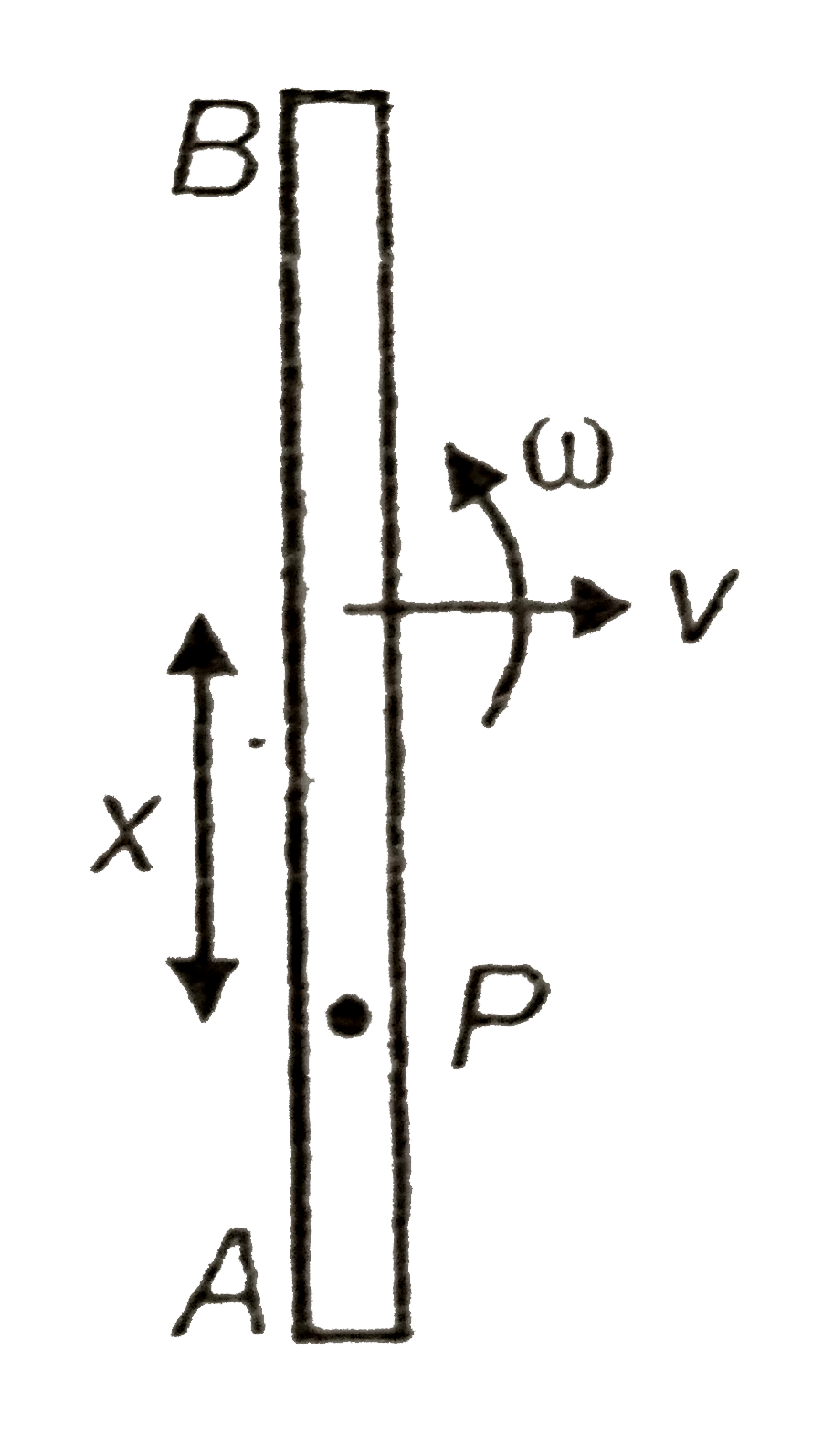
A rod AB of mass `M` and length L is lying on a horizontal frictionless surface. A particle of mass `m` travelling along the surface hits the end A of the rod with a velocity `v_(0)` in a direction perpendicular to AB. The collision in elastic. After the collision the particle comes to rest
(a). Find the ratio `m//M`
(b). A point P on the rod is at rest immediately after collision find the distance AP.
(c). Fid the linear speed of the point P a time `piL//3v_(0)` after the collision.

Text Solution

Verified by Experts
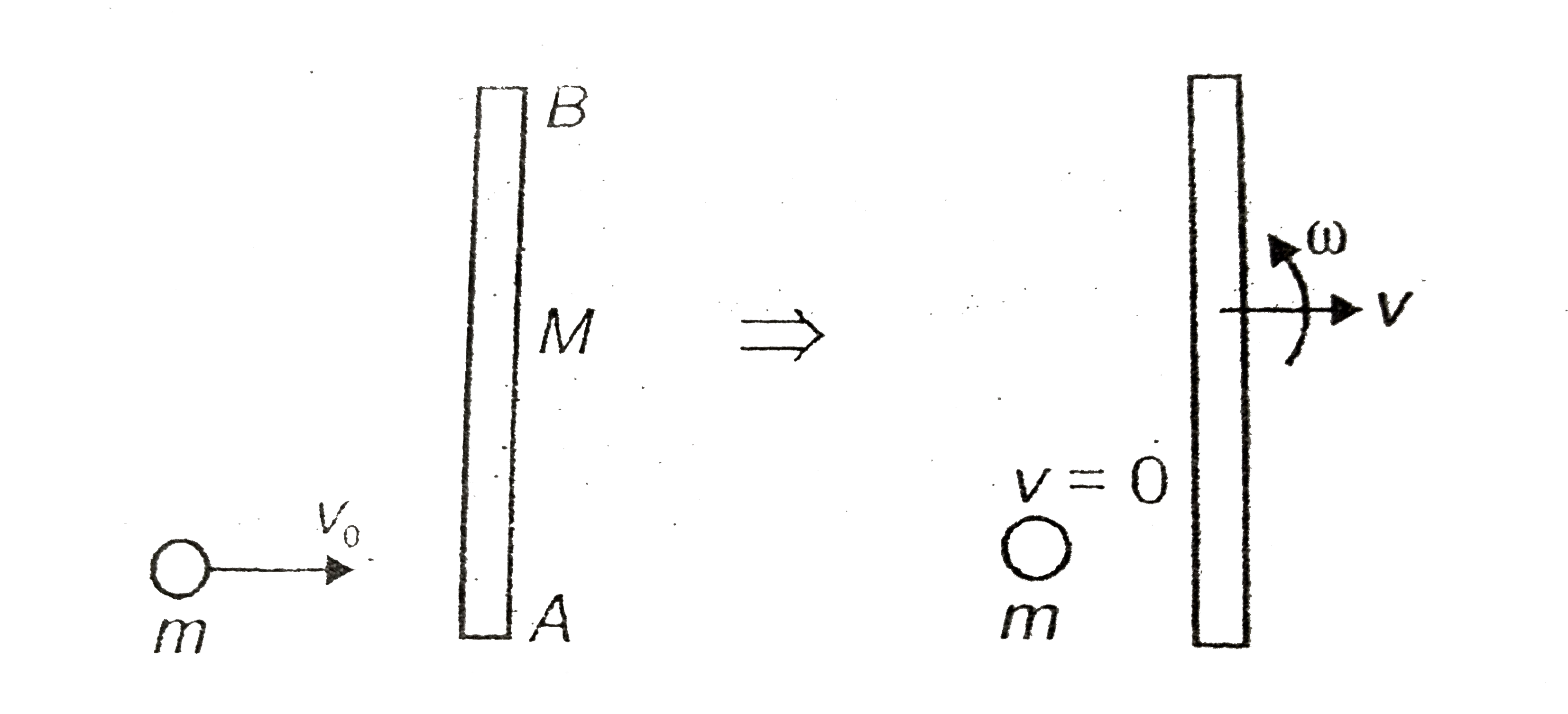
Let us assume that speed of centre of mass of rod be `v_(0)` and angular speed about centre of mass be `omega` immediately after collision.

Taking the ball and rod to be part of a combined system, so for our system `sumF_("ext")=0`. So momentum can be conserved.
`(a) :. mv_(0)=MVimpliesv=(m)/(M)v_(0)`..........`(1)`
`sumtau=0` about centre of rod. So conserving angular momentum
`mv_(0)*(L)/(2)=I_(CM)*omegaimpliesmv_(0)(L)/(2)=(ML^(2))/(12)omega`
`:.omega=(6m)/(M)(v_(0))/(L)`..........`(2)`
Since the collision is perfectly elastic, K.E. of system will remain conserved.
`(1)/(2)mv_(0)^(2)=(1)/(2)MV^(2)+(1)/(2)I_(C.M.*omega^(2)` [Replacing the values of `v` and `omega` from equation `(1)` and `(2)` ]
`implies(1)/(2)mv_(0)^(2)=(1)/(2)M((m)/(M)v_(0))^(2)+(1)/(2)*(ML^(2))/(12)xx(36m^(2))/(M^(2))(v_(0)^(2))/(L^(2))`
or `1=(m)/(M)+(3m)/(M)=(4m)/(M)`
`(m)/(M)=(1)/(4)`
`(b)` For velocity of any point `P` to be zero immediately after the collision, the net velocity of point `P` is
`v+omegax=0`
`:.x=-(v)/(omega)`
`=-(mv_(0))/((M*6mv_(0))/(ML))`
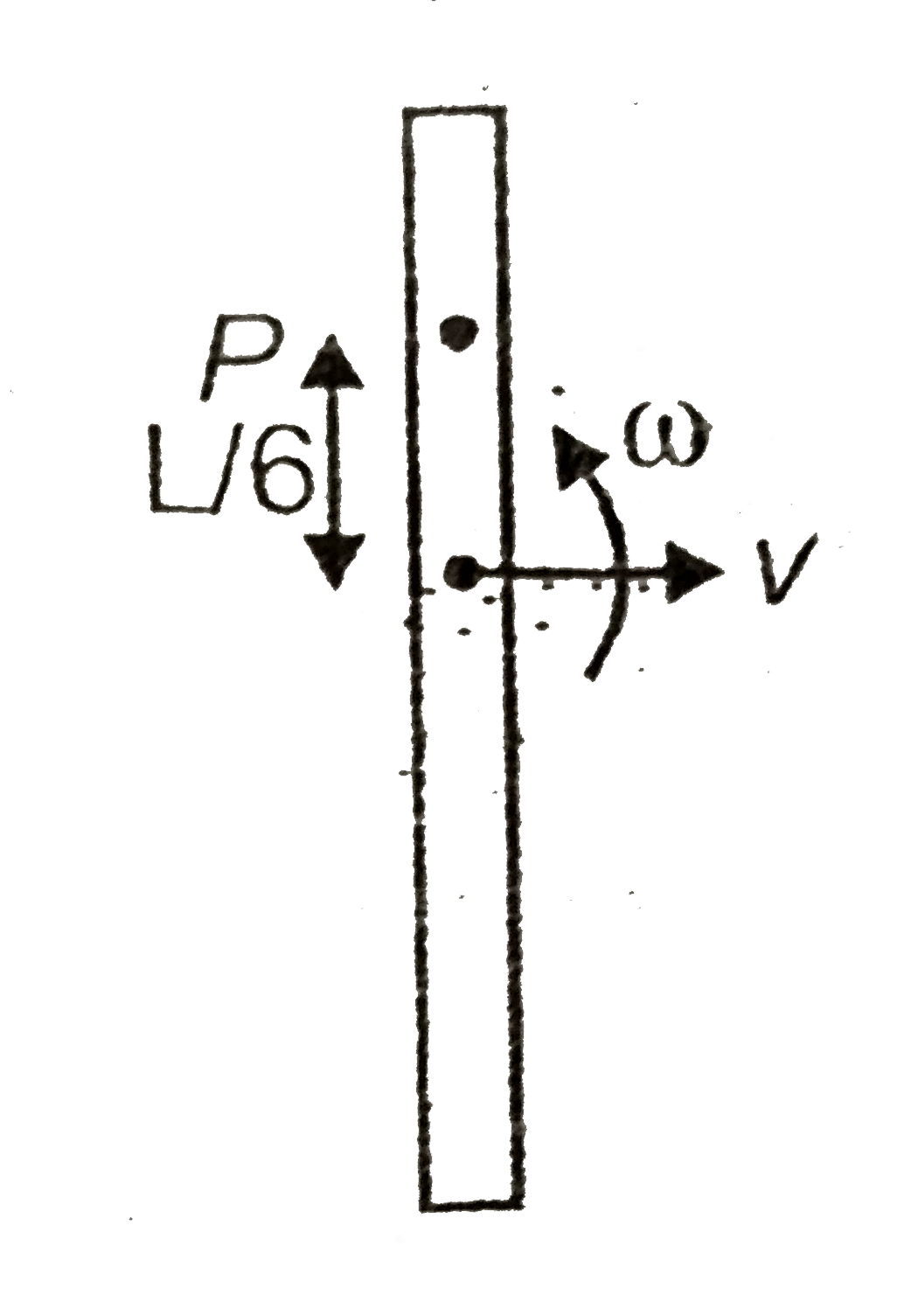
`:.=-(L)/(6)`

(-ve sign shows that the point will be on opposite side of what we have taken and is quite-logical too)

So, `AP=(L)/(2)+(L)/(6)=(4L)/(6)=(2L)/(3)`
`(c )` Just after collision,
`v=(m)/(M)v_(0)=(v_(0))/(4)`
`omega=(6mv_(0))/(ML)=(3v_(0))/(2L)`
Since `v=(omegaL)/(6)`, both the translational speed as well as speed due to rotation will be equal to `v=(v_(0))/(4)` at any time after collision.
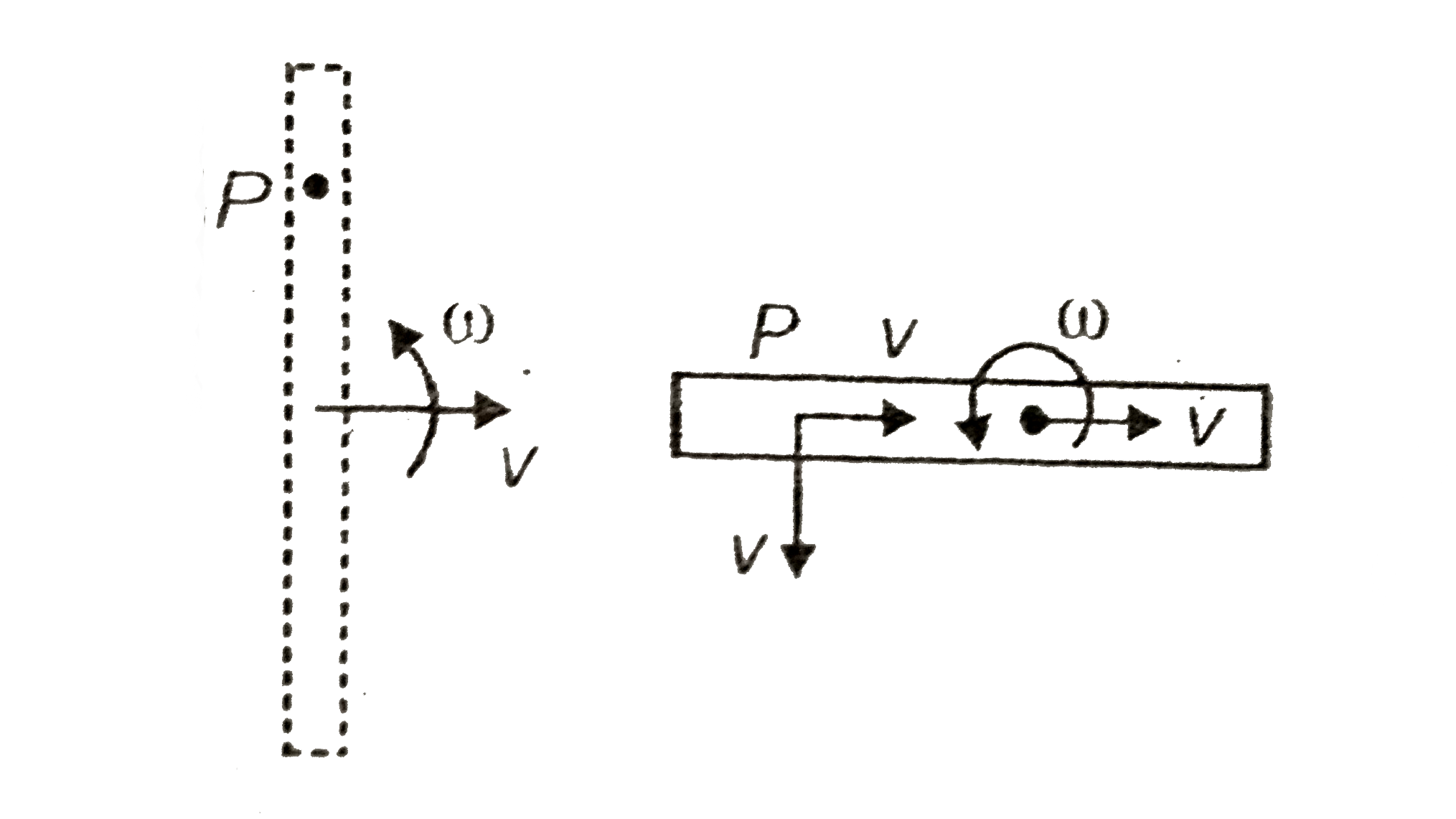
After time `t=(piL)/(3v_(0))`

`theta=omega t=(3v_(0))/(2L)xx(piL)/(3v_(0))=(pi)/(2)`
So rad has turned by an angle `(pi)/(2)`, till that time after collision.
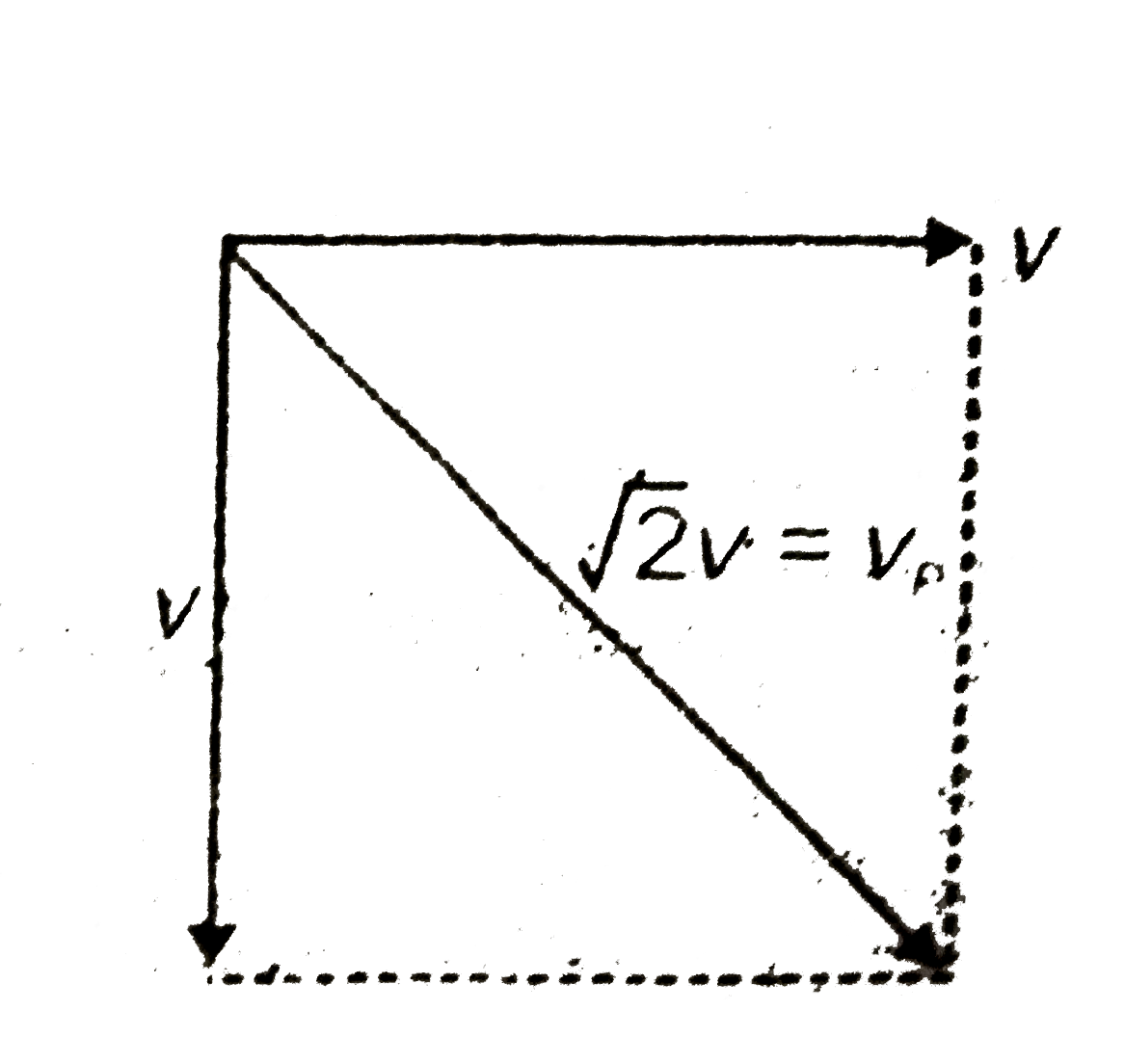
The point `P` has two velocities one in the direction of motion of cenre of rod and another perpendicular to the rod.

Resultant speed `=sqrt(v^(2)+v^(2))=vsqrt(2)=(v_(0))/(4)sqrt(2)`
Promotional Banner

Topper's Solved these Questions

  • SYSTEM OF PARTICLES AND ROTATIONAL MOTION

    AAKASH INSTITUTE|Exercise Illustration|4 Videos
  • SYSTEM OF PARTICLES AND ROTATIONAL MOTION

    AAKASH INSTITUTE|Exercise Assignment (Section - A) Objective Type Questions (One option is correct)|62 Videos
  • SEMICONDUCTOR ELECTRONICS: MATERIALS, DEVICES AND SIMPLE CIRCUITS

    AAKASH INSTITUTE|Exercise Assignment (Section-D (Assertion and reason))|5 Videos
  • TEST 1

    AAKASH INSTITUTE|Exercise EXERCISE|9 Videos

Similar Questions

Explore conceptually related problems

A rod AB of mass M and length L is lying on a horizontal frictionless surface. A particle of mass m traveling along the surface hits the end A of the rod with a velocity v_(0) in a direction perpendicular to AB . The collision is completely elastic. After the collision the particle comes to rest. Find the ration m//M .

A rod of mass M and length L is lying on a horizontal frictionless surface. A particle of mass 'm' travelling along the surface hits at one end of the rod with a velocity 'u' in a direction perpendicular to the rod. The collision is completely elastic. After collision, particle comes to rest. The ratio of masses ((m)/(M))" is "(1)/(x) . The value of 'x' will be_____.

A rod AB of length 2L and mass m is lying on a horizontal frictionless surface. A particle of same mass m travelling along the surface hits the rod at distance (L)/(2) from COM with a velocity v_(0) in a direction perpendicular to rod and sticks to it. Angular velocity of rod just after collision is

A rod AC of length l and mass m is kept on a horizontal smooth plane. It is free to rotate and move. A particle of same mass m moving on the plane with velocity v strikes the rod at point B making angle 37^@ with the rod. The collision is elastic. After collision,

A rod of mass M and length L is kept on a frictionless horizontal floor. A particle of mass m moving perpendicular to the rod with a speed v strikes at the end of the rod and sticks there. Calculate angular velocity acquired by the combined system.

A rod of mass m and length L is kept on a frictionless horizontal floor. A particle of same mass m moving perpendicular to the rod with a speed v strikes at the end of the rod. If coefficient of elasticity for the collision is 1 then calculate angular velocity acquired by the rod.

A uniform rod AB of mass m and length l is at rest on a smooth horizontal surface. An impulse p is applied to the end B. The time taken by the rod to turn through a right angle is

A uniform rod of mass M and length l is placed on a smooth- horizontal surface with its one end pivoted to the surface. A small ball of mass m moving along the surface with a velocity v_(0) , perpendicular to the rod, collides elastically with the free end of the rod. Find: a. the angular velocity of the rod after collision. b. the impulse applied by the pivot on the rod during collision. (Take M//m = 2 )

AAKASH INSTITUTE-SYSTEM OF PARTICLES AND ROTATIONAL MOTION-Try Yourself
  1. A rod AB of mass M and length L is lying on a horizontal frictionless ...

    Text Solution

    |

  2. Two bodies of masses 1kg and 3kg are lying in xy plane at (0,0) and (2...

    Text Solution

    |

  3. Three point masses of 1kg, 2kg and 3kg lie at (0,0), (1,2), (3,-1) res...

    Text Solution

    |

  4. Three particles of masses m,m and 4kg are kept at a verticals of trian...

    Text Solution

    |

  5. Three particles having their masses in the ratio 1 : 3 : 5 are kept at...

    Text Solution

    |

  6. Centre of mass of the system lies inside disc or square plate and why ...

    Text Solution

    |

  7. Two particles of equal mass are moving along the same line with the sa...

    Text Solution

    |

  8. Two particles of equal mass are moving along the same straight line wi...

    Text Solution

    |

  9. A shell following a parabolic path explodes somewhere in its flight. T...

    Text Solution

    |

  10. All the particles are situated at a distance R from the origin. The di...

    Text Solution

    |

  11. Will the velocity and acceleration of centre of mass change if particl...

    Text Solution

    |

  12. vecA=(3hati+2hatj-6hatk) and vecB=(hati-2hatj+hatk), find the scalar p...

    Text Solution

    |

  13. vecA=(hati-2hatj+6hatk) and vecB=(hati-2hatj+hatk), find the cross pro...

    Text Solution

    |

  14. Find a unit vector in the direction of vector vecA=(hati-2hatj+hatk)

    Text Solution

    |

  15. Find a vector perpendicular to vector vecA=(hati+2hatj-3hatk) as well ...

    Text Solution

    |

  16. The angular displacement of a particle is 24 rad in 10 seconds. Calcul...

    Text Solution

    |

  17. The angular velocity of a rigid body is 24 rad s^(-1), Calculate the t...

    Text Solution

    |

  18. The angular velocity of circular disc of radius 2cm is 20 rad s^(-1). ...

    Text Solution

    |

  19. What is the angular velocity of a particle lying on the axis of rotati...

    Text Solution

    |

  20. What is the angular acceleration of a particle moving with constant an...

    Text Solution

    |

  21. A wheel is rotating with an angular velocity of 3 rad s^(-1). If the a...

    Text Solution

    |