Home
Class 12
PHYSICS
The velocity of a point P on the surface...

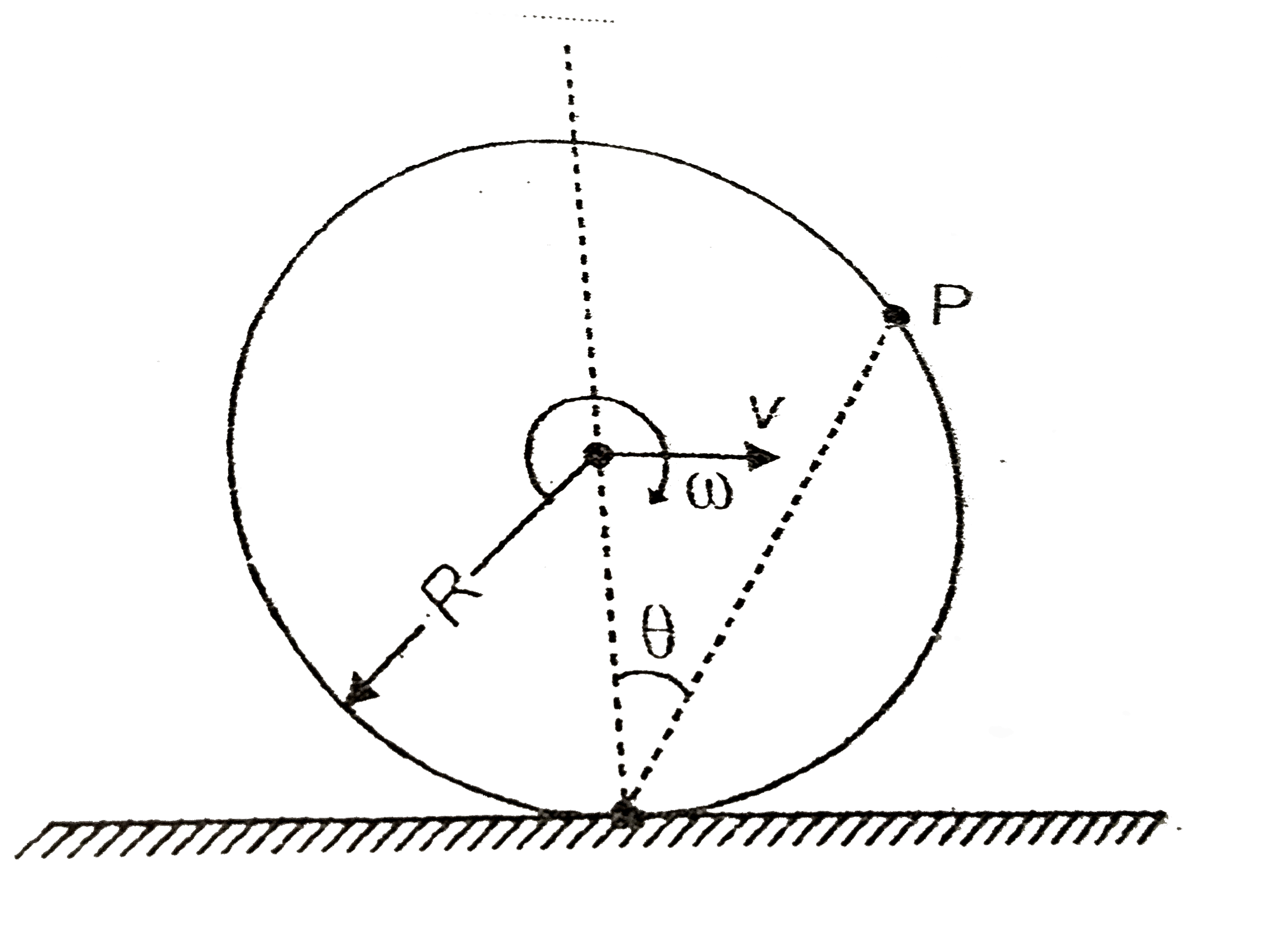
The velocity of a point `P` on the surface of a pure rolling disc as shown in figure, can be calculated as given below.

Text Solution

Verified by Experts
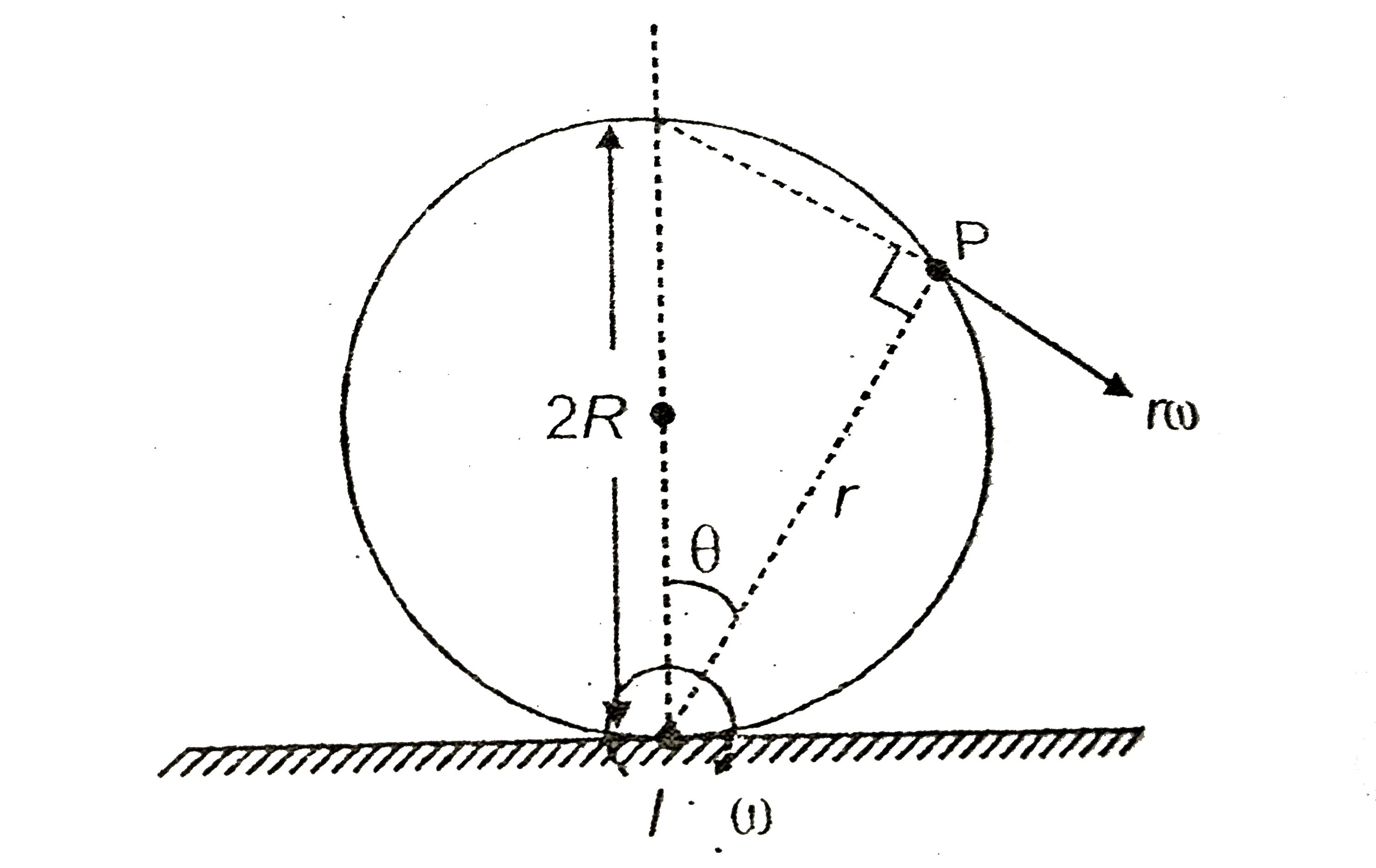

`v_(P)=r omega`
`=2R cos theta omega=2v cos theta`.
Promotional Banner

Topper's Solved these Questions

  • SYSTEM OF PARTICLES AND ROTATIONAL MOTION

    AAKASH INSTITUTE|Exercise Assignment (Section - A) Objective Type Questions (One option is correct)|62 Videos
  • SYSTEM OF PARTICLES AND ROTATIONAL MOTION

    AAKASH INSTITUTE|Exercise Assignment (Section - B) Objective Type Questions (One option is correct)|57 Videos
  • SYSTEM OF PARTICLES AND ROTATIONAL MOTION

    AAKASH INSTITUTE|Exercise Try Yourself|63 Videos
  • SEMICONDUCTOR ELECTRONICS: MATERIALS, DEVICES AND SIMPLE CIRCUITS

    AAKASH INSTITUTE|Exercise Assignment (Section-D (Assertion and reason))|5 Videos
  • TEST 1

    AAKASH INSTITUTE|Exercise EXERCISE|9 Videos

Similar Questions

Explore conceptually related problems

A uniform disc of mass m and radius R is projected horizontally with velocity v_(0) on a rough horizontal floor so that it starts off with a purely sliding motion at t=0 . After t_(0) seconds, it acquires pure rolling motion as shown in the figure. (a) Calculate the velocity of the center of mass of the disc at t_(0) . Assuming that the coefficent of friction to be mu , calculate t_(0) .

Find out velocity of point P which is present on a disc rolling on horizontal surface as shown.

A disc of mass M and radius R rolls on a horizontal surface and then rolls up an inclined plane as shown in the figure. If the velocity of the disc is v, the height to which the disc will rise will be :-

A disc of mass M and radius R rolls on a horizontal surface and then rolls up an inclined plane as shown in the figure. If the velocity of the disc is v, the height to which the disc will rise will be:

A circular disc of mass '2m' and radius '3r' is resting on a flat frictionless surface. Another circular disc of mass m and radius '2r' , moving with a velocity 'u' . hits the first disc as shown in the figure. The collision is elastic. What is the final velocity of the heavier disc?

A circular disc of radius R rolls without slipping along the horizontal surface with constant velocity v_0 . We consider a point A on the surface of the disc. Then, the acceleration of point A is

A disc of radius 0.1 m rolls without sliding on a horizontal surface with a velocity of 6 ms^(-1) . It then ascends a smooth continuous track as shown in figure. The height upto which it will ascend is ( g =10 ms^(-2))

Two point P and Q. diametrically opposite on a disc of radius R have linear velocities v and 2v as shown in figure. Find the angular speed of the disc.

