


Topper's Solved these Questions
SYSTEM OF PARTICLES AND ROTATIONAL MOTION
AAKASH INSTITUTE|Exercise Assignment (Section - G) Integar Type Questions|9 VideosSYSTEM OF PARTICLES AND ROTATIONAL MOTION
AAKASH INSTITUTE|Exercise Assignment (Section - H) Multiple True-False Type Questions|4 VideosSYSTEM OF PARTICLES AND ROTATIONAL MOTION
AAKASH INSTITUTE|Exercise Assignment (Section - E) Assertion-Reason Type Questions|12 VideosSEMICONDUCTOR ELECTRONICS: MATERIALS, DEVICES AND SIMPLE CIRCUITS
AAKASH INSTITUTE|Exercise Assignment (Section-D (Assertion and reason))|5 VideosTEST 1
AAKASH INSTITUTE|Exercise EXERCISE|9 Videos
Similar Questions
Explore conceptually related problems
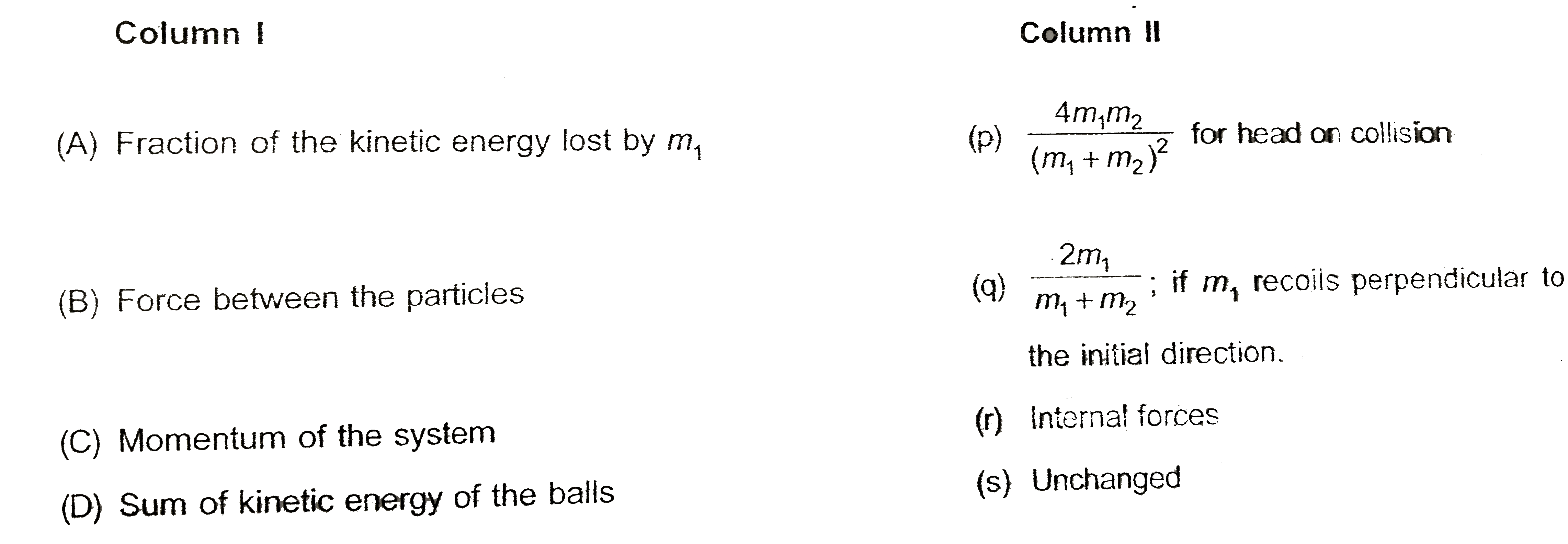
AAKASH INSTITUTE-SYSTEM OF PARTICLES AND ROTATIONAL MOTION-Assignment (Section - F) Matrix-Match Type Questions
- A man of mass m=2kg is standing on a platform of mass M=5kg, then at a...
Text Solution
|
- A shell is projected by a cannon at an angle 30^(@) with the vertical ...
Text Solution
|
- Which of the following is correct for given graph
Text Solution
|
- A particle of mass m(1) experiences a perfectlly elastic collision wit...
Text Solution
|
- A uniform rod of length L is free to rotate about an axis passing thro...
Text Solution
|
- A wheel is executing pure rolling on a horizontal surface with a speed...
Text Solution
|
- A solid sphere hollow sphere disc, ring and hollow cylinder are relase...
Text Solution
|
- A solid spherical ball kept on a horizontal surface is struck by a que...
Text Solution
|