Home
Class 12
PHYSICS
We know that when two equal masses are p...

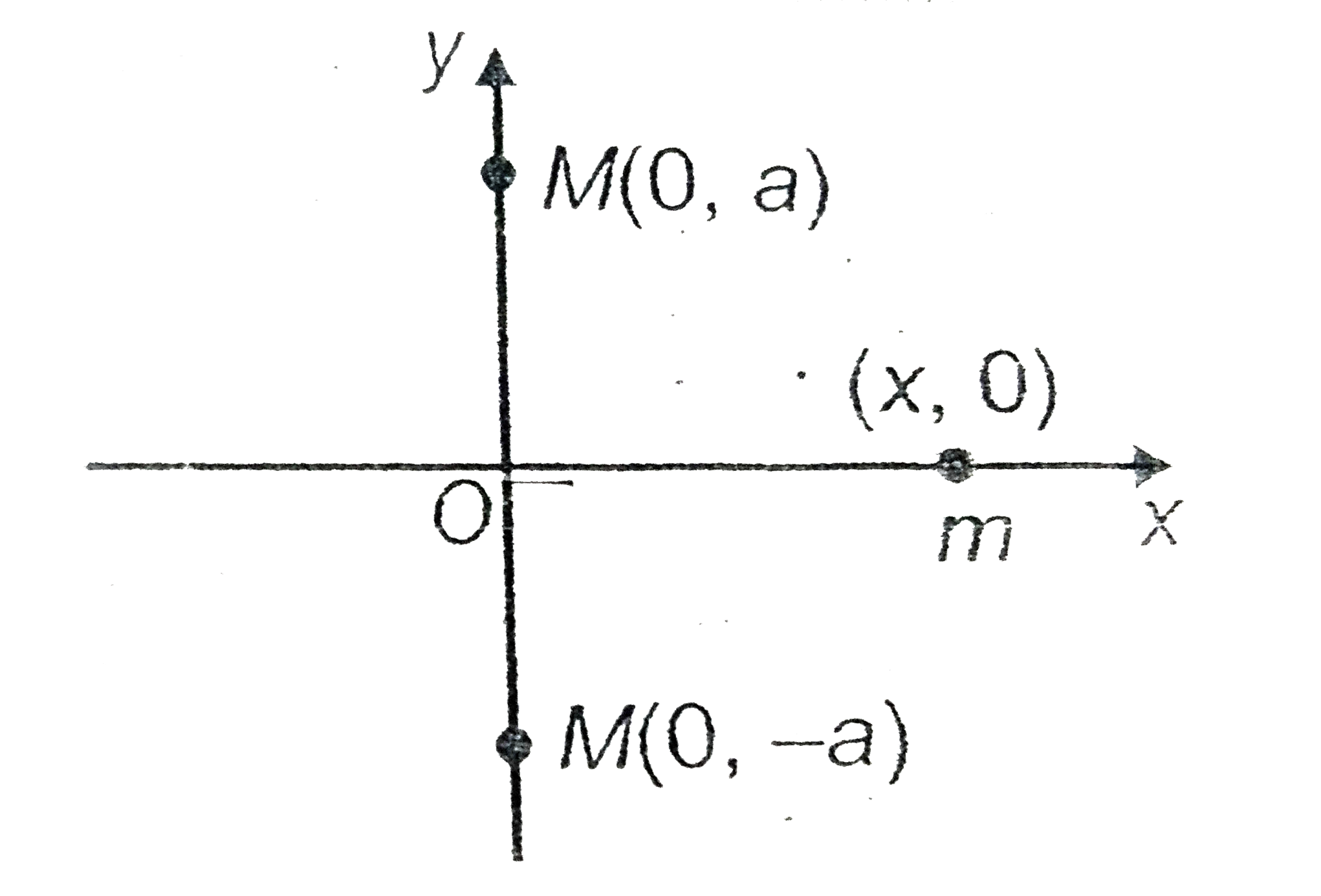
We know that when two equal masses are placed on a line then, gravitational force on a third mass is zero due to these two masses when the third is placed at the centre of line joining the two masses. But if third mass is placed anywhere else on the x-axis, the gravitational force acts on that mass due to these two masses. Consider a system shown in figure.

In this system two point masses of mass M each are placed at y-axis at a distance a from origin and these masses are fixed. If a third point mass of mass m is released at a distance x from origin on x-axis, then answer the following questions.
The distance between positions of maximum force on mass m is

A

`sqrt(2)a`

B

`(a)/(sqrt(2))`

C

`(a)/(2)`

D

2a

Text Solution

Verified by Experts

The correct Answer is:

A
Promotional Banner

Topper's Solved these Questions

  • GRAVITATION

    AAKASH INSTITUTE|Exercise ASSIGNMENT SECTION -E (Assertion - Reason Type Questions)|14 Videos
  • GRAVITATION

    AAKASH INSTITUTE|Exercise ASSIGNMENT SECTION -F (Matrix - Match Type Questions)|9 Videos
  • GRAVITATION

    AAKASH INSTITUTE|Exercise ASSIGNMENT SECTION -C (Objective Type Questions (More than one option are correct))|11 Videos
  • ELECTROSTATIC POTENTIAL AND CAPACITANCE

    AAKASH INSTITUTE|Exercise ASSIGNMENT SECTION - D|13 Videos
  • KINETIC THEORY

    AAKASH INSTITUTE|Exercise EXERCISE (ASSIGNMENT) SECTION - D Assertion - Reason Type Questions|10 Videos

Similar Questions

Explore conceptually related problems

We know that when two equal masses are placed on a line then, gravitational force on a third mass is zero due to these two masses when the third is placed at the centre of line joining the two masses. But if third mass is placed anywhere else on the x-axis, the gravitational force acts on that mass due to these two masses. Consider a system shown in figure. In this system two point masses of mass M each are placed at y-axis at a distance a from origin and these masses are fixed. If a third point mass of mass m is released at a distance x from origin on x-axis, then answer the following questions. Which of the following graphs best represents the variation of force on mass m with distance x ?

We know that when two equal masses are placed on a line then, gravitational force on a third mass is zero due to these two masses when the third is placed at the centre of line joining the two masses. But if third mass is placed anywhere else on the x-axis, the gravitational force acts on that mass due to these two masses. Consider a system shown in figure. In this system two point masses of mass M each are placed at y-axis at a distance a from origin and these masses are fixed. If a third point mass of mass m is released at a distance x from origin on x-axis, then answer the following questions. If a gt gt x, then which of the following statements is correct about the motion of mass m ?

We know that when two equal masses are placed on a line then, gravitational force on a third mass is zero due to these two masses when the third is placed at the centre of line joining the two masses. But if third mass is placed anywhere else on the x-axis, the gravitational force acts on that mass due to these two masses. Consider a system shown in figure. In this system two point masses of mass M each are placed at y-axis at a distance a from origin and these masses are fixed. If a third point mass of mass m is released at a distance x from origin on x-axis, then answer the following questions. The net force on the mass m is when vec(x) is position vector of the point mass of mass m.

At which point on the line joining the two bodies of masses 8 kg and 20 kg, placed 1 m apart, is the gravitational field intensity zero ?

Six particles each of mass m are placed at the corners of a regular hexagon of edge length a . If a point mass m_0 is placed at the centre of the hexagon, then the net gravitational force on the point mass is

On doubling the distance between two masses the gravitational force between them will

A mass is at the center of a square, with four masses at the corners as shown. Rank the choices according to the magnitude of the gravitational force on the center mass.

Two particle of masses m and 2m are at a distance 3r apart at the ends of a straight line AB . C is the centre of mass of the system. The magnitude of the gravitational force on a unit mass placed at C due to the masses is
