Home
Class 12
PHYSICS
A metal block of area 0.10 m^(2) is conn...

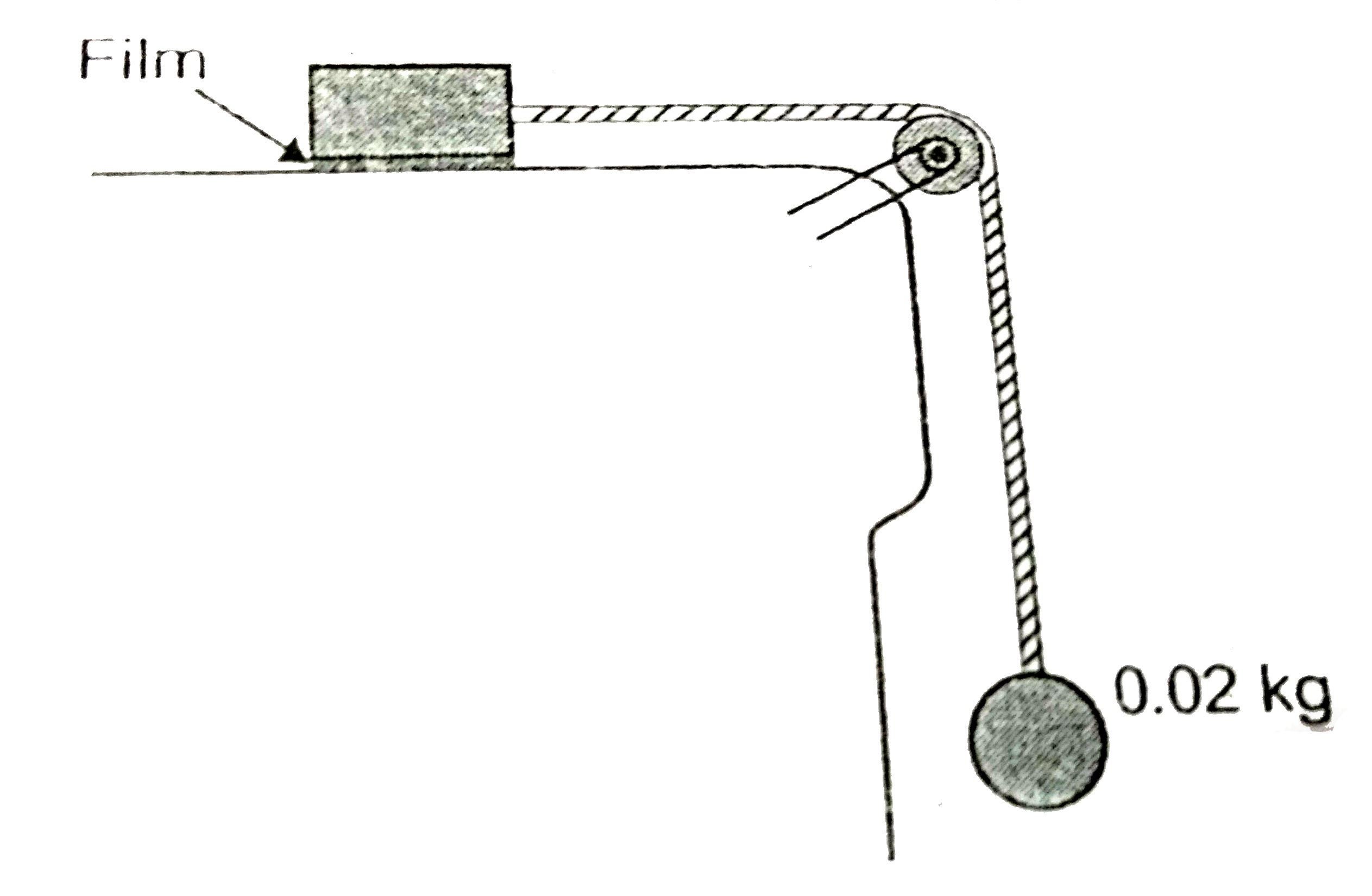
A metal block of area 0.10 `m^(2)` is connected to a 0.02 kg mass via a string. The string passes over an ideal pulley (considered massless and frictionless) as shown in figure. A liquid with a flim of thickness 0.15 mm is placed between the plate and the table. When released the plate movees to the right with a constant speed of 0.075 m `s^(-1)`. What is the coefficient of viscosity of the liquid?

Text Solution

Verified by Experts

Area of the film, A = 0.10 `m^(2)`
Thickness of the film = 0.15 mm
x = 0.25 `xx 10^(-3)`m
Relative velocity of plate v = 0.075 m `s^(-1)`
Since the plate moves with constant speed, the tension developed in the string is equal to the viscous force F. But tension is equal to the weight of suspended mass m.
`therefore` Viscous force F = weight of mass
= 0.02 `xx` 9.8
= 0.196 N
`F = eta (Av)/(x)`
`rArr eta = (Fx)/(Av)`
`=(0.196 xx 0.15 xx 10^(-3))/(0.10 xx 0.075)`
`=(0.0196)/(5)`
= 0.00392 Pa s
Promotional Banner

Topper's Solved these Questions

  • MECHANICAL PROPERTIES OF FLUIDS

    AAKASH INSTITUTE|Exercise TRY YOURSELF|41 Videos
  • MECHANICAL PROPERTIES OF FLUIDS

    AAKASH INSTITUTE|Exercise SECTION - A|50 Videos
  • MAGNETISM AND MATTER

    AAKASH INSTITUTE|Exercise ASSIGNMENT (SECTION D)|26 Videos
  • MECHANICAL PROPERTIES OF SOLIDS

    AAKASH INSTITUTE|Exercise Assignment(Section-D)|12 Videos

Similar Questions

Explore conceptually related problems

A metal plate of area 0.10m^(2) is connected to a 0.01 kg mass via a string that pases over an idial pulley (considered to be frictionless), as shown in the figure. A liquid with a film thickness of 3.0 mm is placed between the plate and the table. When released the plate moves to the right with a constant speed of 0.085ms^(-1) . Find the coefficient of vicosity of the liquid.

A metal plate of area 0.10 m^(2) is connected to a 0.04 kg mass via a string that passes over an ideal pulley (considered massless and frictionless) A liquid with a film of thickness of 0.3mm is placed between the plate and the table. When system is released, the plate moves up with constant speed of 0.085 m//s . Find the approximate value of coefficient of viscosity of the liquid. (mass of metal plate is 0.02 kg , g=9.8 m//s^(2) )

A metal block of area 0.10 m^(2) is connected to a 0.01 kg mass via a string that passes over a massless and frictionless pulley as shoen in figure.A liquid with a film thickness of 0.3 mm is placed between the block and the table. When released the block moves to the right with a constant of 0.085 m s^(-1) . The cofficient of viscosity of the liquid is

A metal block of area 0.10 m^(2) placed at a table, is connected to a 0.010 kg mass via a string that passes over an ideal pulley. Th pulley is fixed at the edge of the table. A liquid with a film of thickness 0.30 mm is placed between the block and the table. If the coefficient of viscosity of the liquid is 3.45 xx 10^(-3) Pa s, with what constant velocity does the block move when released?

Two blocks of masses 2.0 kg and 3.0 kg are connected by light inextensible string. The string passes ove an ideal pulley pivoted to a fixed axel on a smooth incline place as shown in the figure. When the blocks are released, find magnitude of their accelerations.

Two blocks, each having mass m, are connected with an ideal string through ideal pulleys on a frictionless fixed wedge as shown in the figure. The acceleration of the blocks is

Two blocks of masses m and 3m are connected by an inextensible string and the string passes over a fixed pulley which is massless and frictionless. A bullet of mass m moving with a velocity 'u' hits the hanging block of mass 'm' and gets exbedded in it. Find the height through which block A rises after the collision.

In the figure shown, the frictional coefficient between the table and the block is 0.2. Find the ratio of tensions in the right and the left strings.

Find the acceleration of masses m_(1) and m_(2) connected by an inextensible string, shown in figure-2.13(a). The string and pulley are assumed to be massless and frictionless.
