Home
Class 12
PHYSICS
Calculate the rate of flow of glycerine ...

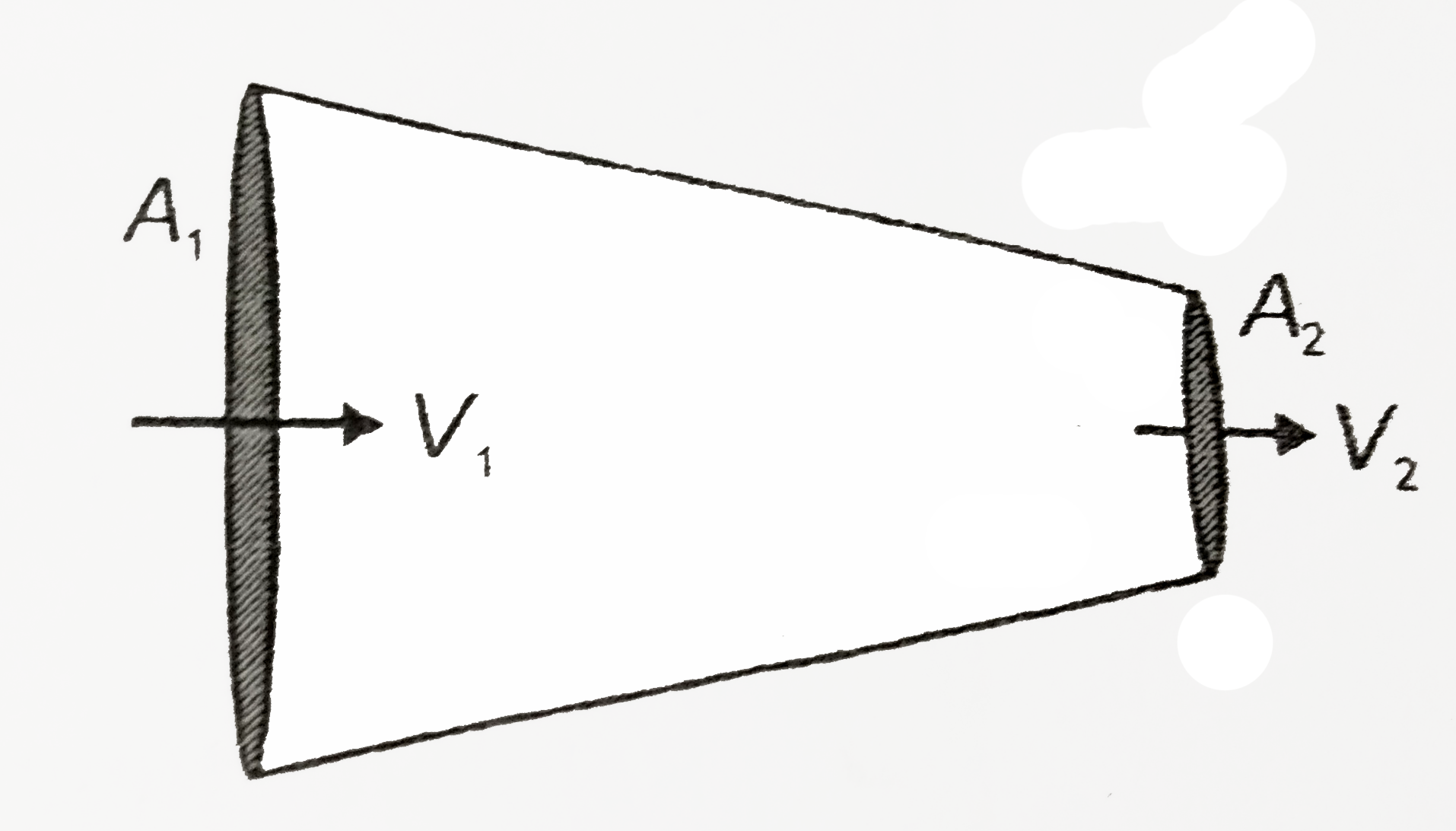
Calculate the rate of flow of glycerine of density 1.20 `xx 10^(3) kg//m^(3)` through the conical section of a pipe. If the radii of its ends are 0.1 m and 0.02 m and the pressure drop across the length is 10 `N/m^(2)`.

Text Solution

Verified by Experts

According to continuity equation,
`A_(1)V_(1) = A_(2)V_(2)`
`rArr (V_(2))/(V_(1))=(A_(1))/(A_(2))=(pi r_(1)^(2))/(pi r_(2)^(2))=(r_(1)^(2))/(r_(2)^(2))`
`rArr (V_(2))/(V_(1))=((r_(1))/(r_(2)))^(2)=((0.10)/(0.02))^(2)=5^(2)=25" "...(i)`
and according to Bernoulli's equation
`P_(1)+(1)/(2)rho v_(1)^(2)+rho gh_(1)=P_(2)+(1)/(2)rho v_(2)^(2)+rho gh_(2)`
Here pipe is horizontal. So `h_(1) = h_(2)`
`rArr P_(1)+(1)/(2) rho v_(1)^(2) + rho gh_(1) = P_(2) + (1)/(2)rho v_(2)^(2) + rho gh_(1)`
`rArr P_(1) + (1)/(2) rho v_(1)^(2)=P_(2)+(1)/(2)rho v_(2)^(2)`
`rArr (1)/(2) rho v_(2)^(2) - (1)/(2) rho v_(1)^(2) = P_(1)-P_(2)`
`rArr v_(2)^(2)-v_(1)^(2)=(2(P_(1)P_(2)))/(rho)=(2xx10)/(1.20 xx 10^(3))=(20)/(1.20 xx 10^(3))`
`rArr v_(2)^(2) - v_(1)^(2) = (20)/(1200) = (2)/(120) = (1)/(60) = 16.7 xx 10^(-3)" "...(ii)`
Substituting the value of `V_(2)` from equation (i) in (ii)
`(25 V_(1))^(2) - V_(1)^(2) = 16.7 xx 10^(-3)`
`rArr 624 V_(1)^(2) = 16.7 xx 10^(-3)`
`rArr v_(1)^(2) = (167 xx 10^(-4))/(624)`
`rArr V_(1) = sqrt((167)/(624))xx 10^(-2)m//sec`
So, rate of flow through the tube
`R=A_(1)V_(1)=A_(2)V_(2) = pi xx (0.1)^(2) xx sqrt((167)/(624)) xx 10^(-2)`
`=pi xx sqrt((167)/(624))xx 10^(-4)`
Promotional Banner

Topper's Solved these Questions

  • MECHANICAL PROPERTIES OF FLUIDS

    AAKASH INSTITUTE|Exercise TRY YOURSELF|41 Videos
  • MECHANICAL PROPERTIES OF FLUIDS

    AAKASH INSTITUTE|Exercise SECTION - A|50 Videos
  • MAGNETISM AND MATTER

    AAKASH INSTITUTE|Exercise ASSIGNMENT (SECTION D)|26 Videos
  • MECHANICAL PROPERTIES OF SOLIDS

    AAKASH INSTITUTE|Exercise Assignment(Section-D)|12 Videos

Similar Questions

Explore conceptually related problems

Calculate the rate of flow of glycerine of density 1.25 xx 10^(3) kg//m^(3) through the conical section of a pipe if the radii of its ends are 0.1m and 0.04 m and the pressure drop across its lengths is 10N//m^(2) .

Calculate the rate of flow of glycerine of density. 1.25xx10^(3) kg//m^(3) through the conical section of a pipe. If the radii of its ends are 1.0m and 0.04m and the pressure drop across its length is 10N//m^(2) .

Calculate the rate of flow of glycerine of density 1.25xx10^(3) kg m^(-3) through the conical section of a pipe, if the radii of its ends are 0.1 m and 0.04 m and the pressure drop across its length is 10 Nm^(-2) .

Calculate the moment of inertia of a cylinder of length 1.5 m , radius 0.05m and density 8 xx 10^(3) kg//m^(3) about the axis of the cylinder.

The workdone by pressure in forcing 1m^3 of water through a pipe if the pressure difference across the pipe is 10^4 Pa, is

Two metal spheres are falling through a liquid of density 2xx10^(3)kg//m^(3) with the same uniform speed. The material density of sphere 1 and sphere 2 are 8xx10^(3)kg//m^(3) and 11xx10^(3)kg//m^(3) respectively. The ratio of their radii is :-

A drop of radius 2xx10^(-5) and density 1.2xx10^(3)kg//m^(3) falls through air. The viscosity of air is 1.8xx10^(-5) N s//m^(2). Neglecting buoyancy due to air, the terminal speed of the drop is

Water at a pressure of 4xx 10^(4) Nm^(-2) flows at 2 ms^(-1) through a horizontal pope of 0.02 m^(2) . What is the pressure in the smaller cross-section of the pipe?
