Home
Class 12
PHYSICS
The block of M in the figure is connecte...

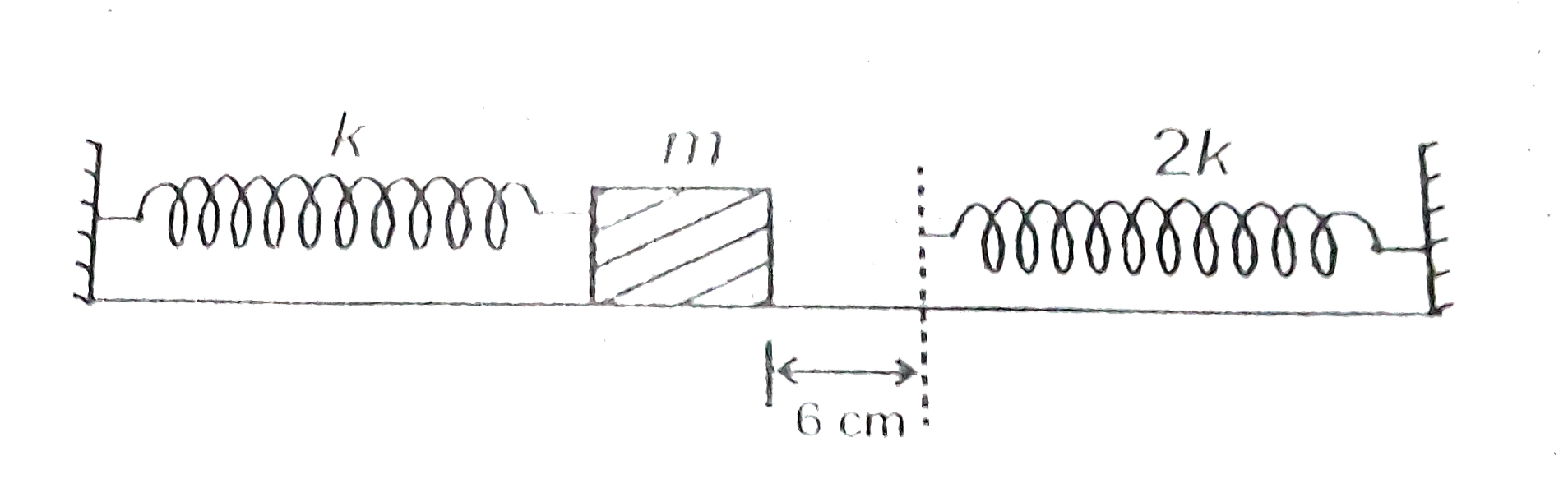
The block of M in the figure is connected to a left spring `(k_(1)= k)`. The right spring `(k_(2) = 2k)` is fixed to the other wall such that its free end is 6 cm away from blocm. In this situation, entire system isin equilibrium. Now, block is displaced to left by `6 sqrt(2)` cm and released. Determine the time period of oscillatory motion of the block.

Text Solution

Verified by Experts

`2pi [(3)/(4) + (1)/( 3sqrt(3))] sqrt((m)/(k))`
Promotional Banner

Topper's Solved these Questions

  • OSCILLATIONS

    AAKASH INSTITUTE|Exercise EXAMPLE|21 Videos
  • OSCILLATIONS

    AAKASH INSTITUTE|Exercise Exercise|20 Videos
  • OSCILLATIONS

    AAKASH INSTITUTE|Exercise ASSIGNMENT ( SECTION-I(SUBJECTIVE TYPE QUESTIONS) )|7 Videos
  • NUCLEI

    AAKASH INSTITUTE|Exercise ASSIGNMENT (SECTION-D)|10 Videos
  • PHYSICAL WORLD

    AAKASH INSTITUTE|Exercise ASSIGNMENT (Section-B)|5 Videos

Similar Questions

Explore conceptually related problems

Two blocks each of mass m are connected with springs each of force constant K as shown in fig. The mass A is displaced to the left & B to the right by the same amount and released then the time period of oscillation is -

A block of mass m is connected to three springs as shown in Fig. The block is displaced down slightly and left free, it starts oscillating. Find time period of oscillations.

The system is in equilibrium and at rest. Now mass m_(1) is removed from m_(2) . Find the time period and amplituded of resultant motion. Spring constant is K .

Figure shown a block P of mass m resting on a smooth horizontal surface, attached to a spring of force constant k which is rigidly fixed on the wall on left side, shown in the figure . At a distance l to the right of the block there is a rigid wall. If block is pushed towards loft so that spring is comparessed by a distance 5l//3 and when released, if will starts its oscillations. If collision of block with the wall is consdered to be perfectly elastic. Find the time period of oscillation of the block.

A block of mass 'm' is attached to a spring in natural length of spring constant 'k' . The other end A of the spring is moved with a constat velocity v away from the block . Find the maximum extension in the spring.

The period of oscillation of a mass M suspended from a spring of spring constant K is T. the time period of oscillation of combined blocks is

In the figure, the block of mass m, attached to the spring of stiffness k is in correct with the completely elastic wall, and the compression in the spring is e. The spring is compressed further by e by displacing the block towards left and is then released. If the collision between the block and the wall is completely eleastic then the time period of oscillation of the block will be

Two light spring of force constants k_(1) and k_(2) and a block of mass m are in one line AB on a smooth horizontal table such that one end of each spring is fixed on rigid supports and the other end is free as shown in the figure. The distance CD between the spring is 60cm . If the block moves along AB with a velocity 120 cm//s in between the springs, calculate the period of oscillation of the block. (take k_(1) = 1.8 N//m , k_(2) = 3.2 N//m , m = 200 g )
