Home
Class 12
PHYSICS
A uniform string of length 'L' is suspen...

A uniform string of length 'L' is suspended from a point on the ceiling. A small wave pulse is now introduced at its lowest end and it starts moving up towards the ceiling.
(i) What will be the speed of the wave pulse when it has moved up a distance x?
(ii) How much time does this wave pulse take to reach the ceiling?

Text Solution

Verified by Experts
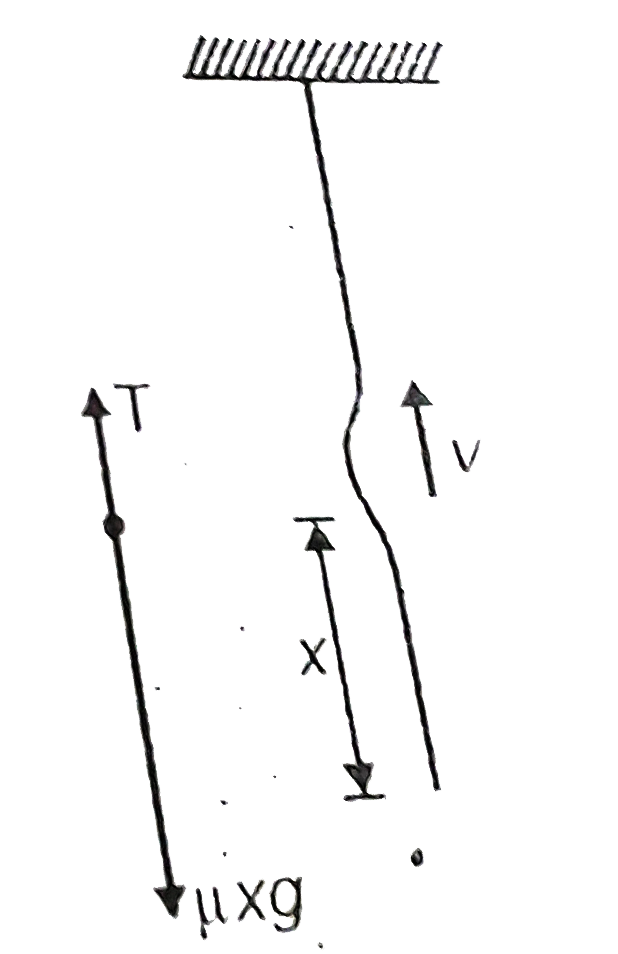
(i) Let the mass per unit length of the string be `mu`. Consider a section of the string of length x (x measured from the lower end)
The mass of this section is `mux` and hence its weight is `mux`. This weight is balanced by the tension T at the piont x distant x from the lower end.
Hece `T=muxg`
the wave velocity v is now given by
or `v=sqrt(xg)`
(ii) as the wave pulse climbs up, x changes from zero to L.
now, `V=(dx)/(dt)` or `(dx)/(sqrt(x))=sqrt(g)dt`
Integrating, we get
`int_(0)^(L)(dx)/(sqrt(x))=sqrt(g)int_(0)^(t)dtimplies2sqrt(x)int_(0)^(L)=sqrt(g)t`
or `2sqrt(L)=sqrt(g)t` or `t=2sqrt((L)/(g))`.
Promotional Banner

Topper's Solved these Questions

  • WAVES

    AAKASH INSTITUTE|Exercise Try Yourself|64 Videos
  • WAVES

    AAKASH INSTITUTE|Exercise Assignment (Section-A)|55 Videos
  • WAVE OPTICS

    AAKASH INSTITUTE|Exercise Assignment (Section-J (Aakash Challengers question))|1 Videos
  • WORK, ENERGY AND POWER

    AAKASH INSTITUTE|Exercise Assignment (SECTION - D)|15 Videos

Similar Questions

Explore conceptually related problems

A uniform string of length 10 m is suspended from a rigid support A short wave pulse is introduced at its lowest end it starts moving up the string the time taken to reach the support is (take g=10m//sec^(2) )

A uniform string of length 20m is suspended from a rigid support. A shirt wave pulse is introduced at its lowest end. It starts moving up the string. The time taken to reach the support is : (take g = 10ms^(-2) )

(a) A string of mass 'm' and length 'L' is suspended from the ceiling and a mass M is hanged from it. Transverse waves are produced at its lowest point (nearM) having wavelength lambda , find its wavelength at a distance x from the upper point. (b) In the previous question, what time a transverse pulse will take to reach from it lowest point to its uppermost point , if the mass M is not hanged from it

A heavy but unifrom rope of length L is suspended from a celling . A particle is dropped from the celling at the instant when the bottom end is given a transverse wave pulse. Where will the particle meet the pulse.

A heavy but uniform rope of lenth L is suspended from a ceiling. (a) Write the velocity of a transverse wave travelling on the string as a function of the distance from the lower end. (b) If the rope is given a sudden sideways jerk at the bottom, how long will it take for the pulse to reach teh celling ? (c ) A particle is dropped from the ceiling at the instant the bottom end is given the jerk where will the particle meet the pulse ?

A wave train has the equation y = 4 sin (30pit + 0.1x) where x is in cm is the frequency of the source? How much time does a wave-púlse take to reach a point 30 cm from it ?

A perfectly elastic uniform string is suspended vertically with its upper end fixed to the ceiling and the lower end loaded with the weight. If a transverse wave is imparted to the lower end of the string, the pulse will

The block of mass m_(0)=muL is attached to a uniform string of mass M=muL and length L as shown in the figure. If a wave pulse is produced near the block, then the time it taken to reach the ceiling is

A rope of length L and uniform linear density is hanging from the ceiling. A transverse wave pulse, generated close to the free end of the rope, travels upwards through the rope. Select the correct option:

