Home
Class 12
PHYSICS
A cylinder contains 0.50 mol of an ideal...

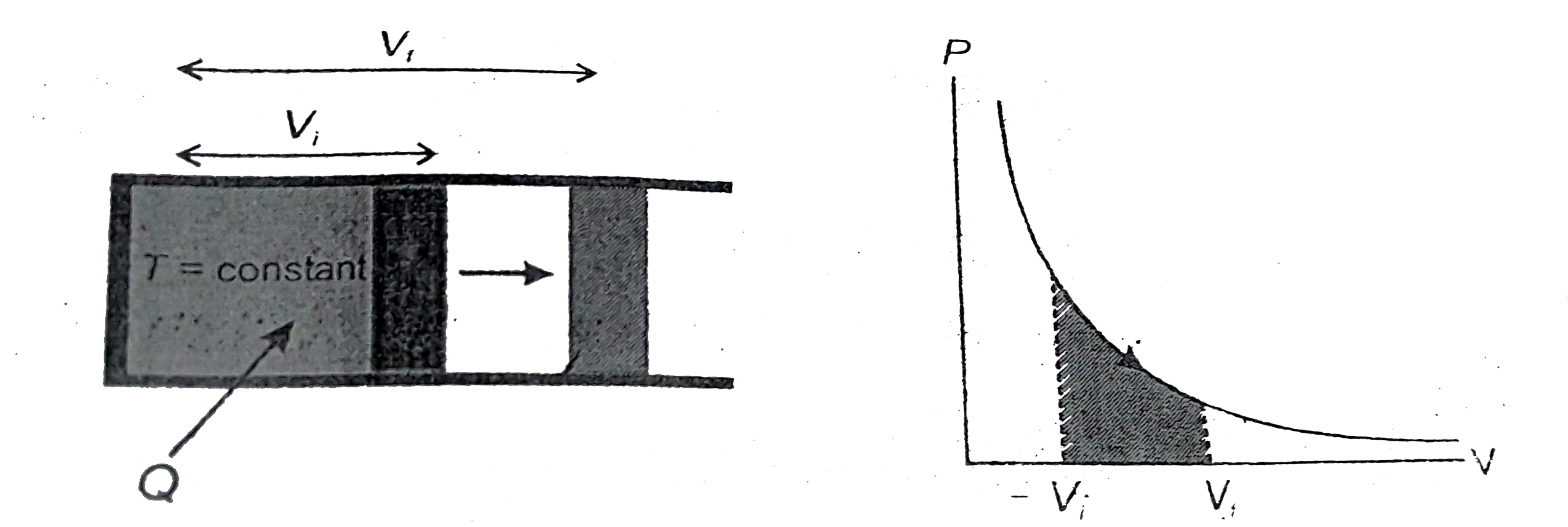
A cylinder contains 0.50 mol of an ideal gas at temperature of 310 K. as the gas expands isothermally from an initial volume of 0.31 `m^(3)` to a final volume of 0.45`m^(3)`, find the amount of heat that must be added to the gas in order to maintain a constant temperature.

Text Solution

Verified by Experts

Since the process is isothermal, the internal energy of an ideal gas does not change, i.e., `DeltaU=0`. The relation `DeltaU=Q-W` gives `Q=W`, where W is positive (work is done by the system). Now, we know that the gas gains heat from the surrounding (positive Q). as the work done W is given by `int_(V_(i))^(V_(f))PdV`, we obtain W as
`W=int_(V_(i))^(V_(f))PdV=int_(V_(i))^(V_(f))(nRT)/(V)dV=nRT int_(V_(i))^(V_(f))(dV)/(V)=nRT" In "V|_(V_(i))^(V_(f))=nRT" In "((V_(f))/(V_(i)))`
Substituting `n=0.50mol,R=8.31J//(mol" "K),V_(f)=0.45m^(3) and V_(i)=0.31m^(3)`, we obatain Q=W=480J.
Promotional Banner

Similar Questions

Explore conceptually related problems

A cyclinder contains 0.5 mole of an ideal gas at 310K . As the gas expands isothermally from an initial volume 0.31m^(3) to a final volume of 0.45m^(3) , find the amount of heat that must be added to the gas in order to maintain a constant temperature.

3 mole of a gas at temperature 400 K expands isothermally from initial volume of 4 litre to final volume of 8 litre. Find the work done by the gas. (R = 8.31 J mol^(-1) K^(-1))

Calculate the work done (in joules) when 0.2 mole of an ideal gas at 300 K expands isothermally and reversible from an initial volume of 2.5 litres to the final volume of 25 litres.

One mole of an ideal gas expands at a constant temperature of 300 K from an initial volume of 10 litres to a final volume of 20 liters. The work done in expanding the gas is (R=8.31 J// "mole"-K) (in joules)

Two moles of an ideal gas have an initial kelvin temperature T_i and absolute pressure P_i the gas undergoes a reversible isothermal compression from an initial volume V_i to a final volume 0.5 V_i The ratio of the molar specific heat capacity at constant pressure to that at constant volume, gamma ,for diatomic hydrogen gas is 7/5. In an adiabatic compression, the gas, originally at atmospheric pressure, is compressed from an original volume of 0.30 m^3 to 0.15 m^3 What is the final pressure of the gas?

The pressure of a gas is doubled keeping its temperature constant. Find the ratio of the final volume of the gas to its initial volume.

A gas is compressed at a constant pressure of 50N//m^(2) from a volume 10m^(3) to a volume of 4m^(3) . 100J of heat is added to the gas then its internal energy is
