Home
Class 12
PHYSICS
What are value of phi(1), phi(2) and r t...

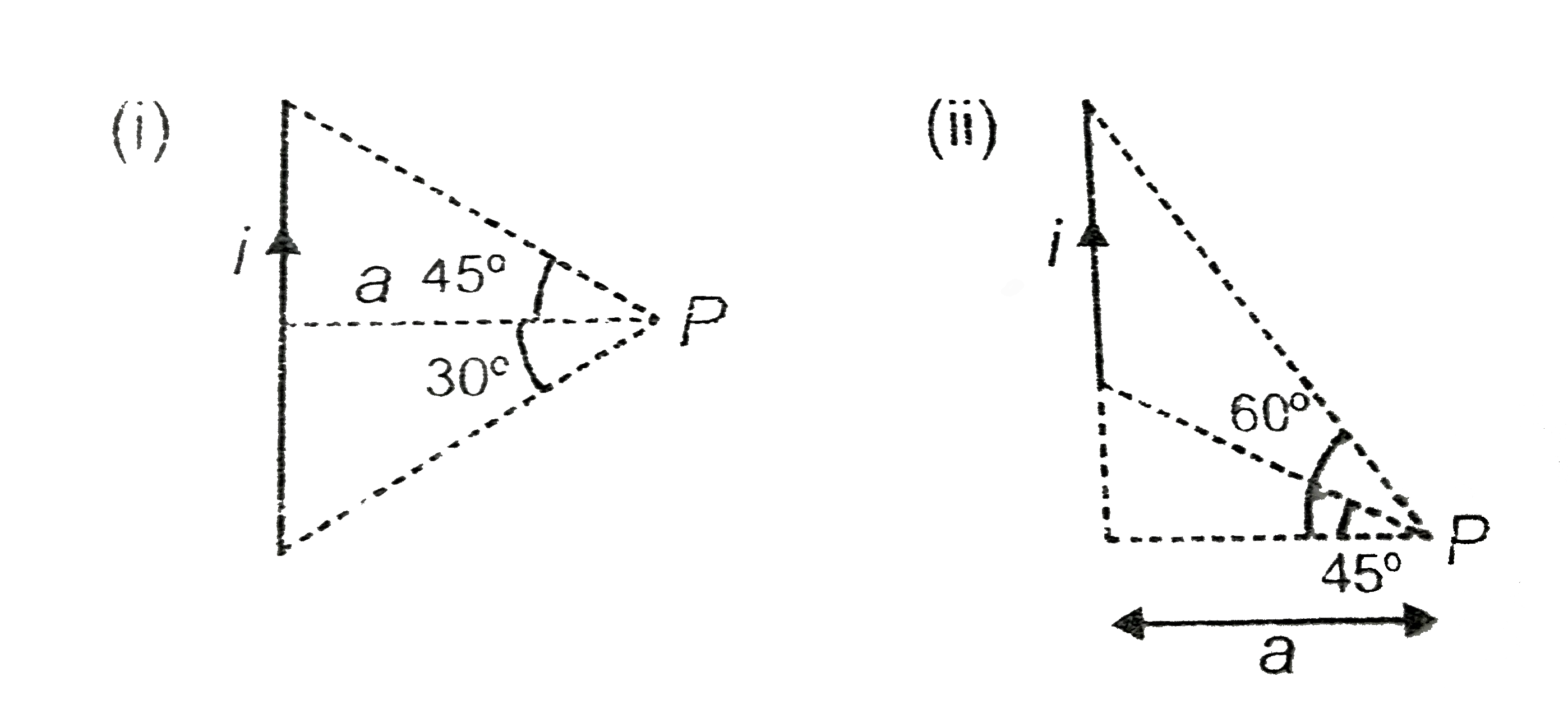
What are value of `phi_(1), phi_(2)` and r to find out magnetic field at P in the following cases ?

Text Solution

Verified by Experts

(i) Comparing with general expression, `phi_(1) = 45^(@), phi_(2) = 30^(@) and r = a`
(ii) Comparing with general expression, `phi_(1) = 60^(@), phi_(2) = -45^(@)` (as the angle is in opposite seense to that considered in standard case), `r = a`
Promotional Banner

Topper's Solved these Questions

  • MOVING CHARGES AND MAGNETISM

    AAKASH INSTITUTE|Exercise Illustration|12 Videos
  • MOVING CHARGES AND MAGNETISM

    AAKASH INSTITUTE|Exercise Try Yourself|27 Videos
  • MOVING CHARGE AND MAGNESIUM

    AAKASH INSTITUTE|Exercise SECTION D|16 Videos
  • NUCLEI

    AAKASH INSTITUTE|Exercise ASSIGNMENT (SECTION-D)|10 Videos

Similar Questions

Explore conceptually related problems

Find the magnetic field at point P in following cases

Evaluate magnitude and direction of magnetic field at a point P in the following cases

The graph between the stopping potential (V_(0)) and ((1)/(lambda)) is shown in the figure phi_(1) , phi_(2) and phi_(3) are work function , which of the following is //are correct

The graph between 1/lambda and stopping potential V_(0) of two metals having work funcation phi_(1) and phi_(2) in an experiment of photoelectric effect is obtained as shown in the figure. Find out - (i) Threshold wavelength ofboth metals (ii) phi_(1) : phi_(2) (iii) Whihc metal cen emit photoelectrons with visible light ?

A closedc coil with a resitance R is placed in a magnetic field. The flux linked with the coil is phi . If the magnetic field is suddenly reversed in direction, the charge that flows through the coil will be

The magnetic flux linked with a coil of N turns and resistance R changes from phi_(1) " to " phi_(2) . Show that the charge that has passed through the coil is q=-(N(phi_(2)-phi_(1)))/( R) .

Show that if the flux of magnetic induction through a coil changes from phi_(1)" to "phi_(2) then the charge q that flows through the circuit of total resistance R is given by q=(phi_(2)-phi_(1))/(R) where R is the resistance of the coil.

If phi(x)=phi'(x) and phi(1)=2, then phi(3) equals
