Home
Class 12
PHYSICS
A particle of charge q and mass m releas...

A particle of charge q and mass m released from origin with velocity `vec(v) = v_(0) hat(i)` into a region of uniform electric and magnetic fields parallel to y-axis. i.e., `vec(E) = E_(0) hat(j) and vec(B) = B_(0) hat(j)`. Find out the position of the particle as a functions of time
Strategy : Here `vec(E) || vec(B)`
The electric field accelerates the particle in y-direction i.e., component of velocity goes on increasing with acceleration
`a_(y) = (F_(y))/(m) = (F_(e))/(m) = (qE_(0))/(m)`
The magnetic field rotates the particle in a circle in x-z plane (perpendicular to magnetic field) The resultant path of the particle is a helix with increasing pitch.
Velocity of the particle at time t would be
`vec(v) (t) = v_(x) hat(i) + v_(y) hat(j) + v_(z) hat(k)`

Text Solution

Verified by Experts
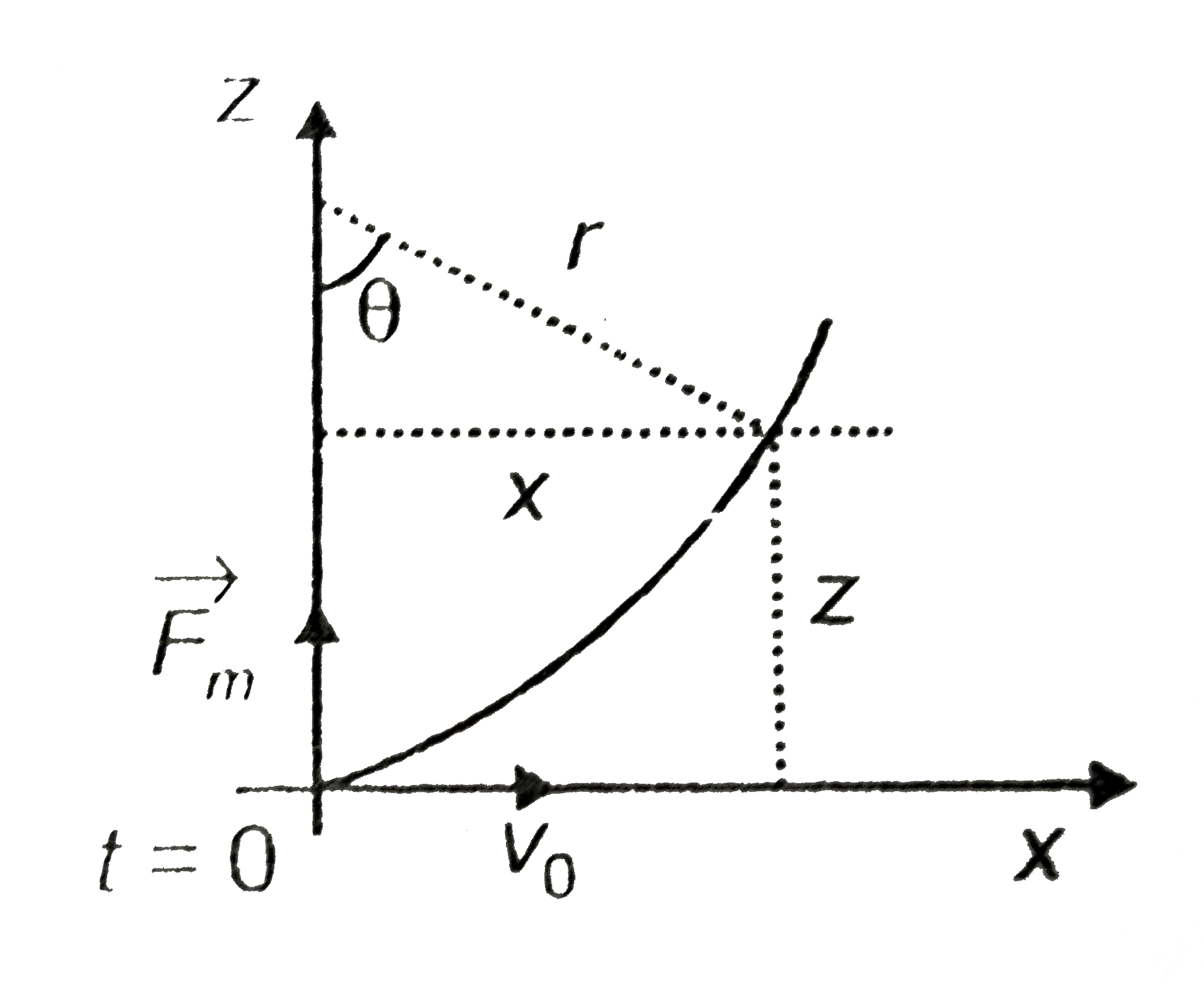
Here `v_(y) = a_(y) t = (qE_(0) t)/(m)`
`v_(x)^(2) + v_(z)^(2) = " constant" = v_(0)^(2)`
`theta = omega t = (Bqt)/(m)`
`v_(x) = v_(0) cos theta = v_(0) cos ((Bqt)/(m))`
`v_(z) = v_(0) sin theta = v_(0) sin ((Bqt)/(m))`
`vec(v) (t) = v_(0) cos ((Bqt)/(m)) hat(i) + ((qE_(0)t)/(m)) hat(j) + v_(0) sin ((Bqt)/(m)) hat(k)`
Position vector of particle at time t can be given by
`vec(r) (t) = x hat(i) + y hat(j) + z hat(k)`
`y = (1)/(2) a_(y) t^(2) = (1)/(2) ((qE_(0))/(m)) t^(2)`
`x = r sin theta = ((mv_(0))/(Bq)) sin ((Bqt)/(m))`
`z = r (1 - cos theta) = ((mv_(0))/(Bq)) [{1 - cos ((Bqt)/(m))}]`
`vec(r) (t) = ((mv_(0))/(Bq)) sin ((Bqt)/(m)) hat(i) + (1)/(2) ((qE_(0))/(m)) t^(2) hat(j) + (mv_(0))/(Bq) [{1 - cos ((Bqt)/(m))}] hat(k)`
Promotional Banner

Topper's Solved these Questions

  • MOVING CHARGES AND MAGNETISM

    AAKASH INSTITUTE|Exercise Illustration|12 Videos
  • MOVING CHARGES AND MAGNETISM

    AAKASH INSTITUTE|Exercise Try Yourself|27 Videos
  • MOVING CHARGE AND MAGNESIUM

    AAKASH INSTITUTE|Exercise SECTION D|16 Videos
  • NUCLEI

    AAKASH INSTITUTE|Exercise ASSIGNMENT (SECTION-D)|10 Videos

