Home
Class 12
PHYSICS
A coil of radius R carries a current i(1...

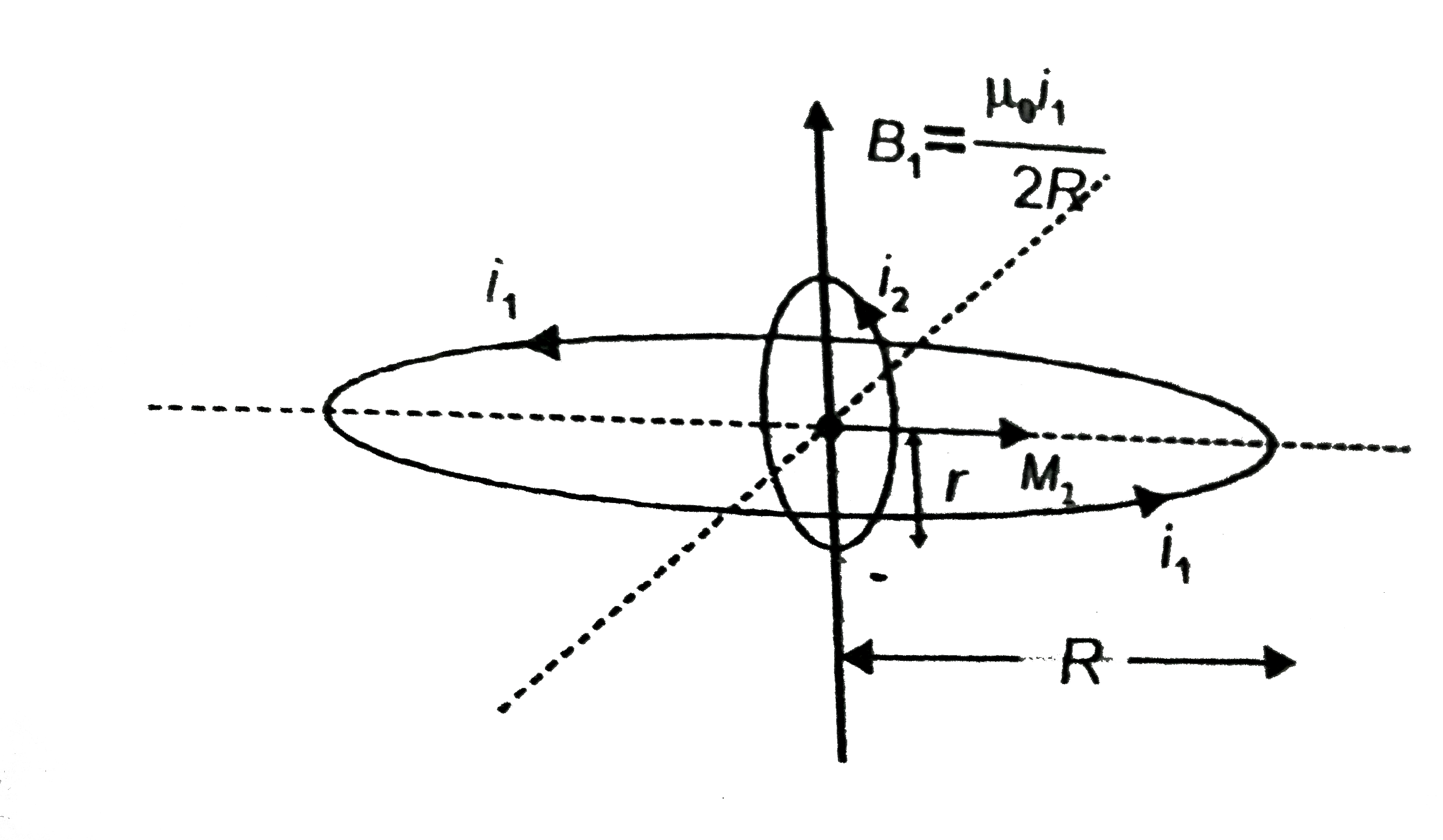
A coil of radius R carries a current `i_(1)`. Another concentric coil of radius `r (r lt lt R)` carries a current `i_(2)`. Planes of two coils are mutually perpendicular and both the coils are free to rotate about common diameter. Find maximum kinetic energy attained by the two coils, when both are released from rest. The masses of two coils are M and m respectively.
Strategy : The magnetic field due to coil of radius R is `(mu_(0)i_(1))/(2R)`. This field exerts a torque on shorter coil. An equal and opposite torque is exerted by the shorter coil on larger coil. There is no external torque acting on the system. The angular momentum remains conserved. Also the total mechanical energy remains conserved. At any instant, let `omega_(1) and omega_(2)` represent the angular velocity

Text Solution

Verified by Experts
`l_(1)omega_(1) - l_(2)omega_(2) = 0`
or `l_(1)omega_(1) = l_(2)omega_(2) = L` (say).

The kinetic energy of the coils are `k_(1) = (1)/(2)l_(1) omega_(1)^(2) = (L^(2))/(2l_(1))`
and `K_(2) = (L_(2))/(2l_(2))`
By conservation of energy `[(k_(1) + k_(2))-0] + [-M_(2)B_(1) - 0] = 0`
`-M_(2)B_(1)` is final potential energy. The kinetic energy is maximum when potential energy is minimum. Potential energy is minimum when `M_(2)` and `B_(1)` are parallel.
`rArr k_(1) + k_(2) = (i_(2) pi r^(2)) xx (mu_(0)i_(1))/(2R)`
Also `(k_(1))/(k_(2)) = (l_(2))/(l_(1))`
`rArr (k_(1))/(k_(2) + k_(1)) = (l_(2))/(l_(1) + l_(2))`
`rArr k_(1) = ((l_(2))/(l_(1) + l_(2))) ((i_(2) pi^(2)) mu_(0) i_(1))/(2R)`
`rArr k_(1) = (mu_(0))/(2R)((mr^(4) pi i_(1) i_(2))/((MR^(2) + mr^(2)))), k_(2) = (mu_(0))/(2)((MR r^(2) pi i_(1) i_(2))/(MR^(2) + mr^(2)))`
Promotional Banner

Topper's Solved these Questions

  • MOVING CHARGES AND MAGNETISM

    AAKASH INSTITUTE|Exercise Illustration|12 Videos
  • MOVING CHARGES AND MAGNETISM

    AAKASH INSTITUTE|Exercise Try Yourself|27 Videos
  • MOVING CHARGE AND MAGNESIUM

    AAKASH INSTITUTE|Exercise SECTION D|16 Videos
  • NUCLEI

    AAKASH INSTITUTE|Exercise ASSIGNMENT (SECTION-D)|10 Videos

Similar Questions

Explore conceptually related problems

A coil of radius R carries current i_1 . Another concentric coil of radius r(rlt ltR) carries current i_2 . Planes of two coils are mutually perpendicular and both the coil are free to rotate about common diametre. Find maximum kinetic energy of smaller coil when both the coils are released, masses of coils are M and m, respectively.

A coil of radius R carries a current I . Another concentric coil of radius r (r lt lt R) carries current (1)/(2) . Initially planes of the two coils are mutually prependicular and both the coil are free to rotate about common diameter. They are released from rest from this position. The masses of the coils are M and m respectively. (m lt M) . During the subsequeny motion let K_(1) and K_(2) be the maximum kinetic energies of the two cells respectively. and let U be the magnetic of maximum potential energy of magnetic interaction of the system of the coils. Choose the correct options.

A coil of length L, carries a current i. The magnetic moment of coil is proportional to

A circular coil of n turns and radius r carries a current I. The magnetic field at the center is

Figure shows a larger horizontal coil of radius R carrying a current I. Another small coil of radius r(r lt lt R) carrying a current i & N turns is placed at the centre with its plane at an angle theta from the axis. Find the torque experienced by the smaller coil in this situation.

A small coil of radius r is placed at the centre of another coaxial coil of radius R(Rgtgtr) find the coeffcient for this pair of coils.

A circular coil of radius r carries I. If the same coil is now changed into a square loop carrying the same current, magnitude of its magnetic moment will

Two concentric circular coils of radii R and r (lt lt R) carry currents of i_(1) and i_(2) respectively. If the smaller coil is rotated slightly about one of its diameter, it starts oscillating. Then, which of the following statement(s) is//are correct ?

