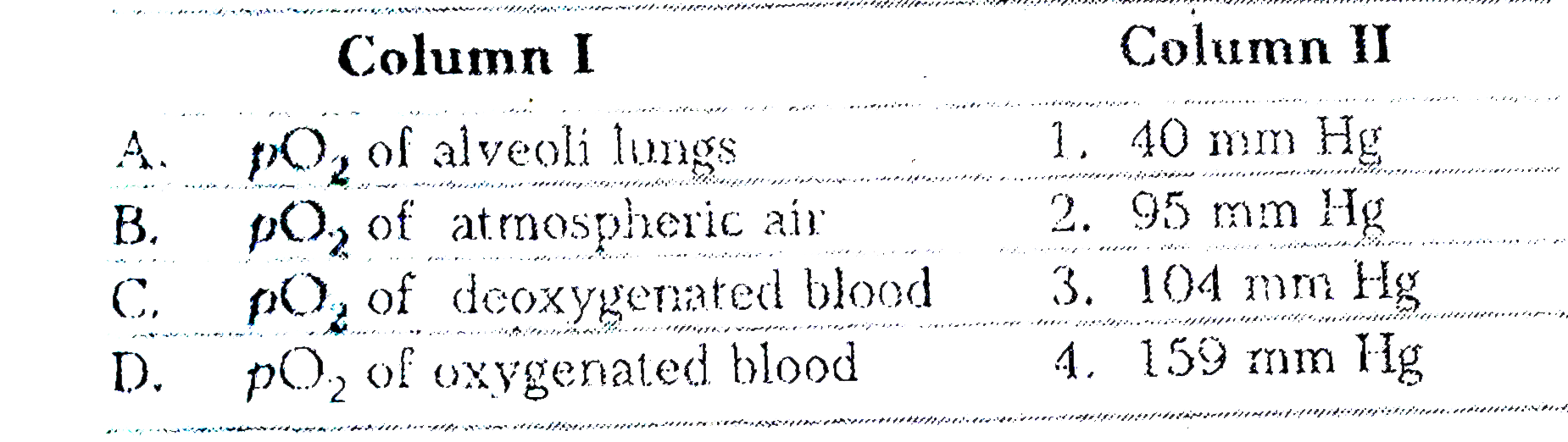
A
B
C
D
Text Solution
Verified by Experts
The correct Answer is:



Topper's Solved these Questions
BREATHING AND EXCHANGE OF GASES
ARIHANT NEET|Exercise Chapter exercises B (Medical entrances special format questions )|21 VideosBODY FLUID AND CIRCULATION
ARIHANT NEET|Exercise MEDICAL ENTRANCES GALLERY COLLECTION OF QUESTIONS ASKED IN NEET AND VARIOUS MEDICAL ENTRANCE EXAMS|72 VideosCELL CYCLE AND CELL DIVISION
ARIHANT NEET|Exercise Chapter Exercises (C) Medical entrances gallery (collection of questions asked in NEET & Various medical entrance exams)|63 Videos
ARIHANT NEET-BREATHING AND EXCHANGE OF GASES -Chapter exercise C (Medical entrances gallery )
- Match the following columns :
Text Solution
|
- The partial pressure of oxygen in the alveoli of the lungs is
Text Solution
|
- Lungs do not collapse between breaths and some air always remains in t...
Text Solution
|
- Name the pulmonary disease in which alveolar surface area involv...
Text Solution
|
- The volume of air that will remain in the lungs after a normal expirat...
Text Solution
|
- Which of the following is the most appropirate in normal circumstances...
Text Solution
|
- The peneumotaxic and repiratory rhythm centres respectively present in
Text Solution
|
- Which of the following sts of conditions promotes the dissociation of ...
Text Solution
|
- Assertion (A) In brain stem, pons is called pneumotaxic centre with t...
Text Solution
|
- When precentrage saturation of haemoglobin with O(2) is plotted again...
Text Solution
|
- The process of exchange of O(2) from the atmosphere with CO(2) prod...
Text Solution
|
- Inspiratory capacity of human is equal to
Text Solution
|
- Approximately seventy percent of carbon dioxide absorbed by the blood ...
Text Solution
|
- The volume of air that can be breathed in by maximum forced inspiratio...
Text Solution
|
- The serous membrane which covers the lungs is called
Text Solution
|
- what is the .(p)O(2) and .(p)CO(2) in the systemic arteries ?
Text Solution
|
- Choose the wrong statement .
Text Solution
|
- To generate pressure gradients to facilitate expiration and inspiratio...
Text Solution
|
- the figure shows a diagrammatic view of human respiratory system with ...
Text Solution
|
- Oxygen dissociation curve is
Text Solution
|