Home
Class 12
BIOLOGY
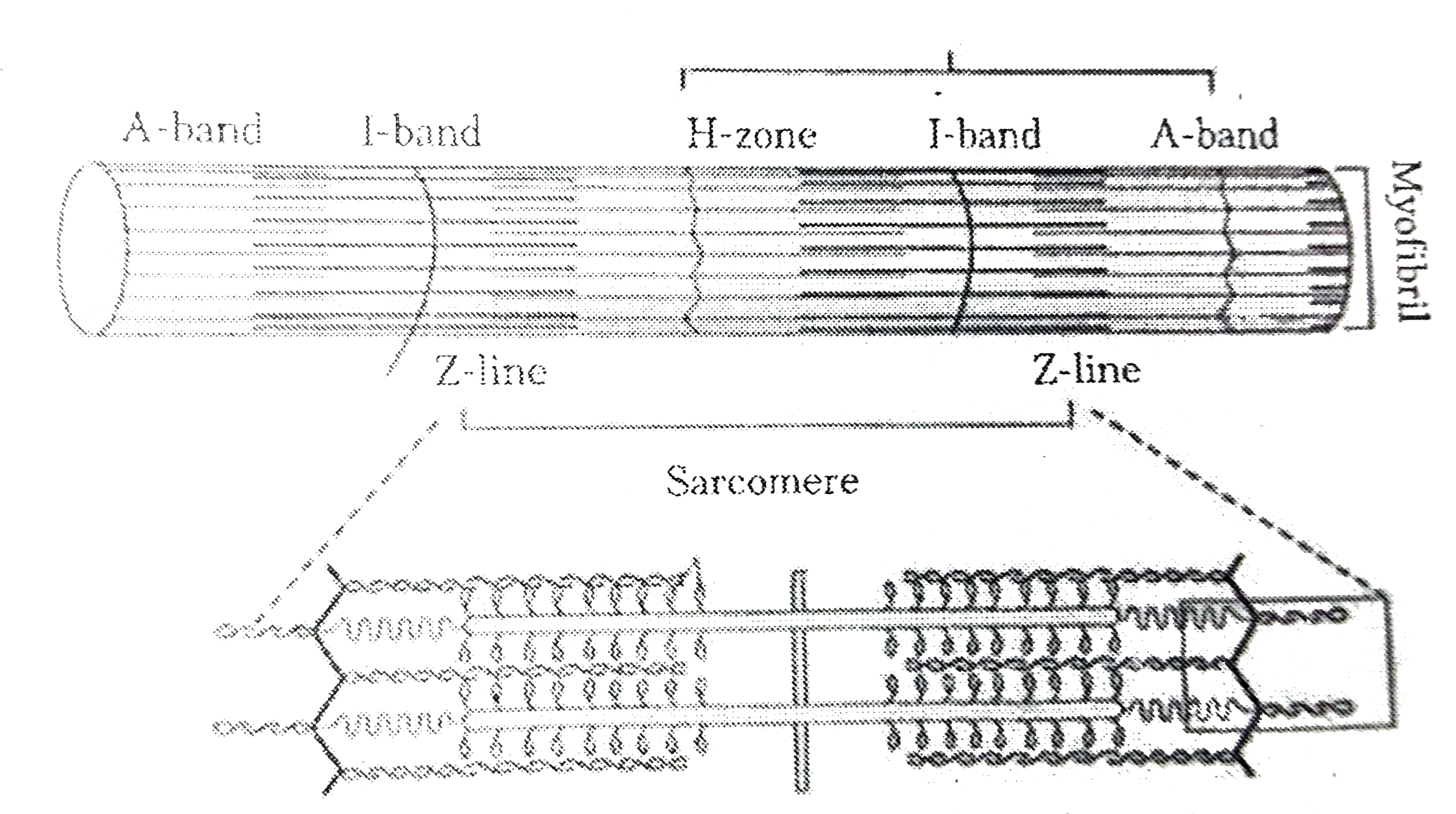
Consder the diagram showing muscle struc...

Consder the diagram showing muscle structure below.

Identify the events that occur during skeletal muscle contraction.
I. I-band shortens
II. A-band shortens
III. H-zone shortens
IV. Sarcomere contracts
V. ATP changes to ADP and Pi
Choose the option incorrect event(s).

A

Only I

B

Only III

C

IV and V

D

Only II

Text Solution

Verified by Experts

The correct Answer is:

d
Promotional Banner

Topper's Solved these Questions

  • MOVEMENT AND LOCOMOTION

    ARIHANT NEET|Exercise Assertion and reason|6 Videos
  • MOVEMENT AND LOCOMOTION

    ARIHANT NEET|Exercise Medical entrances gallary ( Collection of question asked in NEET & various Medical Entrance Exam )|54 Videos
  • MOVEMENT AND LOCOMOTION

    ARIHANT NEET|Exercise Taking it together ( Assorted Questions of the Chapter for Advanced Level Practice )|80 Videos
  • MORPHOLOGY OF FLOWERING PLANTS

    ARIHANT NEET|Exercise Chapter exercises C( Medical entrances gallery ( collection of questions Asked in NEET & Various Medical Entrance Exams ))|140 Videos
  • NEURAL CONTROL AND COORDINATION

    ARIHANT NEET|Exercise CHAPTER EXERCISES MEDICAL ENTRANCES GALLERY|111 Videos

Similar Questions

Explore conceptually related problems

Events occurring in muscular contraction (i) H-zone disappears (ii) A band widens (iii) I-band reduces in width Width of A band is unaffected (v)M-line and Z-line come closer.

During muscle contraction (a) A band remains of length same (b) O band increases (c) H zone and M line disappear (d) I band increases € Membrane of Krause comes closer (f) Sarcomere lengthens

During muscle contraction, the length of all the following gets reduced except? (A) H-Zone (B) A-Band (C) I-Band (D) Sarcomere

Breathing, an important step of the respiratory system, is a two-part process involving-inhalation and exhalation. During the process of breathing, the thorax region shows some changes. Identify the statement/s from below that is/are related to the exhalation process. I. External intercostal muscles contract II. Pressure in the lungs increases III. Diaphragm contracts IV. The volume of thorax decreases

Select the letter from the figure that most appropriately corresponds to the structure I. A-band " " II. I-band III. Sarcomere " " IV. H-zone V. Myosin VI. Actin, Troponin, Tropomyosin VII. Z-line

Which of the following statements is/are correct? I. Striped muscles are in the form of bundles of cells. II. The Pal muscle fibres, which are called fasciculi. III. Skeletal muscles form the largest tissue in the body. IV. Cardiac muscles in the embryo are originated from mesenchyma cell. Choose the option with the correct statement(s).

The given graph shows length-tension curve for a typical vertebrate sarcomere. By analysing the graph, what can you deduce regarding the muscle contraction? (i) Neither the myosin filaments nor the actin thin filaments change in length when a sarcomere shortens or is stretched. Instead, it is the extent of ocerlap between actin and myosin filaments that changes. (ii) The total tension produced by a sarcomere is proportional to the total number of cross-bridges that can interact with actin filaments, and this number in turn is proportional to the amount of of overlap between thick and thin filaments. (iii) The tension produced by the muscle is maximal when the overlap between thick and thin filamentss allows the largest number of myosin cross-bridges to bind to actin. (iv) Tension drops off with increased lenght, because the thick and thin filaments overlap less and fewer cross-bridges can bind. Tension drops off with decreased length, because thin filaments at the two ends of the secromere begin to collide with each other, preventing further shortening.

Statements A-bands of the muscle are dark and contain myosin I-band are the light bands and contain actin During muscle contraction the A-band contracts The part between the two Z-lines is called as sarcomere The central part of thin filament, not over-lapped by thick filament is called H-zone of the above statements.
