

Home
Class 12
PHYSICS
Radius of curvature of a concave spheric...

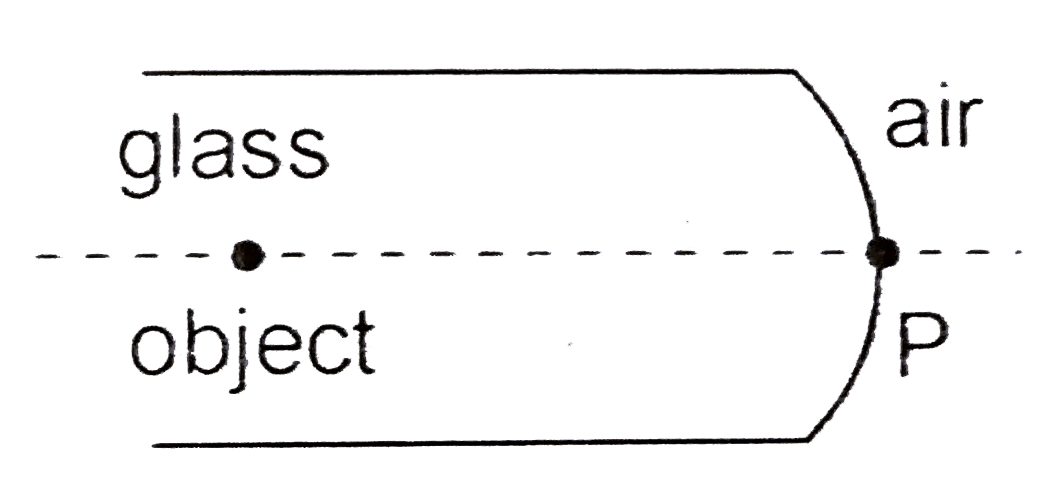
Radius of curvature of a concave spherical surface separating air-glass medium is R. A point object is placed on the principal axis in the glass `(m_(g) = 1.5)`. For the image to be real seen by

observer in air, distance of the object from P should be

Promotional Banner

Similar Questions

Explore conceptually related problems

Refraction takes place at a convex spherical boundary separating air-glass medium. For the image to be real, the object distance (mu_(g) = 3//2) Note Object lying in the glass.

Refraction takes place at a convex spherical boundary separating air-glass medium. For the image to be real, the object distance (mu_(g) = 3//2) Note Object lying in the glass.

If the object is placed on the principal axis at a distance of 10 cm in front of a concave mirror with curvature is 8 cm, what is the distance of the image ?

Refraction takes place at a convex spherical boundary separating glass-air medium. For the image to be real, the object distance (mu_(g)=3//2) should be // is

Show that for refraction at a concave spherical surface (separating glass-air medium), the distance of the object should be greater than three times the radius of curvature of the refracting surface for the image to be real.

Show that for refraction at a concave spherical surface (separating glass-air medium), the distance of the object should be greater than three times the radius of curvature of the refracting surface for the image to be real.

Refraction takes place at a concave spherical boundary separating glass air medium. For the image to be real, the object distance (mu_(g)=3//2)

A convex spherical refracting surfaces separates two media glass and air (mu_g=1.5). If the image is to be real, at what minimum distance u should the object be placed in air if R is the radius of curvature

A convex spherical refracting surfaces separates two media glass and air (mu_g=1.5). If the image is to be real, at what minimum distance u should the object be placed in air if R is the radius of curvature