

Home
Class 11
PHYSICS
A uniform wood door has mass m, height h...

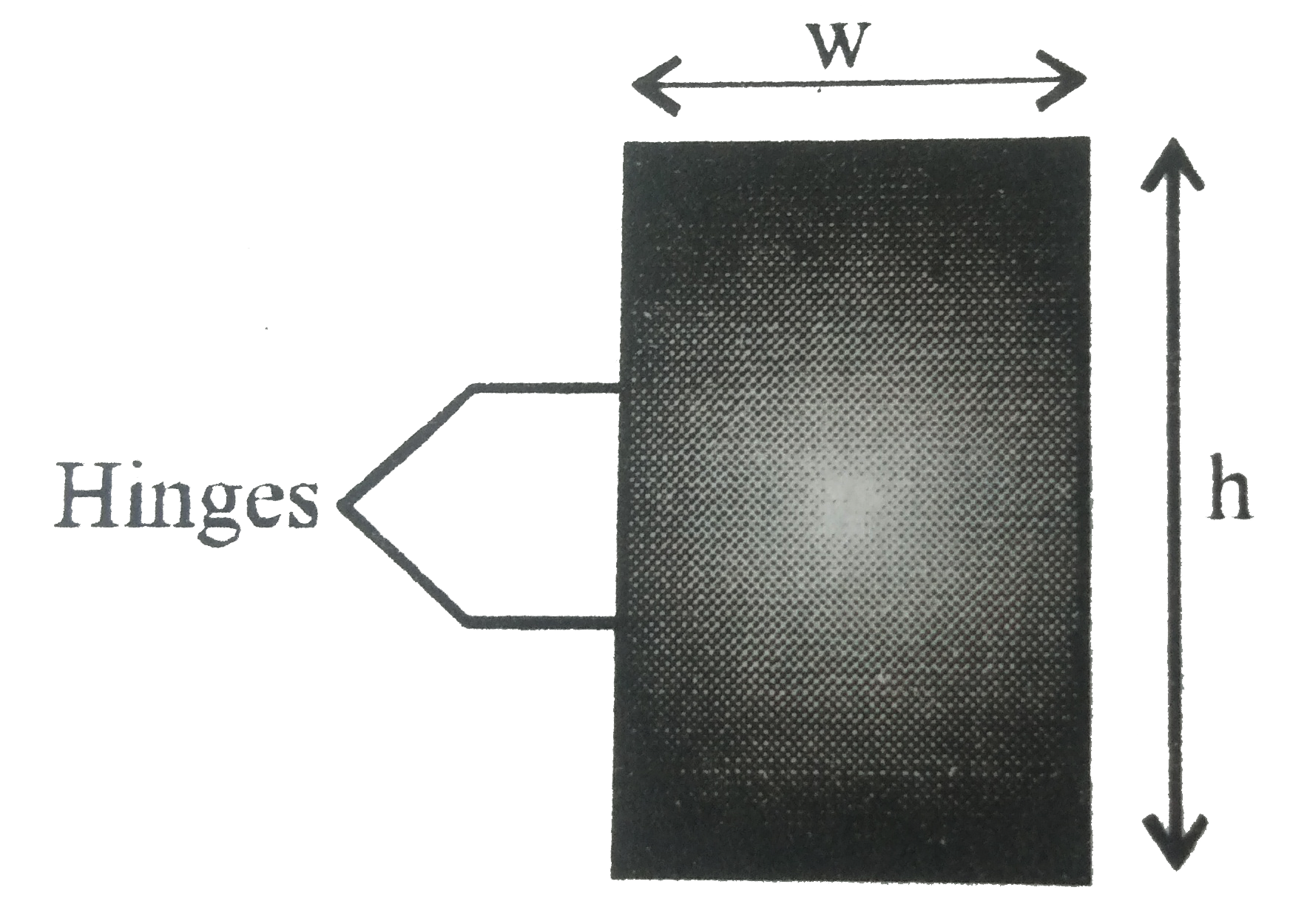
A uniform wood door has mass `m`, height `h`, and width `w`. It is hanging from two hinges attached to one side , the hinges are located `h//3` and `2h//3` form the bottom of the door. Suppose that `m= 20 kg, h = 2.20 m`, and the bottom smooth hinge is not screwed into the door frame. Find the forces acting on the door.
.

Promotional Banner

Similar Questions

Explore conceptually related problems

As shown in figure, the hinges A and B hold a uniform 400N door in place. The upper hinge supports the entire weight of the door. Find the resultant force exerted on the door at the hinges, the width of the door is h/2 , where h is the distance between the hinges.

The figure shows the top view of a door that is 2 m wide. Two forces are applied to the door as indicated. What is the magnitude of the net torque on the door with respect to the hinge?

An object of mass m is released from rest from the top of a smooth inclined plane of height h. Its speed at the bottom of the plane is proportional to

An object of mass m is released from rest from the top of a smooth inclined plane of height h. Its speed at the bottom of the plane is proportional to

A uniform rod of mass M = 2 kg and length L is suspended by two smooth hinges 1 and 2 as shown in Fig. A force F = 4 N is applied downward at a distance L//4 from hinge 2 . Due to the application of force F , hinge 2 breaks. At this instant, applied force F is also removed. The rod starts to rotate downward about hinge 1 . ( g = 10 m//s^(2) ) The reaction at hinge 1 , just after breaking of hinge 2 , is

A uniform rod of mass M = 2 kg and length L is suspended by two smooth hinges 1 and 2 as shown in Fig. A force F = 4 N is applied downward at a distance L//4 from hinge 2 . Due to the application of force F , hinge 2 breaks. At this instant, applied force F is also removed. The rod starts to rotate downward about hinge 1 . ( g = 10 m//s^(2) ) The reaction at hinge 1 , before hinge 2 breaks, is

A uniform rod of mass M = 2 kg and length L is suspended by two smooth hinges 1 and 2 as shown in Fig. A force F = 4 N is applied downward at a distance L//4 from hinge 2 . Due to the application of force F , hinge 2 breaks. At this instant, applied force F is also removed. The rod starts to rotate downward about hinge 1 . ( g = 10 m//s^(2) ) The reaction at hinge 1 , before hinge 2 breaks, is