

Home
Class 12
PHYSICS
A point particle of mass M is attached t...

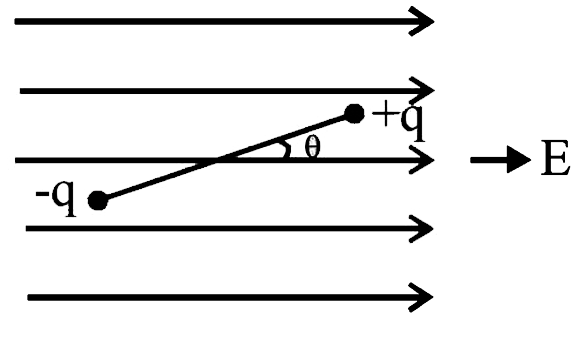
A point particle of mass M is attached to one end of a massless rigid non-conducting rod of length L. Another point particle of the same mass is attached to the other end of the rod. The two particles carry charges `+q` and `-q` respectively. This arrangement is held in a region of a uniform electric field E such that the rod makes a small angle `theta` (say of about 5 degree) with the field direction, fig. Find an expression for the minimum time needed for the rod to become parrallel to the field after it is set free.

Promotional Banner

Similar Questions

Explore conceptually related problems

A point mass M is attached to one end of a masslesa rigid non-conducting rod of length L. Another equal point mass is attached to the other end of the rod. The two particles carry charges +q and -q respectively. This arrangement is held I the region of uniform electric field E such that the rod makes a small theta (say about 5^(@) ) with field direction. Moment of inertia of the rod is I. Now answer the question The ratio (theta)/(alpha) is

A point mass M is attached to one end of a masslesa rigid non-conducting rod of length L. Another equal point mass is attached to the other end of the rod. The two particles carry charges +q and -q respectively. This arrangement is held I the region of uniform electric field E such that the rod makes a small theta (say about 5^(@) ) with field direction. Moment of inertia of the rod is I. Now answer the question Time period of SHM of the given system is

Two charged particles each of mass 9.8 g and charges + 20 mu C and -20 mu C are attached to the two ends of a massless and rigid uniform non-conducting rod of length 50 cm. This arrangement is held in a uniform electric field of 12.1 NC^(-1) such that the rod makes a very small angle with the field direction. If the rod is set free the minimum time needed for the rod to become parallel to the direction of the electric field is ............ seconds.

A particle of mass m is fixed to one end of a light rigid rod of length l and rotated in a vertical ciorcular path about its other end. The minimum speed of the particle at its highest point must be

A particle of mass m is fixed to one end of a light rigid rod of length l and rotated in a vertical ciorcular path about its other end. The minimum speed of the particle at its highest point must be