

Home
Class 11
PHYSICS
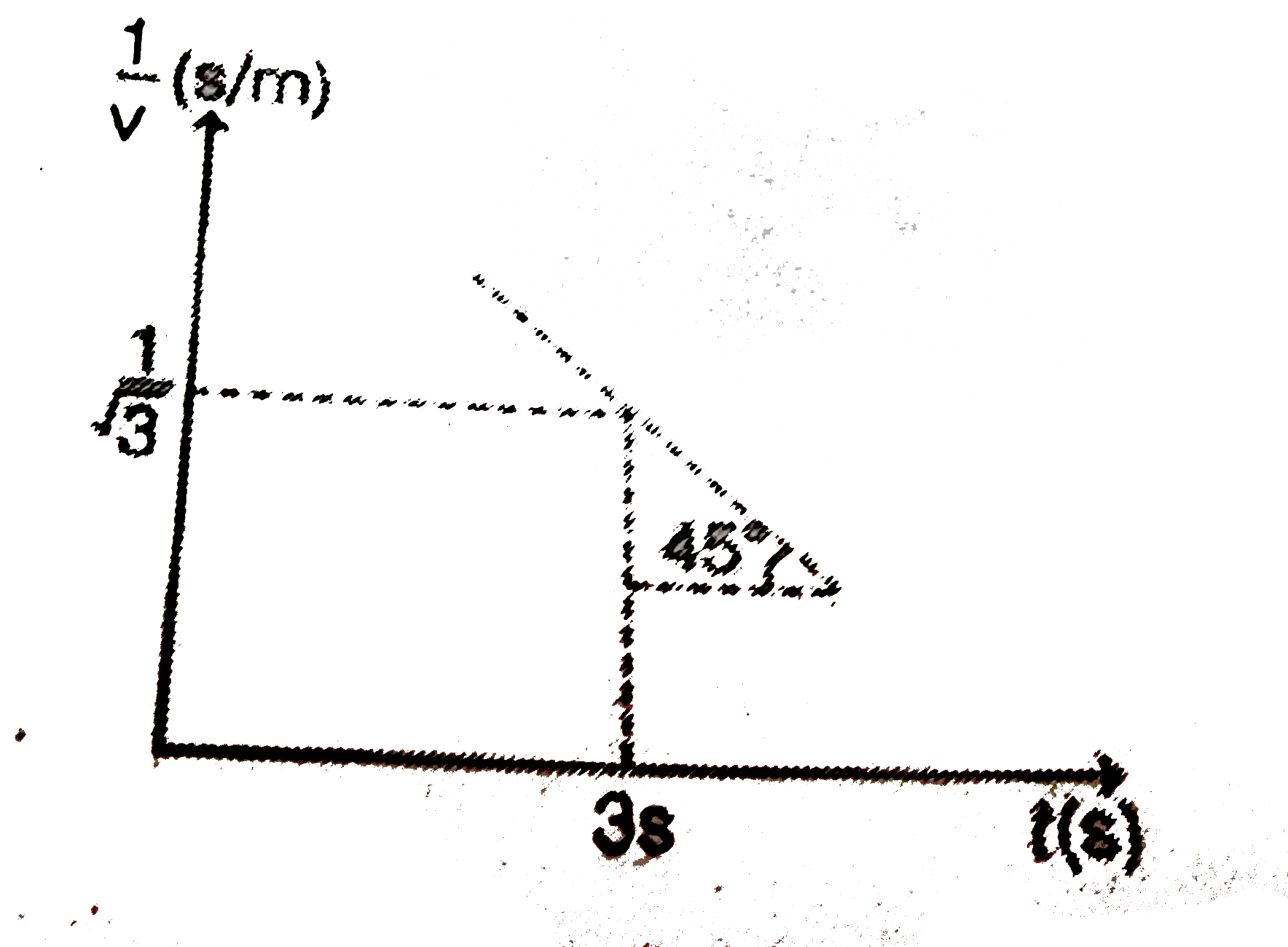
The diagram shows the variatioin of 1//v...

The diagram shows the variatioin of `1//v` (where `v` is velocity of the particle) with respect to time. At time `t=3s` using the details given in the graph, find the instantaneous acceleration (in `m//s^(2)`)

Promotional Banner

Similar Questions

Explore conceptually related problems

The diagram shows variation of (1)/(v) with respect to time (where v is in m/s). What is the instantaneous acceleration of body at t=3 sec. (in (m)/(s^(2)) ).

The velocity of a particle is given by the equation, v = 2t^(2) + 5 cms^(-1) . Find the instantaneous acceleration at t_(2) = 4s

The velocity of a particle is given by v=(2t^(2)-3t+10)ms^(-1) . Find the instantaneous acceleration at t = 5 s.

The velocity of a particle is given by v=(2t^(2)-3t+10)ms^(-1) . Find the instantaneous acceleration at t = 5 s.

The displacement s of a particle at time t is given by s = t^3 -4 t^2 -5t. Find the velocity and acceleration at t=2 sec

Following are three equations of motion S(g)=ut+(1)/(2)at^(2) v(s)=sqrt(u^(2)+2as) v(t)=u+at Where ,S,u,t,a,v are respectively the displacement ( dependent variable ) , initial ( constant ) , time taken ( independent variable ) , acceleration ( constant ) and final velocity ( dependent variable ) of the particel after time t . Find the displacement of the particle when its velocity becomes 10m//s if acceleration is 5m//s^(2) all through -

Following are three equations of motion S(g)=ut+(1)/(2)at^(2) v(s)=sqrt(u^(2)+2as) v(t)=u+at Where ,S,u,t,a,v are respectively the displacement ( dependent variable ) , initial ( constant ) , time taken ( independent variable ) , acceleration ( constant ) and final velocity ( dependent variable ) of the particel after time t . Find the displacement of the particle when its velocity becomes 10m//s if acceleration is 5m//s^(2) all through -

If velocity of a particle is given by v=2t^(2)-2 then find the acceleration of particle at t = 2 s.