

Home
Class 11
PHYSICS
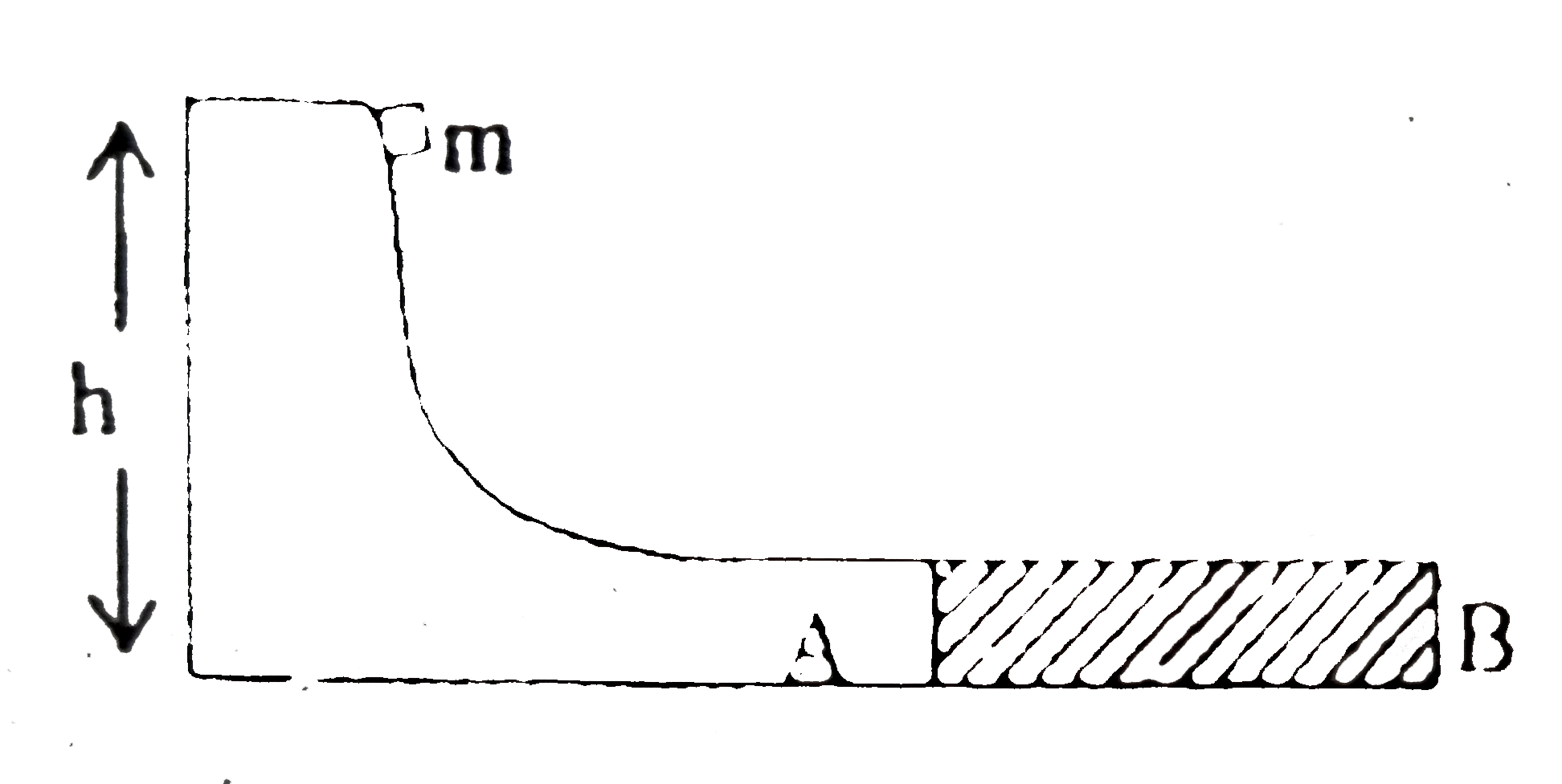
A particle of mass m is released from he...

A particle of mass `m` is released from height `h` on smooth quarter circular fixed wedge. The horizontal surface `AB` following the circular path at bottom of wedge is rough with coefficient of friction `mu` between surface and `m`. Find the distance from bottom of wedge where the mass will stop.

Promotional Banner

Similar Questions

Explore conceptually related problems

A block of mass m is released from the top of a wedge of mass M as shown in figure. Find the displacement of wedges on the horizontal ground when the block reaches the bottom of the wedges. Neglect friction everywhere.

A block of mass m is released from the top of a wedge of mass M as shown in figure. Find the displacement of wedges on the horizontal ground when the block reaches the bottom of the wedges. Neglect friction everywhere.

A block of mass m slides over a smooth wedge of mass M which is placed over a rough horizontal surface . The centre of mass of the system will move towards left Here mu = coefficient of friction between the wedge and the ground .

A block of mass m slides over a smooth wedge of mass M which is placed over a rough horizontal surface . The centre of mass of the system will move towards left Here mu = coefficient of friction between the wedge and the ground .

A wedge B of mass 2 m is placed on a rough horizontal suface. The coefficient of friction between wedge and the horizontal surface is mu_(1) . A block of mass m is placed on wedge as shown in the figure. The coefficient of friction between block and wedge is mu_(2) . The block and wedge are released from rest. Q. Suppose the inclined surface of the wedge is at theta=37^(@) from angle from horizontal and mu_(2)=0 are wedge will remain in equilibrium if

A wedge B of mass 2 m is placed on a rough horizontal suface. The coefficient of friction between wedge and the horizontal surface is mu_(1) . A block of mass m is placed on wedge as shown in the figure. The coefficient of friction between block and wedge is mu_(2) . The block and wedge are released from rest. Q. Suppose the inclined surface of the wedge is at theta=37^(@) from angle from horizontal and mu_(2)=0 are wedge will remain in equilibrium if

A wedge B of mass 2 m is placed on a rough horizontal suface. The coefficient of friction between wedge and the horizontal surface is mu_(1) . A block of mass m is placed on wedge as shown in the figure. The coefficient of friction between block and wedge is mu_(2) . The block and wedge are released from rest. Q. Suppose the inclined surface of the wedge is at theta=37^(@) angle from horizontal and mu_(2)=0.9 then the wedge:

For the figure shown, block of mass m is released from the rest. Find the distance of the wedge from initial position, when block m arrives at the bottom of the wedge. All surfaces are frictionless.

A block of mass m is placed at rest on a smooth wedge of mass M placed at rest on a smooth horizontal surface. As the system is released

A block of mass m is placed at rest on a smooth wedge of mass M placed at rest on a smooth horizontal surface. As the system is released