

Home
Class 12
PHYSICS
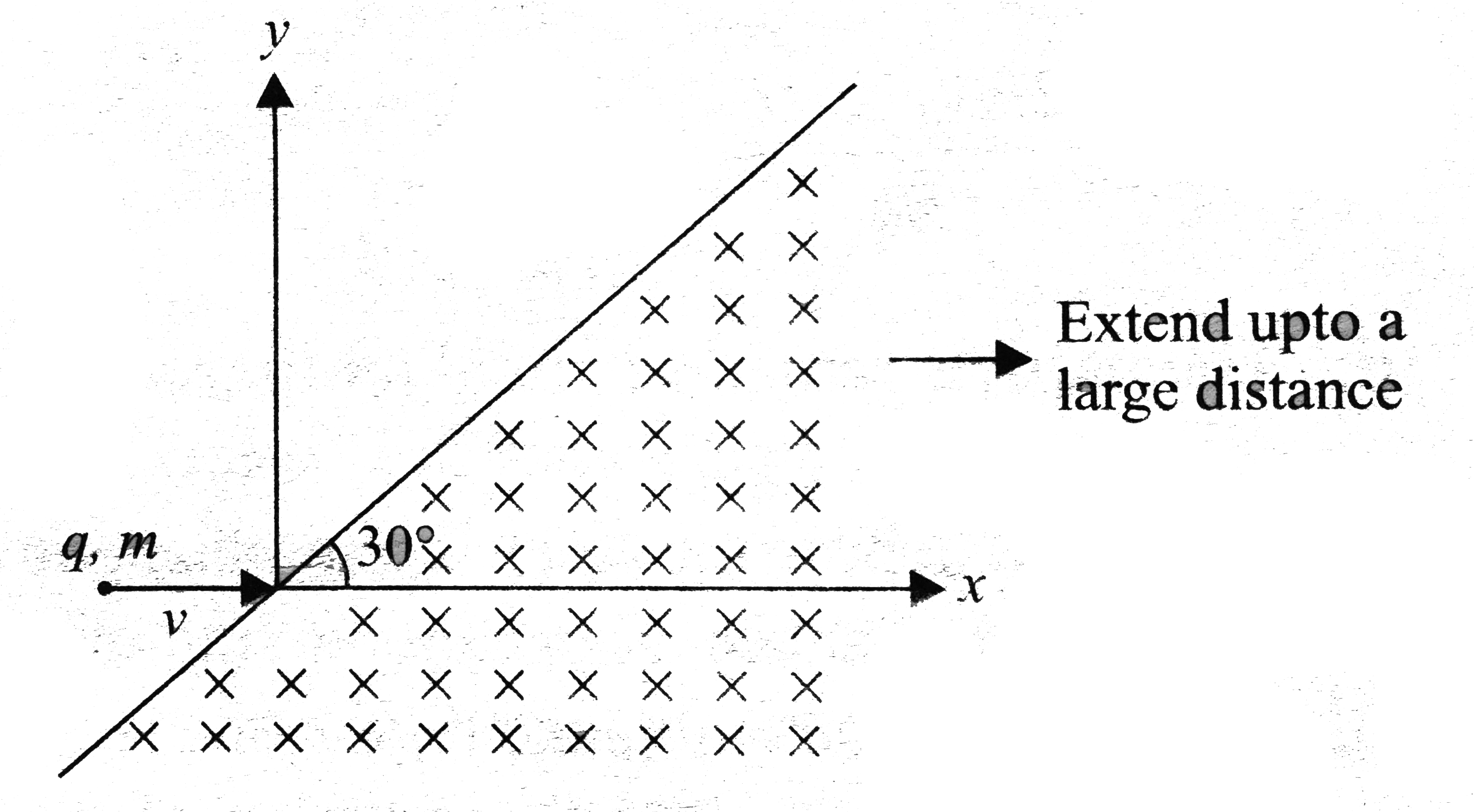
A charge particle of charge q and mass m...

A charge particle of charge q and mass m is moving with velocity v as shown in fig In a uniform magnetic field B along -ve z-direction.Select the correct alternative (s).

Promotional Banner

Similar Questions

Explore conceptually related problems

A particle of charge q and mass m moving with a velocity v along the x-axis enters the region xgt0 with uniform magnetic field B along the hatk direction. The particle will penetrate in this region in the x -direction upto a distance d equal to

A particle of charge q and mass m moving with a velocity v along the x-axis enters the region xgt0 with uniform magnetic field B along the hatk direction. The particle will penetrate in this region in the x -direction upto a distance d equal to

A charged particle (charge q, mass m) has velocity v_(0) at origin in +x direction. In space there is a uniform magnetic field B in -z direction. Find the y coordinate of particle when is crosses y axis.

A charged particle (charge q, mass m) has velocity v_(0) at origin in +x direction. In space there is a uniform magnetic field B in -z direction. Find the y coordinate of particle when is crosses y axis.

A charged particle of charge Q and mass m moves with velocity v in a circular path due to transverse magnetic field, B, then its frequency is

A positive charge particle of charge q and mass m enters into a uniform magnetic field with velocity v as shown in Fig. There is no magnetic field to the left of PQ. Find (a) time spent, (b) distance travelled in the magnetic field, (c) impulse of magnetic force.

A positive charge particle of charge q and mass m enters into a uniform magnetic field with velocity v as shown in Fig. There is no magnetic field to the left of PQ. Find (a) time spent, (b) distance travelled in the magnetic field, (c) impulse of magnetic force.

A positive charge particle of charge q and mass m enters into a uniform magnetic field with velocity v as shown in Fig. There is no magnetic field to the left of PQ. Find (a) time spent, (b) distance travelled in the magnetic field, (c) impulse of magnetic force.

A charge q of mass m moving with velocity v, at right angles to a uniform magnetic field B. Deduce the expression for the radius of the circular path it describes.