

Home
Class 11
PHYSICS
A uniform quarter circular thin rod of m...

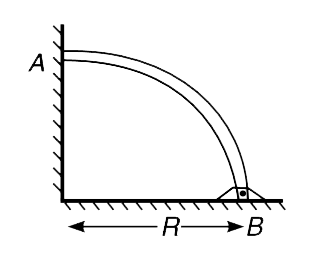
A uniform quarter circular thin rod of mass M and radius R is pivoted at a point B on the floor. It can rotate freely in the vertical plane about B. It is supported by a smooth vertical wall at its other free end A so that it remains at rest. Find the reaction force of wall on the rod.

Promotional Banner

Similar Questions

Explore conceptually related problems

A homogenous rod XY of length L and mass 'M' is pivoted at the centre 'C' such that it can rotate freely in vertical plane. Initially the rod is in the horizontal position.

A rod of length I leans by its upper end against a smooth vertical wall, while its other end leans against the floor. The end that leans against the wall moves uniformly downward. Then:

A rod of length I leans by its upper end against a smooth vertical wall, while its other end leans against the floor. The end that leans against the wall moves uniformly downward. Then:

A slender uniform rod of mass M and length l is pivoted at one end so that it can rotate in a vertical plane, Fig. There is negligible friction at the pivot. The free end is held vertically above the pivot and then released. The angular acceleration of the rod when it makes an angle theta with the vertical is

A slender uniform rod of mass M and length l is pivoted at one ens so that it can rotate in a vertical plane, Fig. There is negligible friction at the pivot. The free end is held vertically above the pivot and then released. The angular acceleration of the rod when it makes an angle theta with the vertical is

A uniform rod of mass M and length L is hinged at its lower end on a table. The rod can rotate freely in vertical plane and there is no friction at the hinge. A ball of mass M and radius R = (L)/(3) is placed in contact with the vertical rod and a horizontal force F is applied at the upper end of the rod. (a) Find the acceleration of the ball immediately after the force starts acting. (b) Find the horizontal component of hinge force acting on the rod immediately after force F starts acting.

A thin rod of mass M and length a is free to rotate in horizontal plane about a fixed vertical axis passing through point O. A thin circular disc of mass M and of radius a/4 is pivoted on this rod with its center at a distance a/4 from the free end so that it can rotate freely about its vertical axis. Assume that both rod and disc have uniform density and they remain horizontal during motion. An outside stationary observer finds the rod rotating with an angular velocity Omega and the disc rotating about its vertical axis with angular velocity 4 Omega . Total angular momentum of system about point O is ((M a^2 Omega)/(48)) n . The value of n is

A light rigid rod of mass M, and length L is pivoted at one of its end. The rod can swing freely in the vertical plane through a horizontal axis passing through the pivot. Show that the time period of the rod about the pivot is T = pi sqrt((2L)/(3g))

A slender uniform rod of mass M and length l is pivoted one end so that it can rotate in a vertical plane (see figure). There is negligible friction at the pivot. The free end is held vertically above the pivot and then released. The angular acceleration of the rod when it makes an angle theta with the vertical is