

Home
Class 11
PHYSICS
A unifrom rod is fixed at one end to a r...

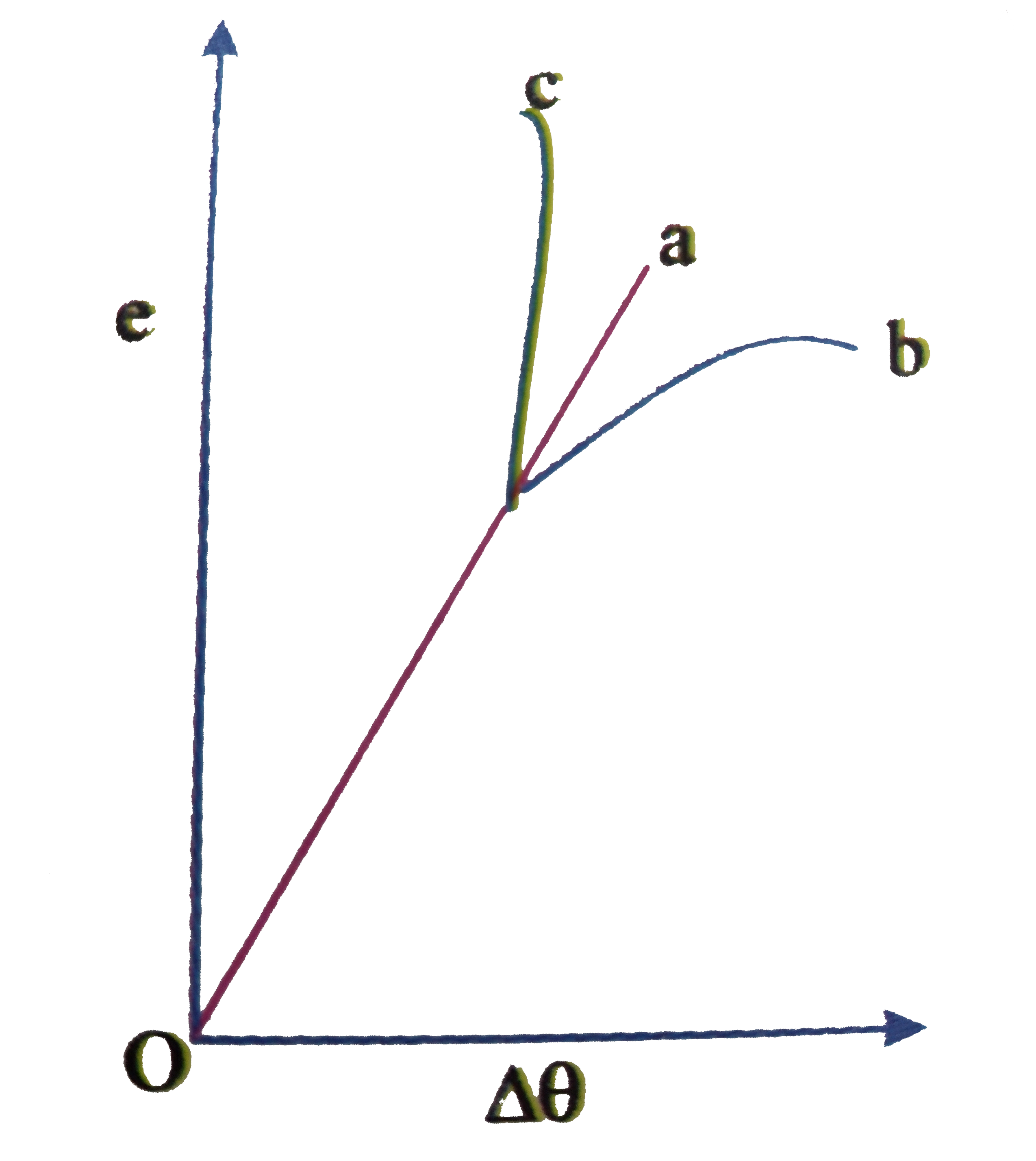
A unifrom rod is fixed at one end to a rigid support, its temperture is gradually increased the representaion of graph strain `(e)` versus increment in temperature `Delta theta` is

Promotional Banner

Similar Questions

Explore conceptually related problems

A uniform rod is fixed at one end to a rigid support, its temperature is gradually increased the representation of graph strain (e) versus increment in temperature Delta theta is

What will happen of a rod is tied with fixed supports rigidly at both ends and temperature is increased ?

A 1 m long metal wire of cross sectional area 10^(-6)m^(2) is fixed at one end from a rigid support and a weight W is hanging at its other end. The graph shows the observed extension of length Deltal of the wire as a function of W. young’s modulus of material of the wire in SI units is :

A rod of aluminium is fixed between two rigid support. If the temperature of rod is increased by 10°C , then the thermal stress on the rod is (Take Y= 7×10^10 Pa and alpha =2.4* 10^-5 K^-1 )

A rod of aluminium is fixed between two rigid support. If the temperature of rod is increased by 10°C , then the thermal stress on the rod is (Take Y= 7×10^10 Pa and alpha =2.4* 10^-5 K^-1 )

A steel rod is clamped at its two ends and rests on a fixed horizontal base. The rod is unstrained at 20^@C . Find the longitudinal strain developed in the rod if the temperature rises to 50^@C . Coefficient of linear expansion of steel =1.2 xx 10^(-5)C^(-1) .

A steel rod is clamped at its two ends and rests on a fixes horizontal base. The rod is unstrained at 20^@C . Find the longitudinal strain developed in the rod if the temperature rises to 50^@C . Coefficient of linear expansion of steel =1.2 xx 10^(-5 @)C^(-1) .

A steel rod is clamped at its two ends and rests on a fixes horizontal base. The rod is unstrained at 20^@C . Find the longitudinal strain developed in the rod if the temperature rises to 50^@C . Coefficient of linear expansion of steel =1.2 xx 10^(-5 @)C^(-1) .