

Home
Class 11
PHYSICS
A ball of mass m = 1 kg is hung vertical...

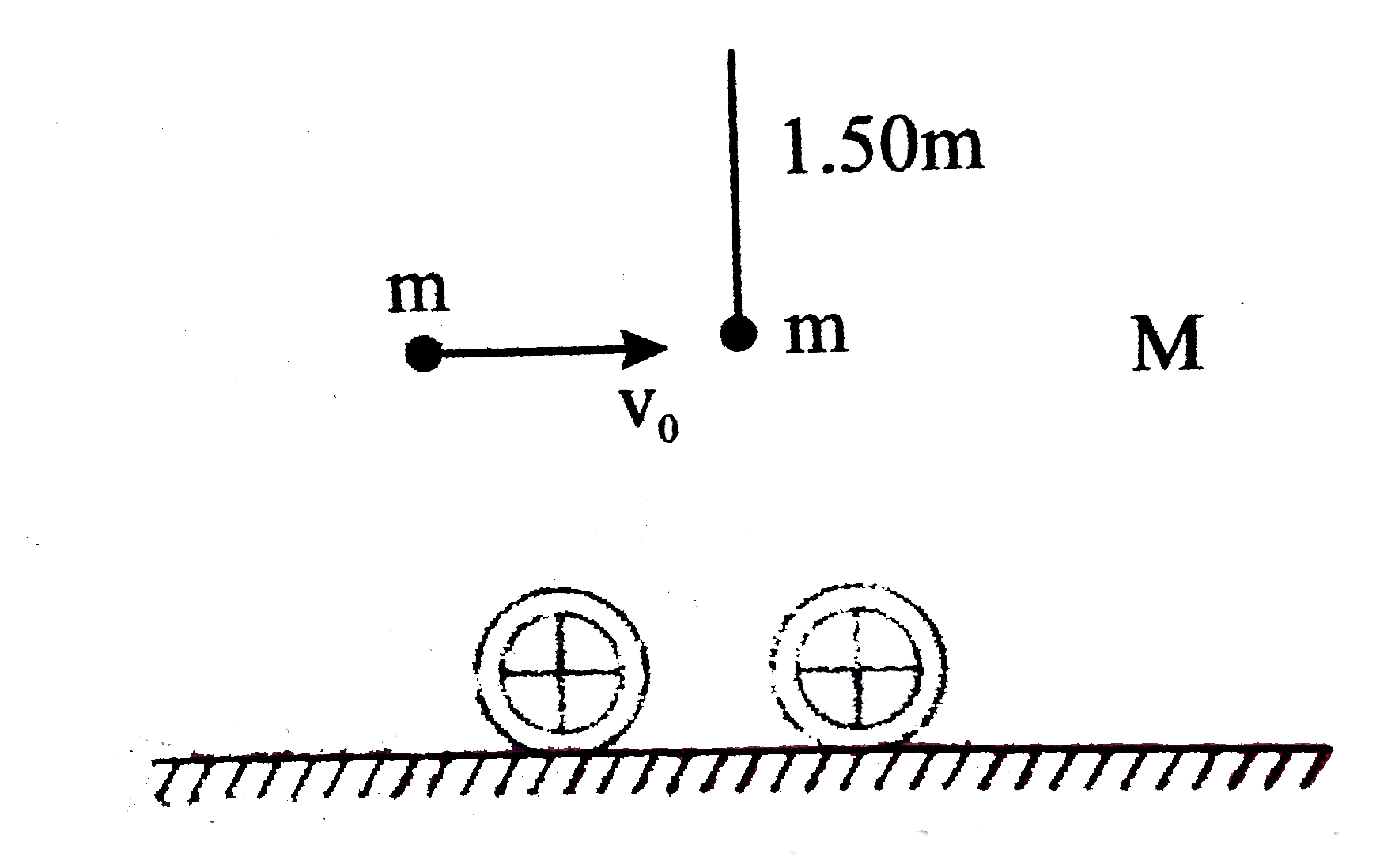
A ball of mass `m = 1 kg` is hung vertically by a thread of length `1=1.50 m`. Upper end of the thread is attached to the ceiling of a trolley of mass `M = 4kg`. Initially, the trolley is stationary and it is free to move along horizontal rails with out friction. A shell of mass `m=1 kg`, moving horizontally with velocity `v_(0) = 6m//s` collides with thread starts to deflect towards right

At the time a maximum deflection of the thread with vertical, the trolley will move with velocity

Promotional Banner

Similar Questions

Explore conceptually related problems

A ball of mass m = 1 kg is hung vertically by a thread of length 1=1.50 m . Upper end of the thread is attached to the ceiling of a trolley of mass M = 4kg . Initially, the trolley is stationary and it is free to move along horizontal rails with out friction. A shell of mass m=1 kg , moving horizontally with velocity v_(0) = 6m//s collides with thread starts to deflect towards right The maximum deflection of the thread with the vertical is

A ball of mass m = 1 kg is hung vertically by a thread of length 1=1.50 m . Upper end of the thread is attached to the ceiling of a trolley of mass M = 4kg . Initially, the trolley is stationary and it is free to move along horizontal rails with out friction. A shell of mass m=1 kg , moving horizontally with velocity v_(0) = 6m//s collides with thread starts to deflect towards right The velocity of the combined body just after collision is

A ball of mass in m= 1 kg is hung vertically by a thread of length l = 1.50 m . Upper end of the thread is attached to the ceiling of a trolley of mass M= 4 kg . Initially, the trolley is stationary and it is free to move along horizontal rails without friction. A shell of mass m=1 kg , moving horizontally with velocity v_(0 )= 6 m//s collides with the ball and gets stuck with it. As a result, the thread starts to deflect towards right. At the time of maximum deflection of the thread with vertical, the trolley will move with velocity

A ball of mass in m= 1 kg is hung vertically by a thread of length l = 1.50 m . Upper end of the thread is attached to the ceiling of a trolley of mass M= 4 kg . Initially, the trolley is stationary and it is free to move along horizontal rails without friction. A shell of mass m=1 kg , moving horizontally with velocity v_(0 )= 6 m//s collides with the ball and gets stuck with it. As a result, the thread starts to deflect towards right. At the time of maximum deflection of the thread with vertical, the trolley will move with velocity

A ball of mass in m= 1 kg is hung vertically by a thread of length l = 1.50 m . Upper end of the thread is attached to the ceiling of a trolley of mass M= 4 kg . Initially, the trolley is stationary and it is free to move along horizontal rails without friction. A shell of mass m=1 kg , moving horizontally with velocity v_(0 )= 6 m//s collides with the ball and gets stuck with it. As a result, the thread starts to deflect towards right. At the time of maximum deflection of the thread with vertical, the trolley will move with velocity

A ball of mass in m= 1 kg is hung vertically by a thread of length l = 1.50 m . Upper end of the thread is attached to the ceiling of a trolley of mass M= 4 kg . Initially, the trolley is stationary and it is free to move along horizontal rails without friction. A shell of mass m=1 kg , moving horizontally with velocity v_(0) = 6 m//s collides with the ball and gets stuck with it. As a result, the thread starts to deflect towards right. The maximum deflection of the thread with the vertical is

A ball of mass in m= 1 kg is hung vertically by a thread of length l = 1.50 m . Upper end of the thread is attached to the ceiling of a trolley of mass M= 4 kg . Initially, the trolley is stationary and it is free to move along horizontal rails without friction. A shell of mass m=1 kg, moving horizontally with velocity v_(0) = 6 m//s collides with the ball and gets stuck with it. As a result, the thread starts to deflect towards right. The velocity of the combined body just after collision is

A ball of mass in m= 1 kg is hung vertically by a thread of length l = 1.50 m . Upper end of the thread is attached to the ceiling of a trolley of mass M= 4 kg . Initially, the trolley is stationary and it is free to move along horizontal rails without friction. A shell of mass m=1 kg, moving horizontally with velocity v_(0) = 6 m//s collides with the ball and gets stuck with it. As a result, the thread starts to deflect towards right. The velocity of the combined body just after collision is

A shell of mass 1kg is projected with velocity 20m//s at an angle 60^@ with horizontal. It collides inelastically with a ball of mass 1kg which is suspended through a thread of length 1m . The other end of the thread is attached to the ceiling of a trolley of mass 4/3kg as shown in figure. Initially the trolley is stationary and it is free to move along horizontal rails wihtout any friction. What is the maximum deflection of the thread with vertical? String does not slack. Take g=10m//s^2 .

A shell of mass 1kg is projected with velocity 20m//s at an angle 60^@ with horizontal. It collides inelastically with a ball of mass 1kg which is suspended through a thread of length 1m . The other end of the thread is attached to the ceiling of a trolley of mass 4/3kg as shown in figure. Initially the trolley is stationary and it is free to move along horizontal rails wihtout any friction. What is the maximum deflection of the thread with vertical? String does not slack. Take g=10m//s^2 .