

Home
Class 12
PHYSICS
Two particles A and B of masses mA and m...

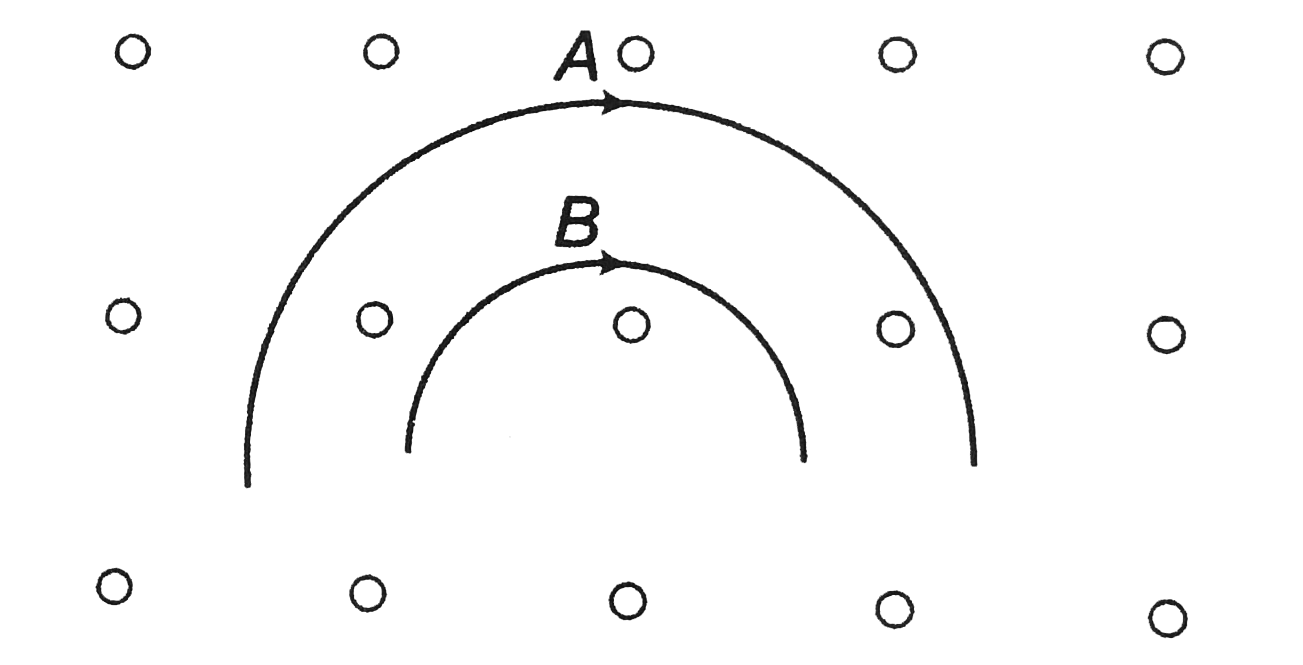
Two particles `A` and `B` of masses `m_A` and `m_B` respectively and having the same charge are moving ina plane. A uniform magnetic field exists perependicular to this plane. The speeds of the particles are `v_A` and `v_B` respectively and the trajectories are as shown in the figure. Then,

Promotional Banner

Similar Questions

Explore conceptually related problems

Two particles A and B of masses m_A and m_B respectively and having the same charge are moving in a plane. A uniform magnetic field exists perpendicular to this plane. The speeds of the particles are v_A and v_B respectively and the trajectories are as shown in figure , then

Two particles A and B of mass m_(A) and m_(B) respectively and having the same charge are moving in a plane. A uniform magnetic field exists perpendicular to this plane. The speeds of the particles are v_(A) and v_(B) respectively, and the trajectories are as shown in the figure. Then

Two particle A and B of masses m_(A) and m_(B) respectively and having the same charge are moving in a plane. A uniform magnetic field exists perpendicular to this plane. The speeds of the particles are v_(A) and v_(B) respectively and the trajectories are as shown in the figure. Then-

Two particles A and B of masses m_(A)andm_(B) respectively and having the same charge are moving in a plane. A uniform magnetic field exists perpendicular to this plane. The speeds of the particles are v_(A)andv_(B) respectively and the trajectories are as shown in the figure. Then -

Two particles A and B of masses m_(A)andm_(B) respectively and having the same charge are moving in a plane. A uniform magnetic field exists perpendicular to this plane. The speeds of the particles are v_(A)andv_(B) respectively and the trajectories are as shown in the figure. Then -

Two particles A and B of masses m_(A) and m_(B) respectively and having the same charge are moving in a plane . The speeds of the particles are v_(A) and v_(B) respectively and the trajectories are as shown in the figure. Then

A charge particle is moving in a plane perpendicular to uniform magnetic field, then

A particle of mass m, charge e and velocity v moving in a magnetic field B perpendicular to the motion of particle. The radius of its path is:

In a region of space a uniform magnetic field perpendicular to the plane of the page and directed towards reader exists. A particle has a trajectory as shown in fig. The particle is-