

Home
Class 11
PHYSICS
Two identical uniform solid spherical ba...

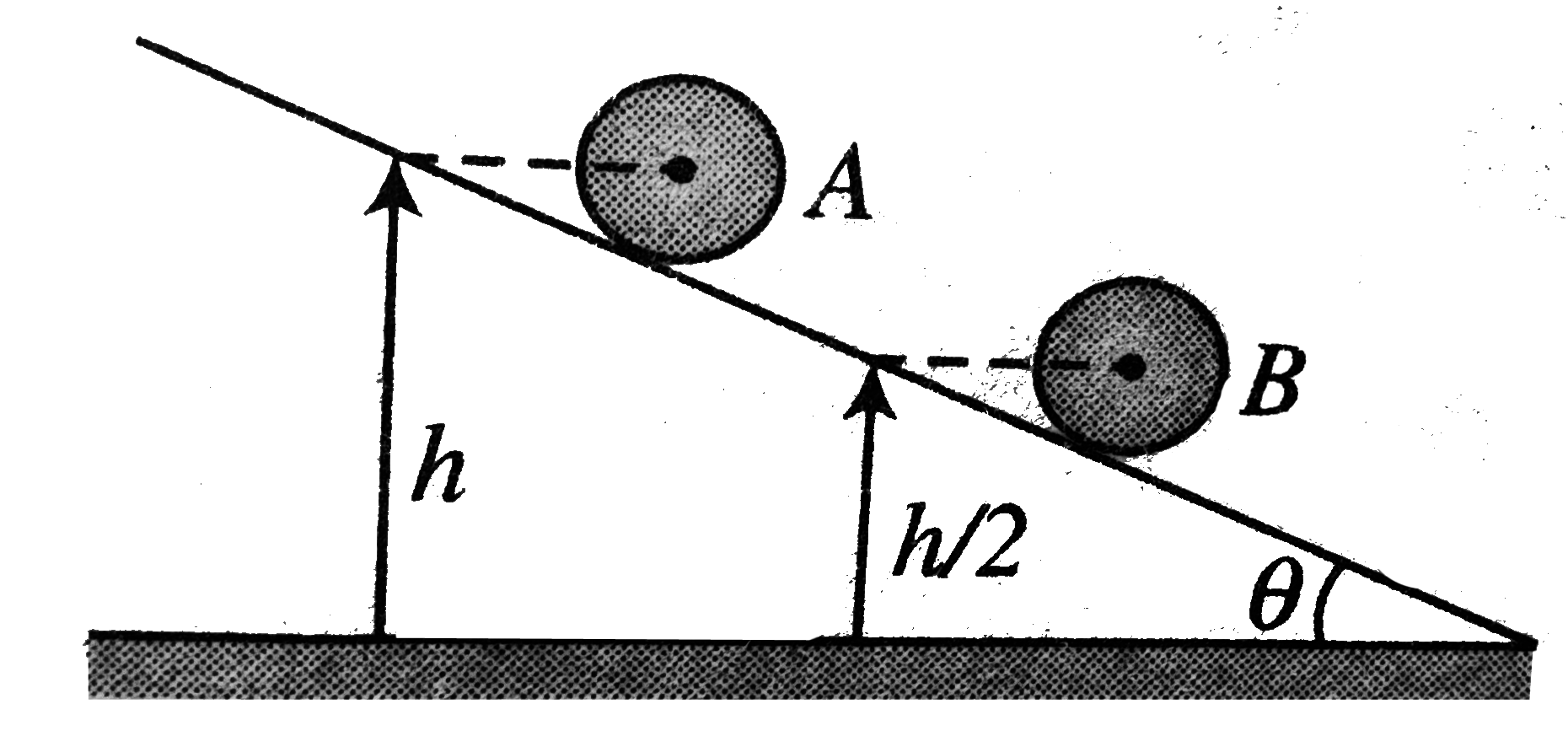
Two identical uniform solid spherical balls `A` and `B` of mass `m` each are placed on a the fixed wedge as shown in figure. Ball `B` is kept at rest and it is released just before two balls collides. Ball `A` rolls down without slipping on inclined plane and collide elastically with ball `B`. The kinetic energy of ball `A` just after the collision with ball `B` is:

Promotional Banner

Similar Questions

Explore conceptually related problems

A solid spherical ball is rolling without slipping down an inclined plane. The fraction of its total kinetic energy associated with rotation is

A solid spherical ball is rolling without slipping down an inclined plane. The fraction of its total kinetic energy associated with rotation is

A ball A of mass M collides elastically with a similar ball B at rest as shown in figure. Initially velocity of ball A is u m/s. After collision,

A ball A of mass M collides elastically with a similar ball B at rest as shown in figure. Initially velocity of ball A is u m/s. After collision,

A ball of mass m is released from A inside a smooth wedge of mass m as shown in figure. What is the speed of the wedge when the ball reaches point B?

A ball of mass m is released from A inside a smooth wedge of mass m as shown in figure. What is the speed of the wedge when the ball reaches point B?

A ball of mass m is released from A inside a smooth wedge of mass m as shown in figure. What is the speed of the wedge when the ball reaches point B?

A ball of mass m moving with velocity v collides head on elastically with another identical ball moving with velocity - V. After collision

A ball of mass m moving with velocity v collides head on elastically with another identical ball moving with velocity - V. After collision

Two smooth balls A and B , each of mass m and radius R , have their centres as shown in fig. Ball A , moving along positive x-axis, collides with ball B . Just before the collision, speed of ball 'A' is 4m//s and ball 'B' is stantionary. The collision Velocity of the ball 'A' just after the collision is