

Home
Class 11
PHYSICS
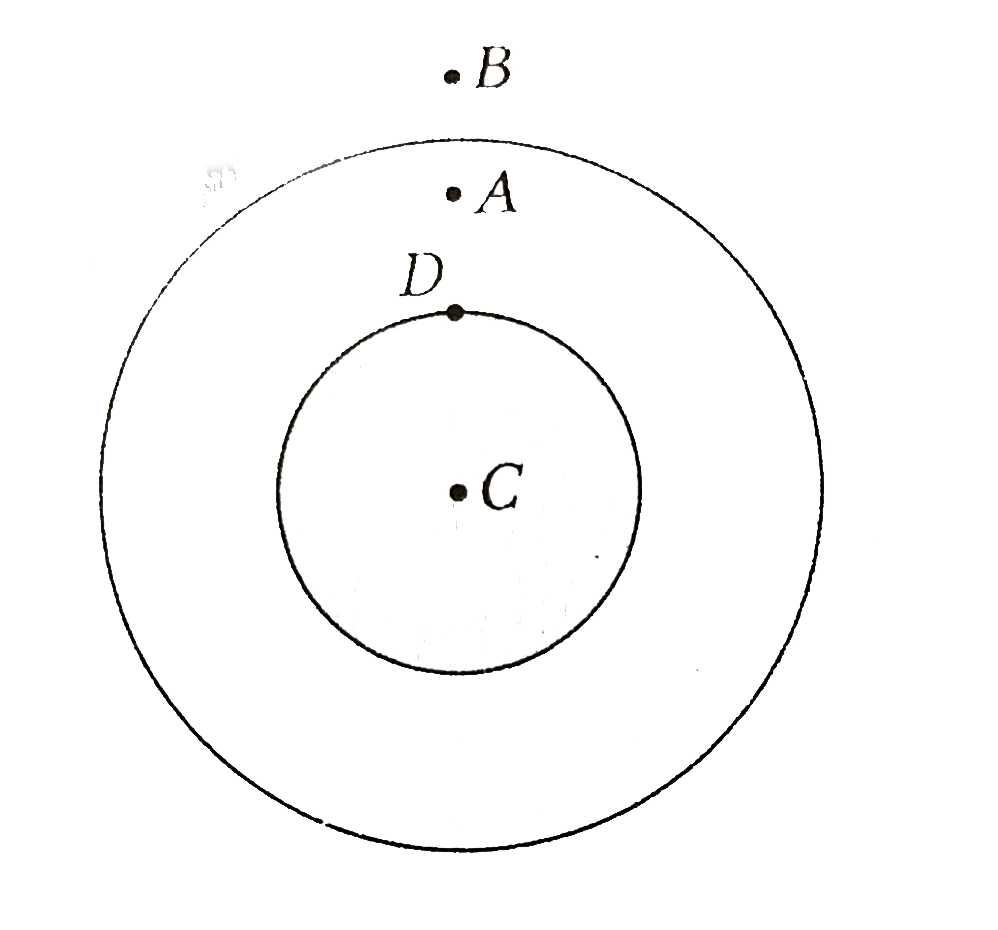
Two concentric spherical shells are as s...

Two concentric spherical shells are as shown in figure. Match the following columns

`{:(,"Column-I",,"Column-II"),("(A)","Potential at A","(p)","greater than B"),("(B)","Gravitational field at A","(q)","less than B"),("(C)","As one moves from C to D","(r)","Potential remains constant"),("(D)","As one moves from D to A","(s)","Gravitational field decreases"),(,,"(t)","None"):}`

Promotional Banner

Similar Questions

Explore conceptually related problems

Density of a planet is two times the density of earth. Radius of this planet is half. Match the following (as compared to earth) {:(,"Column-I",,"Column-II"),("(A)","Accleration due to gravity on this planet's surface","(p)","Half"),("(B)","Gravitational potential on the surface","(q)","Same"),("(C)","Gravitational potential at centre","(r)","Two times"),("(D)","Gravitational field strength at centre","(s)","Four times"):}

Density of a planet is two times the density of earth. Radius of this planet is half. Match the following (as compared to earth) {:(,"Column-I",,"Column-II"),("(A)","Accleration due to gravity on this planet's surface","(p)","Half"),("(B)","Gravitational potential on the surface","(q)","Same"),("(C)","Gravitational potential at centre","(r)","Two times"),("(D)","Gravitational field strength at centre","(s)","Four times"):}

Let V and E denote the gravitational potential and gravitational field at a point. Then, match the following columns {:(,"Column-I",,"Column-II"),("(A)",E = 0","V = 0,"(p)","At centre of spherical shell"),("(B)",E ne0","V=0,"(q)","At centre of solid sphere"),("(C)",V ne0","E=0,"(r)","At centre of circular ring"),("(D)",V ne0","E ne0,"(s)","At cetre of two point masses of equal magnitude"),(,,"(t)","None"):}

Let V and E denote the gravitational potential and gravitational field at a point. Then, match the following columns {:(,"Column-I",,"Column-II"),("(A)",E = 0","V = 0,"(p)","At centre of spherical shell"),("(B)",E ne0","V=0,"(q)","At centre of solid sphere"),("(C)",V ne0","E=0,"(r)","At centre of circular ring"),("(D)",V ne0","E ne0,"(s)","At cetre of two point masses of equal magnitude"),(,,"(t)","None"):}

Match the following : {:(,"Column-1",," Column-2"),("(A)","Electrostatic potential energy",,"(P) Positive"),("(B)","Gravitational potential energy",,"(Q) Negative"),("(C)","Elastic potential energy",,"(R) Zero"),("(D)","Magnetic potential energy",,"(S) Not defined"):}

{:(,"Column I",,"Column II"),((A),"Dimensional variable",(p),pi),((B),"Dimensionless variable",(q),"Force"),((C),"Dimensional constant",(r),"Angle"),((D),"Dimensionless constant",(s),"Gravitational constant"):}

{:(,"Column I",,"Column II"),((A),"Dimensional variable",(p),pi),((B),"Dimensionless variable",(q),"Force"),((C),"Dimensional constant",(r),"Angle"),((D),"Dimensionless constant",(s),"Gravitational constant"):}

{:(,"Column I",,"Column II"),((A),"Dimensional variable",(p),pi),((B),"Dimensionless variable",(q),"Force"),((C),"Dimensional constant",(r),"Angle"),((D),"Dimensionless constant",(s),"Gravitational constant"):}

Match the following columns and Choose the correct combination from the given option : {:("Column - I","Column - II"),("(A) Plantae","(p) Bacteria"),("(B) Fungi","(q) Euglenoids"),("(C) Protista","(r) Phycomycetes"),("(D) Monera","(s) Algae"):}