

Home
Class 12
PHYSICS
A circular disc D(1) of mass M and radi...

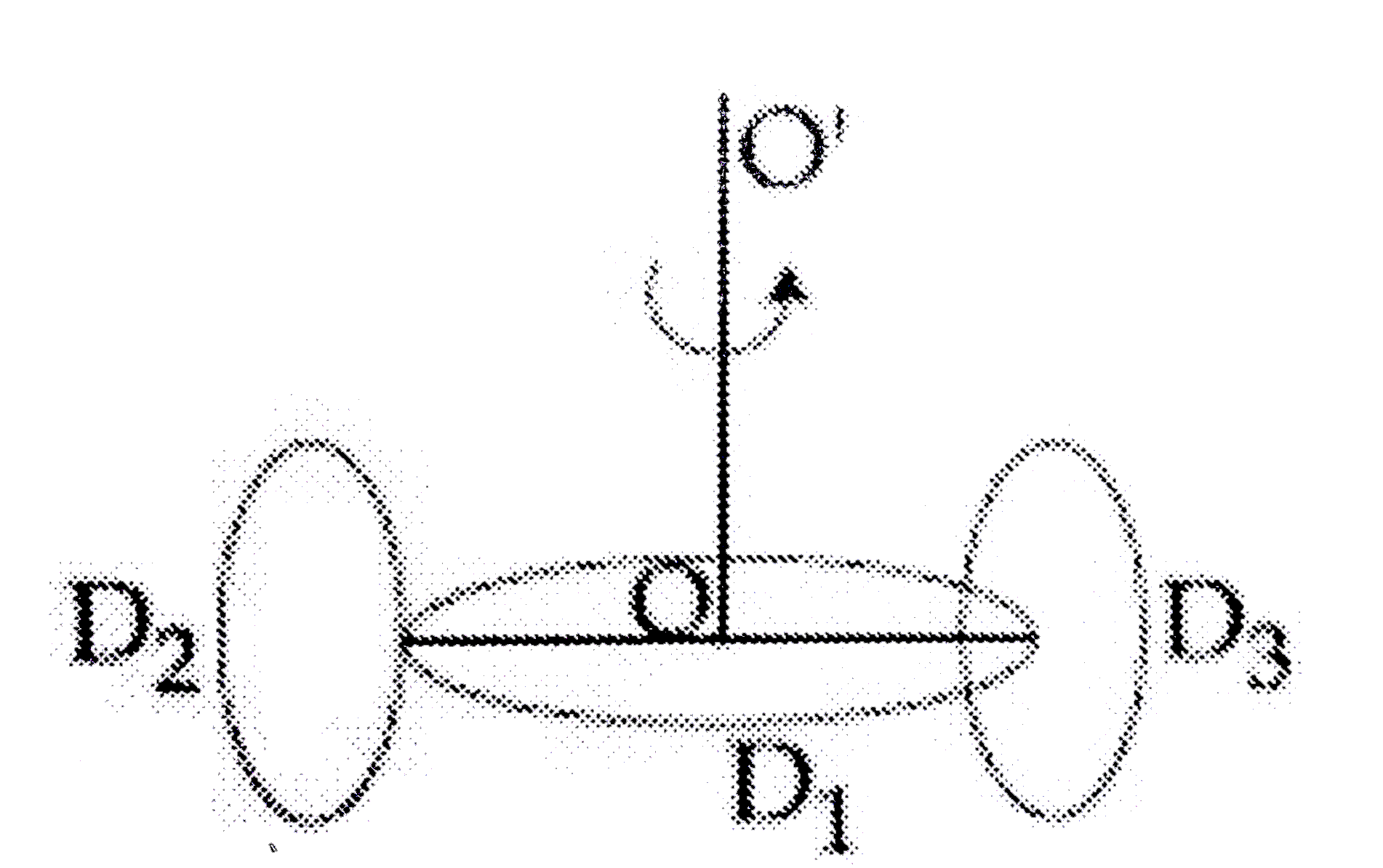
A circular disc `D_(1)` of mass M and radius R has two identical disc `D_(2)` and `D_(3)` of the same mass M and radius R attached rigidly at its opposite ends (see figure). The moment of inertia of the system about the axis OO, passing through the centre of `D_(1)` as shown in the figure, will be :

Promotional Banner

Similar Questions

Explore conceptually related problems

Three identical solid discs, each of mass M and radius R, are arranged as shown in figure. The moment of inertia of the system about an axis AB will be

A disc of mass m and radius R is attached to a rectangular plate of the same mass m, breadth R and length 2R as shown in figure. The moment of inertia of the system about the axis AB passing through the centre of the disc and along the plane is I = 1/(alpha) (31/3 m R^2) .

A disc of mass m and radius R is attached to a rectangular plate of the same mass m, breadth R and length 2R as shown in figure. The moment of inertia of the system about the axis AB passing through the centre of the disc and along the plane is I = 1/(alpha) (31/3 m R^2) .

Two identical circular plates each of mass M and radius R are attached to each other with their planes bot^r to each other. The moment of inertia of system about an axis passing through their centres and the point of contact is

A disc has mass 9 m. A hole of radius R/3 is cut from it as shown in the figure. The moment of inertia of remaining part about an axis passing through the centre 'O' of the disc and perpendicular to the plane of the disc is :

A disc has mass 9 m. A hole of radius R/3 is cut from it as shown in the figure. The moment of inertia of remaining part about an axis passing through the centre 'O' of the disc and perpendicular to the plane of the disc is :