

Home
Class 11
PHYSICS
Two identical beads, each of m=100g, are...

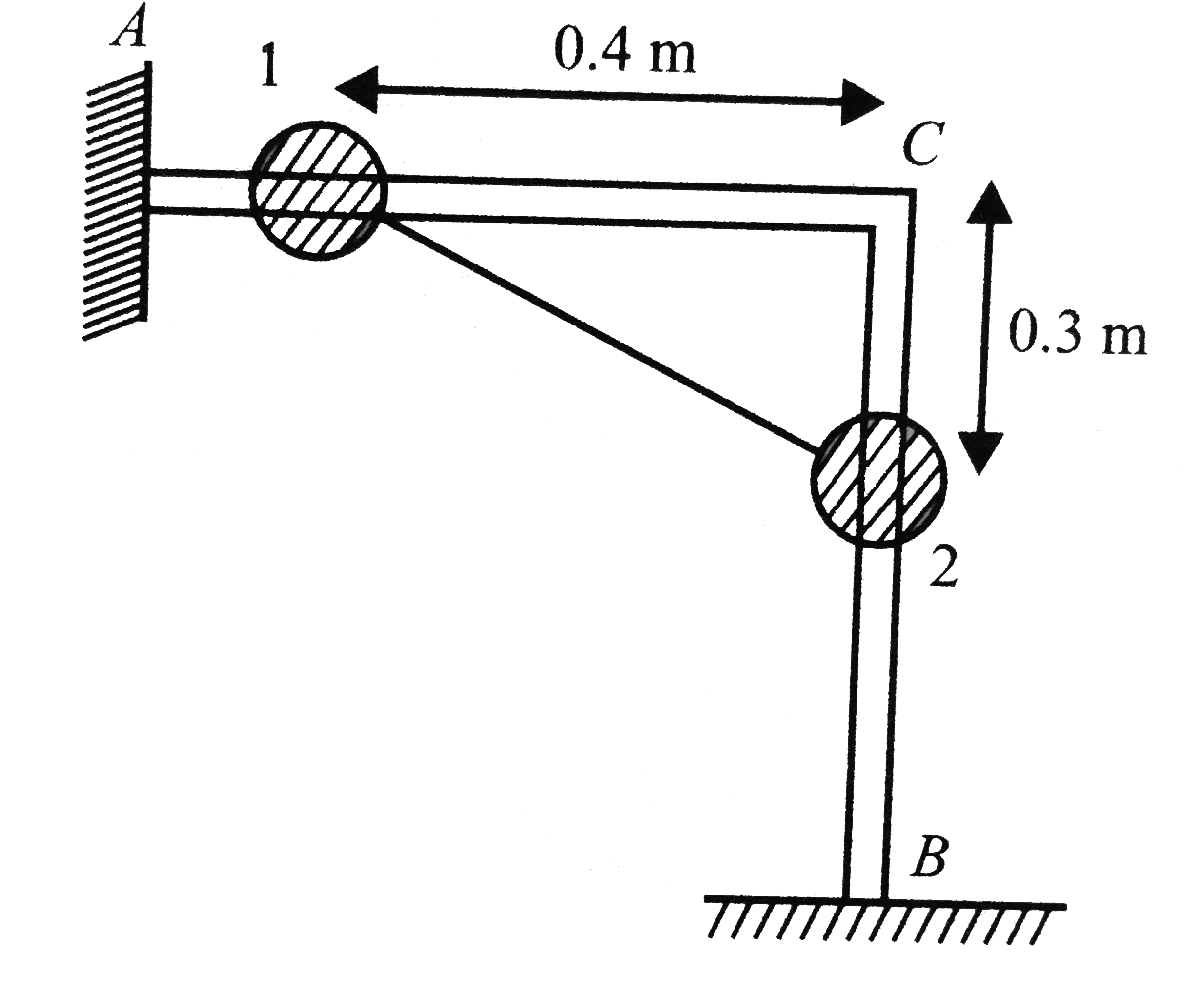
Two identical beads, each of `m=100g`, are connected by an inextensible massless string, which can slide along the two arms AC and BC of a rigid smooth wire frame in a vertical plane. If the system is released from rest, the kinetic energy of the first bead when the second bead has moved down by a distance of `0.1m` is `xxx10^-3J`. Find the value of `x(g=10ms^-2)` (shown situation is after movement of `0.1m`).

Promotional Banner

Similar Questions

Explore conceptually related problems

Beads A and B each of mass m , are connected by a light inextensible cord. They are constrained (restricted) to move on a frictionless ring in a vertical plane as shown. The beads are released from rest at the position shown. The tension in the cord just after the release is.

Two beads A & B of equal mass m are connected by a light inextensible to move on a connected to move on a frictionless ring in vertical plane. The beads are released from rest as shown. The tension in the cord just after the release is:

Two beads of masses m_(1) and m_(2) connected by an inextensible string are kept at rest at the horizontal diametrical points of a fixed smooth vertical semicircular tube. If the beads are released from the given position, find their speeds as the function of vertical distance y converted by miss m_(2).

Two beads of masses m_(1) and m_(2) connected by an inextensible string are kept at rest at the horizontal diametrical points of a fixed smooth vertical semicircular tube. If the beads are released from the given position, find their speeds as the function of vertical distance y converted by mass m_(2).

Two beads of masses m_(1) and m_(2) connected by an inextensible string are kept at rest at the horizontal diametrical points of a fixed smooth vertical semicircular tube. If the beads are released from the given position, find their speeds as the function of vertical distance y converted by miss m_(2).

Two beads A and B of equal mass m are connected by a light inextensibe chord. They are constrined to move on a frictionless ring in vertical plane. The blocks are released from rest as shown in figure. The tension in the chord just after the release is

Two beads A and B of equal mass m are connected by a light inextensibe chord. They are constrined to move on a frictionless ring in vertical plane. The blocks are released from rest as shown in figure. The tension in the chord just after the release is

Two identical beads each of mass 'm' can slide freely on a ring of mass M lying on smooth horizontal surface. The masses are brought to diametrically opposite positions and both are imparted with same tangential speed v in same direction. Find the kinetic energy of the ring when beads are about to collide.

Two identical beads each of mass 'm' can slide freely on a ring of mass M lying on smooth horizontal surface. The masses are brought to diametrically opposite positions and both are imparted with same tangential speed v in same direction. Find the kinetic energy of the ring when beads are about to collide.

In the given figure, Find mass of the block A, if it remains at rest, when the system is released from rest. Pulleys and strings are massless. [g=10m//s^(2)]