

Home
Class 11
PHYSICS
Four pieces of string of length L are jo...

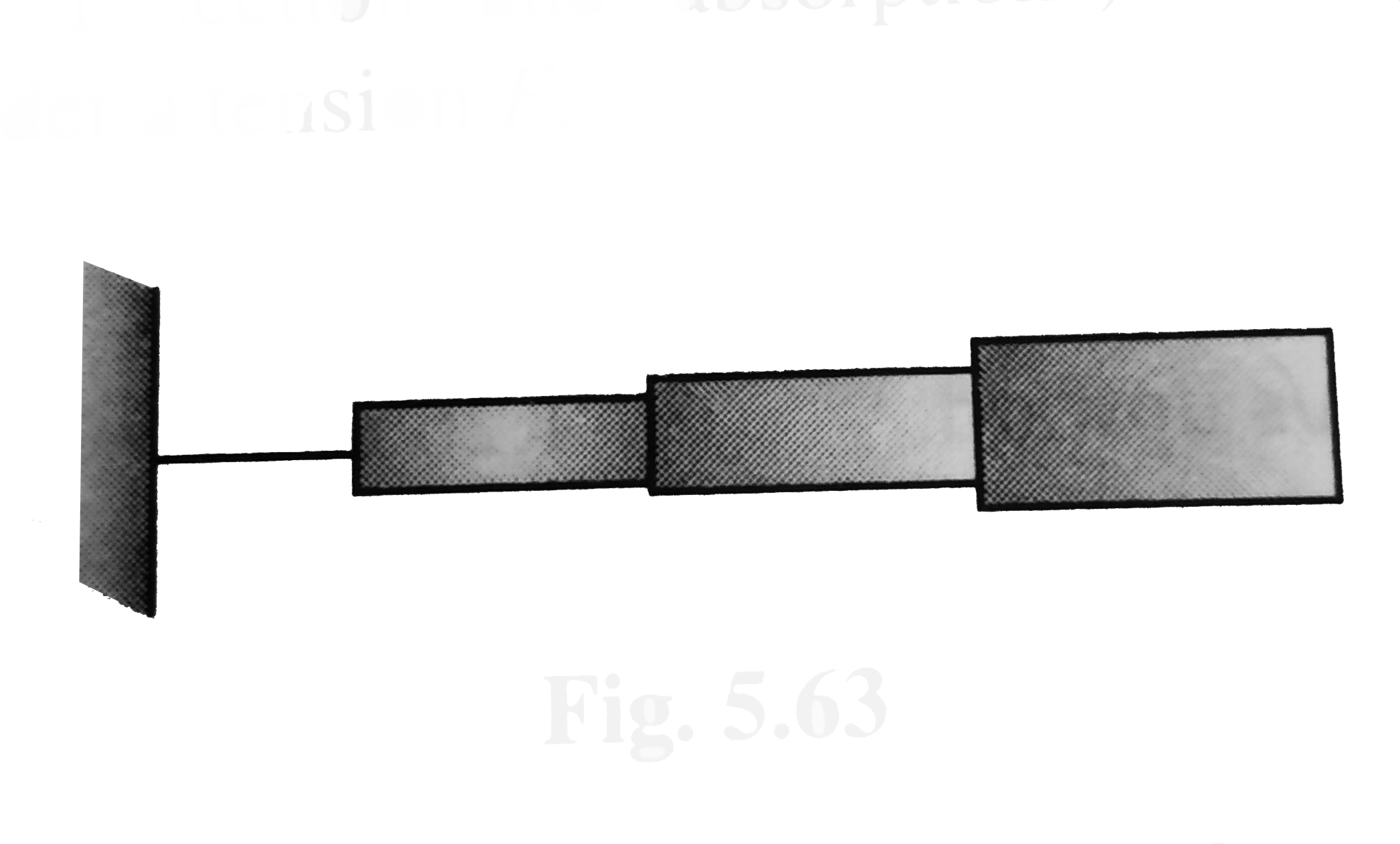
Four pieces of string of length L are joined end to end to make a long string of length 4L. The linear mass density of the strings are `mu,4mu,9mu and 16mu`, respectively. One end of the combined string is tied to a fixed support and a transverse wave has been generated at the other end having frequency `f` (ignore any reflection and absorption). string has been stretched under a tension `F`.

Find the time taken by wave to reach from source end to fixed end.

Promotional Banner

Similar Questions

Explore conceptually related problems

Four pieces of string of length L are joined end to end to make a long string of length 4L. The linear mass density of the strings are mu,4mu,9mu and 16mu , respectively. One end of the combined string is tied to a fixed support and a transverse wave has been generated at the other end having frequency f (ignore any reflection and absorption). string has been stretched under a tension F . Find the ratio of wavelength of the wave on four string, starting from right hand side.

Three pieces of string, each of length L, are joined together end-to-end, to make a combined string of length 3L. The first piece of string has mass per unit length mu_1 , the second piece has mass per unit length mu_2 = 4mu_1 and the third piece has mass per unit length mu_3 = mu_1//4 . (a) If the combined string is under tension F, how much time does it take a transverse wave to travel the entire length 3L? Give your answer in terms of L,F and mu_1 . (b) Does your answer to part (a) depend on the order in which the three piece are joined together? Explain.

Three pieces of string, each of length L, are joined together end-to-end, to make a combined string of length 3L. The first piece of string has mass per unit length mu_1 , the second piece has mass per unit length mu_2 = 4mu_1 and the third piece has mass per unit length mu_3 = mu_1//4 . (a) If the combined string is under tension F, how much time does it take a transverse wave to travel the entire length 3L? Give your answer in terms of L,F and mu_1 . (b) Does your answer to part (a) depend on the order in which the three piece are joined together? Explain.