

Home
Class 11
PHYSICS
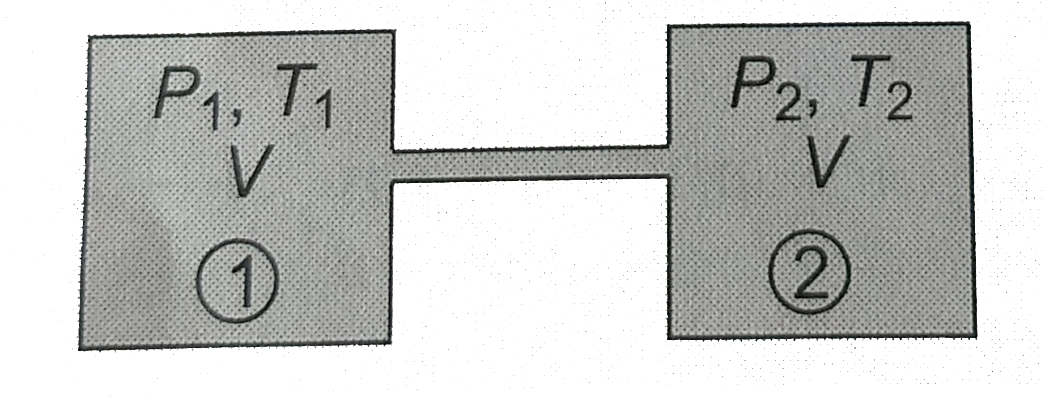
Two vessels A and B with rigid walls con...

Two vessels `A` and `B` with rigid walls containing ideal gases. The pressure, temperature and the volume are `P_(1), T_(1), V` in the vessel `A` and `P_(2), T_(2), V` in the vessel `B`. The vessels are now connected through a small tube. In equilibrium, pressure `P` and temerature `T` becomes same in two vessels. Find the value of `P//T`.

Promotional Banner

Similar Questions

Explore conceptually related problems

Shows two vessel A and B with rigid walls containing ideal gases. The pressure, temperature and the volume are P_(A),T_(A),V in the vessel A and P_(B),T_(B),V in the vessel B. The vessels are mow connected through a small tube. Show that pressure p and the temperature T satisfy (P)/(T)=(1)/(2)((P_(A))/(T_(A))+(P_(B))/(T_(B)) when equilibrium is archieved .

shows two vessels A and B with rigid walls containing ideal gas. The pressure volume and temperature in vessel A are P_(A), V and T_(A) whereas in vessel B,P_(B) V and T_(B) The vessel are now connected through small tube of negligible volume Show that the final pressure P and temperature T satisfy the equation (P)/(T) =(1)/(2)[(P_(A))/(T_(A)) +(P_(B))/(T_(B))] .

Two thermally insulated vessels are filled with an ideal gas. The pressure, volume and temperature in the two vessels are P_(1), V_(1), T_(1) and P_(2), V_(2), T_(2) respectively. Now, the two vessels are connected using a short insulating tube. (a) Find final temperature of the gas. (b) Express the final pressure of the gas in terms of P_(1), V_(1), P_(2) and V_(2) only.

Two vessels A and B have volumes V and 4V respectively Both vessels contain some water The pressure in the space above water is P^(1) in vessel A and P_(2) in vessel B at temperature T which one is correct ? .

Two vessels of volume (V_1) and (V_2) contain the same ideal gas. The pressures in the vessels are (P_1) and (P_2) and the temperatures are (T_1) and (T_2) respectively . The two vessels are now connected to each other through a narrow tube. Assuming thar no heat is exchanged between the surrounding and the vessels, find the common pressure and temperature attained after the connection.

Two vessels of volume (V_1) and (V_2) contain the same ideal gas. The pressures in the vessels are (P_1) and (P_2) and the temperatures are (T_1) and (T_2) respectively . The two vessels are now connected to each other through a narrow tube. Assuming that no heat is exchanged between the surrounding and the vessels, find the common pressure and temperature attained after the connection.

A vessel of volume 3V contains a gas at pressure 4 P_(0) and another vessel of volume 2V contains same gas at pressure 1.5 P_(0) . Both vessels have same temperature. When both vessels are connected by a tube of negligible volume, the equilibrium is IP_(0) , where I is an integer. Find the value of I .

A vessel of volume 3V contains a gas at pressure 4 P_(0) and another vessel of volume 2V contains same gas at pressure 1.5 P_(0) . Both vessels have same temperature. When both vessels are connected by a tube of negligible volume, the equilibrium is IP_(0) , where I is an integer. Find the value of I .