

Home
Class 9
MATHS
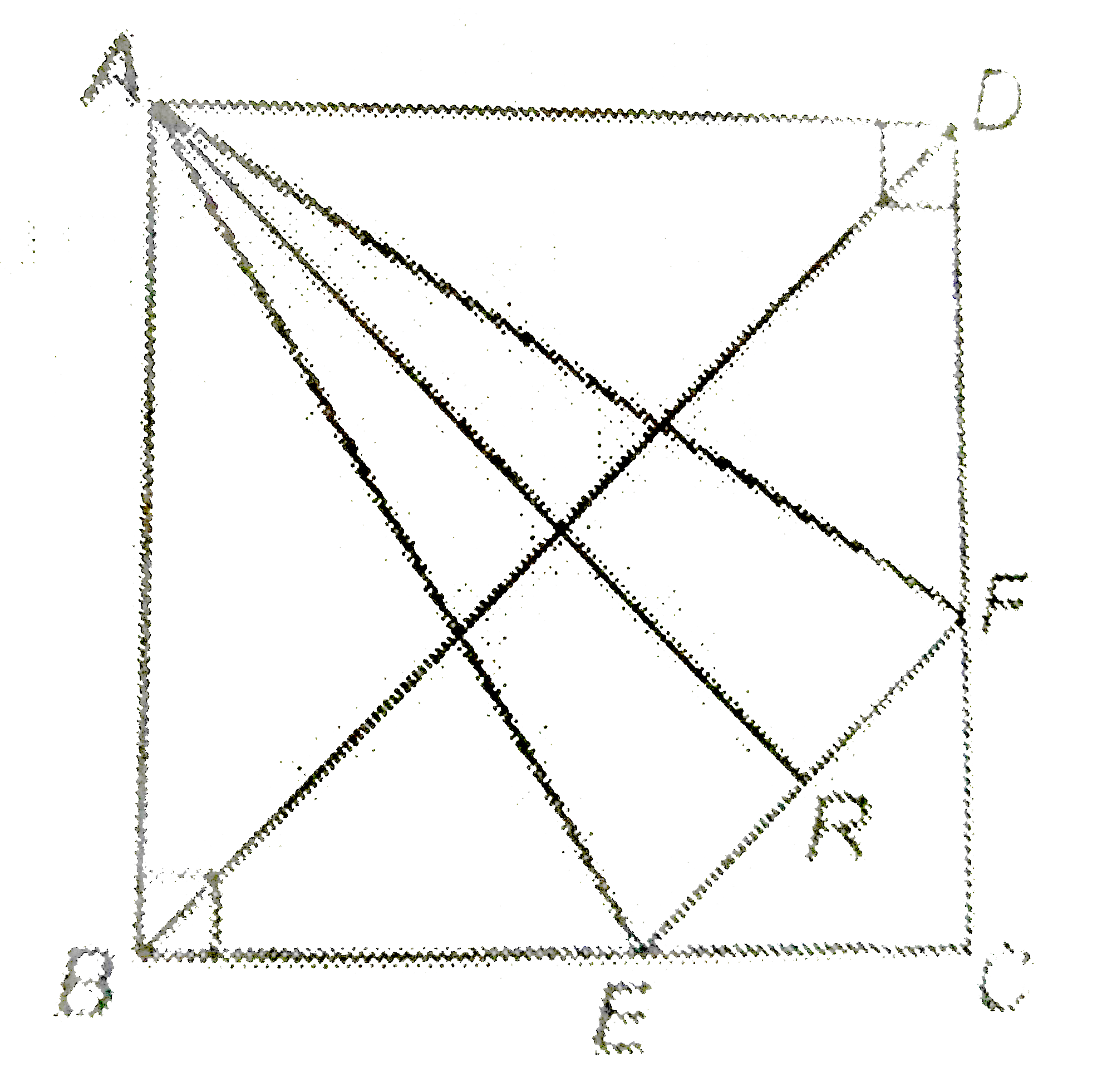
ABCD is a square EF is parallel to BD. R...

ABCD is a square EF is parallel to BD. R is the mid-point of EF. Prove that :
(i) `BE = DF`
(ii) AR bisects angle BAD
(iii) If AR produced it will pass through C.

Promotional Banner

Similar Questions

Explore conceptually related problems

In the figure,ABCD is a square and EF is parallel to BD.R is the mid-point of EF.Prove that (i) BE=DF( ii) AR bisects /_BAD and (iii) If AR is produced it will pass through C.

In parallelogram ABCD, E is the mid-point of side AB and CE bisect angle BCD. Prove that : (i) AE=AD (ii) DE bisect angleADC and (iii) Angle DEC is a right angle.

ABCD is a parallelogram E is mid-point of AB and DE bisects angle D. Prove that CE bisects angle C

ABCD is a squre. E and F are respectivley the mid-points of BC and CD. If R is the mid-points of EF. Prove that ar (AER) = ar(AFR).

ABCD is a square. E and F are respectively the mid-points of BC and CD. If R is the mid-point of EF, prove that ar (DeltaAER) = ar (DeltaAFR) .

ABCD is a square. E and F are respectively the mid-points of BC and CD. If R is the mid-point of EF, prove that ar (DeltaAER) = ar (DeltaAFR) .

In a quadrilateral ABCD, AB = AD and CB = CD. Prove that : (i) AC bisects angle BAD (ii) AC is perpendicular bisector of BD.

ABCD is a parallelogram. X and Y are mid-points of BC and CD. Prove that ar(triangleAXY)=3/8ar(||^[gm] ABCD)

ABCD is parallelogram and ABEF is a rectangle and DG is perpendicular on AB. Prove that (i) ar (ABCD) = ar(ABEF) (ii) ar (ABCD) = AB xx DG

ABCD is parallelogram and ABEF is a rectangle and DG is perpendicular on AB. Prove that (i) ar (ABCD) = ar(ABEF) (ii) ar (ABCD) = AB xx DG