

Home
Class 11
PHYSICS
A glass full of water has a bottom of ar...

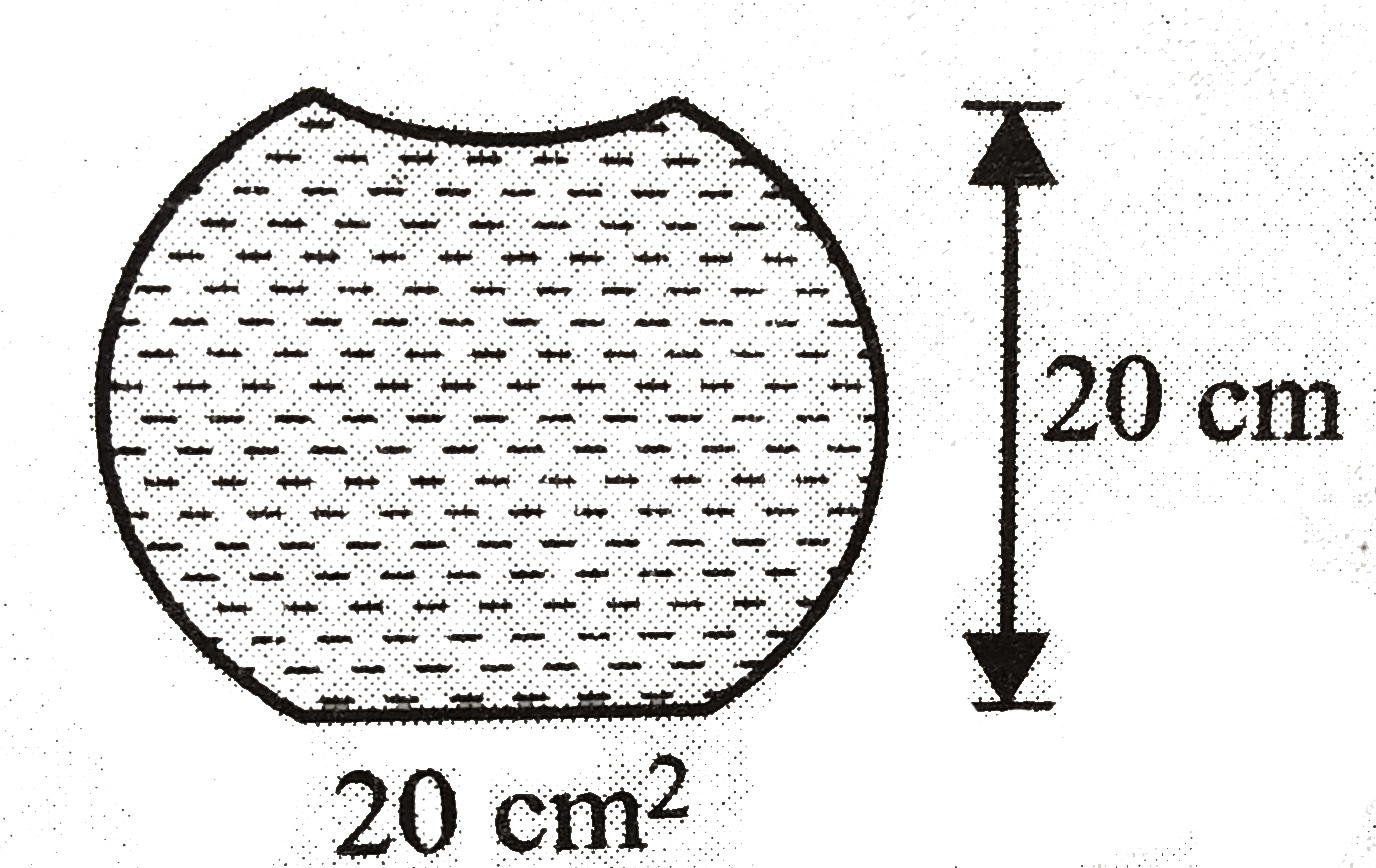
A glass full of water has a bottom of area `20 cm^(2)`, top of area `20 cm`, height `20 cm` and volume half a litre.

a. Find the force exerted by the water on the bottom.
b. Considering the equilibrium of the `v`, after. find the resultant force exerted by the side, of the glass on the water. Atmospheric pressure `= 1.0 xx 10^(5) N//m^(2)`. Density of water `= 1000 kg//m^(-3)` and `g = 10 m//s^(2)`

Promotional Banner

Similar Questions

Explore conceptually related problems

A vessel full of water has a bottom of area 20 cm^(2) , top of area 20 cm^(2) , height 20 cm and volume half a litre as shown in figure. (a) find the force exerted by the water on the bottom. (b) considering the equilibrium of the water, find the resultant force exerted by the sides of the glass vessel on the water. atmospheric pressure =1.0xx10^(5) N//m^(2) . density of water =1000 kg//m^(3) and g=10m//s^(2)

A glass full of water has a bottom of area 20 cm^(2) , top of area 20 cm , height 20 cm and volume half a litre. Find the force exerted by the water on the bottom. Atmospheric pressure = 1.0 xx 10^(5) N//m^(2) . Density of water = 1000 kg//m^(-3) and g = 10 m//s^(2)

A glass full of water upto a height of 10 cm has a bottom of are 10 cm^(2) , top of area 30cm^(2) and volume 1 litre. (a) Find the force exerted by the water on the bottom. (b) Find the resultant force exerted by the sides of the glass on the water. (c ) If the glass is convered by a jar and the air inside the jar is completely pumped out, what will be the answer to parts (a) and (b). (d) If a glass of different shape is used, provided the height, the bottom area, the top area and the volume are unchanged, will the answer to parts (a) and (b) change. Take g=10m//s^(3) , density of water =10^(3) kg//m^(3) and atmospheric pressure =1.01xx10^(5)N//m^(2) .

A glass full of water upto a height of 10 cm has a bottom of are 10 cm^(2) , top of area 30cm^(2) and volume 1 litre. (a) Find the force exerted by the water on the bottom. (b) Find the resultant force exerted by the sides of the glass on the water. (c ) If the glass is convered by a jar and the air inside the jar is completely pumped out, what will be the answer to parts (a) and (b). (d) If a glass of different shape is used, provided the height, the bottom area, the top area and the volume are unchanged, will the answer to parts (a) and (b) change. Take g=10m//s^(3) , density of water =10^(3) kg//m^(3) and atmospheric pressure =1.01xx10^(5)N//m^(2) .

A curved glass vessel full of water upto a height of 10 cm has a bottom of area 10 cm^(2) , top of area 30 cm^(2) and volume 1 L. (i) Find the force exerted by the water on the bottom. (ii) Find the resultant force exerted by the sides of the glass on the water. (iii) If the glass vessel is covered by a jar and the air inside the jar is completely pumped out, what will be the answers to parts (a) and (b) (iv) If a glass vessel of different shape is used provided the height, the bottom area and the volume are unchanged, will the answers to parts (a) and (b) change. (Take, g=10 ms^(-2) , density of water = 10^(3) kgm^(-2) and atmospheric pressure =1.01xx10^(5)Nm^(-2))

A beaker of circular cross-section of radius 4 cm is filled with mercury up to a height of 10 cm. Find the force exerted by the mercury on the bottom of the beaker. The atmospheric pressure =10^5Nm^-2 . Density of mercury =13600 kgm^-3. Take g10ms^-2

A beaker of circular ceross sectionof radius 4 cm is filled with mercury up to a height of 10 cm. Find the force exerted by the mercury on the bottom of the beaker. The atmospheric pressure =10^5Nm^-2 . Density of mercury =13600 kgm^-3. Take g10ms^-2

A beaker of circular cross-section of radius 4 cm is filled with mercury up to a height of 10 cm. Find the force exerted by the mercury on the bottom of the beaker. The atmospheric pressure =10^5Nm^-2 . Density of mercury =13600 kgm^-3. Take g10ms^-2