Home
Class 12
MATHS
Prove that the area of the parallelogram...

Prove that the area of the parallelogram with diagonal `veca` and `vecb` is `(1)/(2)|vecaxxvecb|`

Text Solution

Verified by Experts
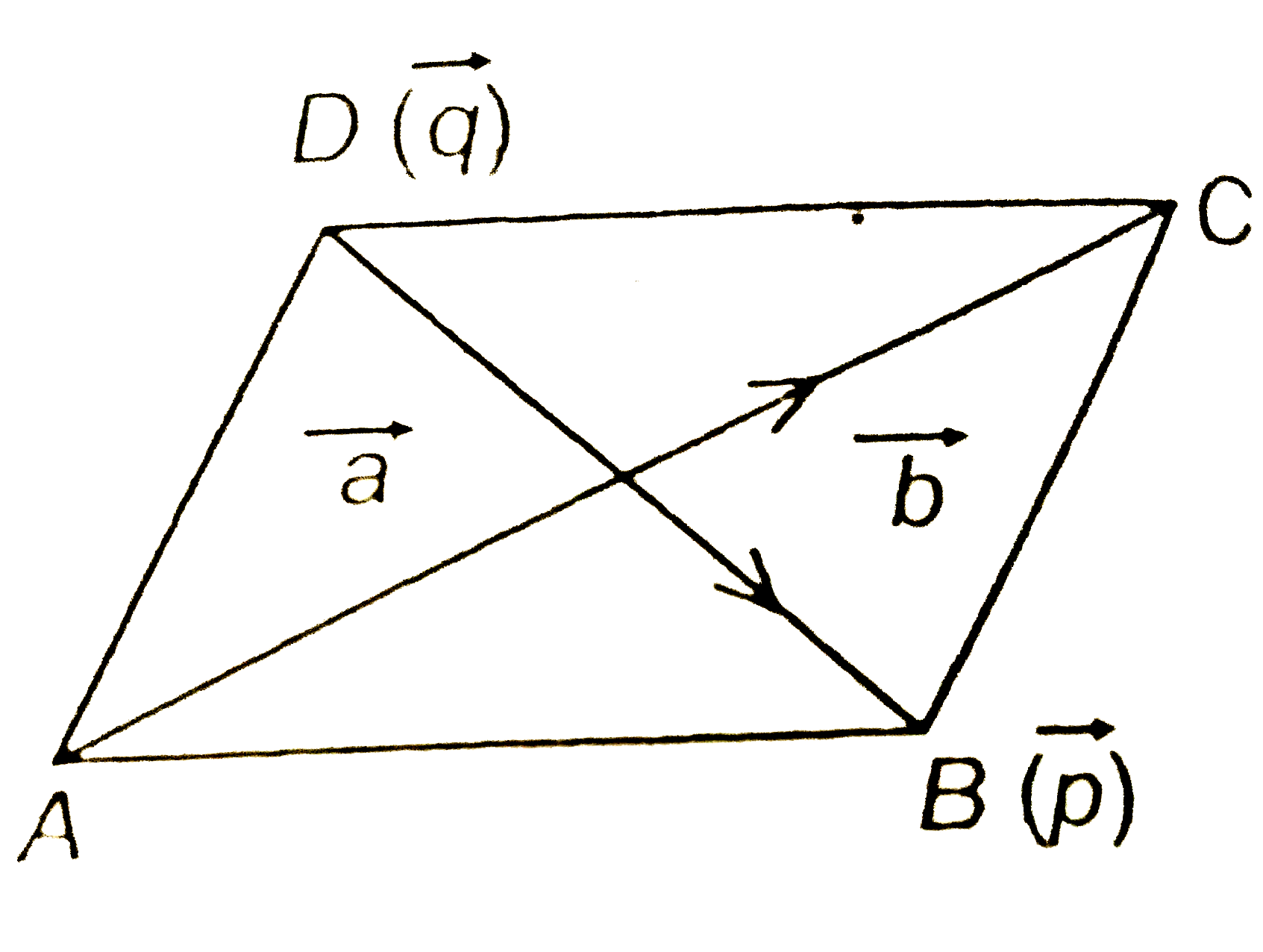
Let ABCD is a parallelogram with A as the origin. Let the position vector of B and D be `vecp` and `vecq` respectively. Then
`vec(AB)=vecp" and " vec(AD)=vecq`
But `vec(BC)=vec(AD)` Therefore `vec(BC)=vecq`
By triangle law of addition
`vec(AB)+vec(BC)=vec(AC)`

`vecp+vecq=vec(AC)`
`vecp+vecq=veca" "`.......(i)
`vec(BD)`=postion vector of D-positon vector of B.
`rArr " " vecb=vecq-vecp" "` .......(ii)
Adding (i) and (ii), we get
`2vecq=veca+vecb rArr vecq=(1)/(2)(veca+vecb)`
Subtracting (ii) from (i), we get
`2vecp=veca-vecb rArr vecp=(1)/(2)(veca-vecb)`
Now `vecpxxvecq=(1)/(2)(veca-vecb)xx(1)/(2)(veca+vecb)`
`rArr vecpxxvecq=(1)/(4)[(veca-vecb)xx(veca+vecb)]`
`rArr vecpxxvecq=(1)/(4)[vecaxxveca+vecaxxvecb-vecbxxveca-vecbxxvecb]`
`rArr " "vecpxxvecq=(1)/(4)[vecaxxvecb+vecaxxvecb]`
`rArr " " vecpxxvecq=(1)/(2)(vecaxxvecb)`
So, the area of parallelogram ABCD `=|vecpxxvecq|=(1)/(2)|vecaxxvecb|`
Promotional Banner

Topper's Solved these Questions

  • VECTOR ALGEBRA

    AAKASH INSTITUTE|Exercise ILLUSTRATION|1 Videos
  • VECTOR ALGEBRA

    AAKASH INSTITUTE|Exercise TRY YOURSELF|20 Videos
  • TRIGNOMETRIC FUNCTIONS

    AAKASH INSTITUTE|Exercise Section - J (Akash Challengers Question)|15 Videos

Similar Questions

Explore conceptually related problems

Show that area of the parallelogram whose diagonals are given by veca and vecb is (|veca xx vecb|)/2 . Also, find the area of the parallelogram, whose diagonals are 2hati - hatj + hatk and hati + 3hatj - hatk .

If the area of the parallelogram with veca and vecb as two adjacent sides is 15 sq unit ,than the area of the parallelogram having, 3veca + 2vecb and veca + 3 vec b as two adjacent sides in sq unit is

Let veca,vecb and vecc be three non zero vectors. The area of the parallelogram formed by veca and vecb as diagonals is veca=hati-2hatj vecb=2hati+hatj+3hatk

The length of the longer diagonal of the parallelogram constructed on 5veca + 2vecb and veca - 3vecb, if it is given that |veca|=2sqrt2, |vecb|=3 and veca. Vecb= pi/4 is

find the area of a parallelogram whose diagonals are veca=3hati+hatj-2hatk and vecb=hati-3hatj+4hatk .

Show that the components of vecb parallel to veca and perpendicular to it are ((veca.vecb)veca)/veca^2 and ((vecaxxvecb)veca))/a^2 respectively.

Show that (veca+vecb)xx(veca-vecb)=-2(vecaxxvecb) and use this result to find the area of a parallelogram whose diagonals are hati-2hatj-3hatk and 2hati-3hatj+2hatk

If the non zero vectors veca and vecb are perpendicular to each other then the solution the equation vecrxxveca=vecb is (A) vecralphavecb- 1/(|vecb|^2)(vecaxxvecb) (B) vecralphavecb+ 1/(|veca|^2)(vecaxxvecb) (C) vecralphavecb+ 1/(|vecb|^2)(vecaxxvecb) (D) none of these

If veca and vecb are two such that |veca|=5, |vecb|=4 and |veca.vecb|=10 , find the angel between veca and vecb and hence find |vecaxxvecb|

If veca vecb be any two mutually perpendiculr vectors and vecalpha be any vector then |vecaxxvecb|^2 ((veca.vecalpha)veca)/(veca|^2)+|vecaxvecb|^2 ((vecb.vecalpha)vecb)/(|vecb|^2)-|vecaxxvecb|^2vecalpha= (A) |(veca.vecb)vecalpha|(vecaxxvecb) (B) [veca vecb vecalpha](vecbxxveca) (C) [veca vecb vecalpha](vecaxxvecb) (D) none of these

