

Home
Class 12
PHYSICS
Wave property of electron implies that t...

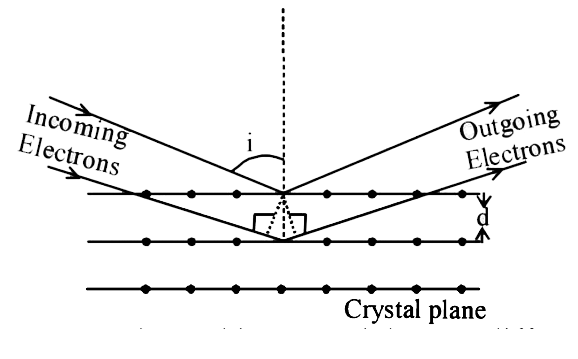
Wave property of electron implies that they will show diffraction effected . Davisson and Germer demonstrated this by diffracting electron from crystals . The law governing the diffraction from a crystals is obtained by requiring that electron waves reflected from the planes of atoms in a crystal inter fere constructiely

If a strong diffraction peak is observed when electrons are incident at an angle `i` from the normal to the crystal planes with distance `d` between them (see fig) de Brogle wavelength `lambda_(dB)` of electrons can be calculated by the relationship (n is an intenger)

Promotional Banner

Similar Questions

Explore conceptually related problems

Wave property of electron implies that they will show diffraction effected . Davisson and Germer demonstrated this by diffracting electron from crystals . The law governing the diffraction from a crystals is obtained by requiring that electron waves reflected from the planes of atoms in a crystal inter fere constructiely Electron accelerated by potential V are diffracted from a crystal if d = 1 Å and i = 30^(@), V should be about (h = 6.6 xx 10^(-34) Js, m_(e) = 9.1 xx 10^(-31) kg , e = 1.6 xx 10^(-19)C)

Wave property of electron implies that they will show diffraction effected . Davisson and Germer demonstrated this by diffracting electron from crystals . The law governing the diffraction from a crystals is obtained by requiring that electron waves reflected from the planes of atoms in a crystal interfere constructiely Electron accelerated by potential V are diffracted from a crystal if d = 1 Å and i = 30^(@), V should be about (h = 6.6 xx 10^(-34) Js, m_(e) = 9.1 xx 10^(-31) kg , e = 1.6 xx 10^(-19)C)

Wave property of electron implies that they will show diffraction effected . Davisson and Germer demonstrated this by diffracting electron from crystals . The law governing the diffraction from a crystals is obtained by requiring that electron waves reflected from the planes of atoms in a crystal interfere constructiely Electron accelerated by potential V are diffracted from a crystal if d = 1 Å and i = 30^(@), V should be about (h = 6.6 xx 10^(-34) Js, m_(e) = 9.1 xx 10^(-31) kg , e = 1.6 xx 10^(-19)C)

Wave property of electrons implies that they will show diffraction effects. Davission and Germer demonstrated this by diffracting electrons from crystals. The law governing the diffraction from a crystal is obtained by requiring that electron waves reflected from the planes of atoms in a crystal interfere constructively (see figure) The surface of a metal is illuminated with the light of 400 nm . The kinetic energy of the ejected photoelectrons was found to be 1.68 eV . The work function of the metal is : ( hc = 1240 eV-nm )

Wave property of electrons implies that they will show diffraction effects. Davission and Germer demonstrated this by diffracting electrons from crystals. The law governing the diffraction from a crystal is obtained by requiring that electron waves reflected from the planes of atoms in a crystal interfere constructively (see figure) The surface of a metal is illuminated with the light of 400 nm . The kinetic energy of the ejected photoelectrons was found to be 1.68 eV . The work function of the metal is : ( hc = 1240 eV-nm )

Wave property of electrons implies that they will show diffraction effects. Davission and Germer demonstrated this by diffracting electrons from crystals. The law governing the diffraction from a crystal is obtained by requiring that electron waves reflected from the planes of atoms in a crystal interfere constructively (see figure) The surface of a metal is illuminated with the light of 400 nm . The kinetic energy of the ejected photoelectrons was found to be 1.68 eV . The work function of the metal is : ( hc = 1240 eV-nm )