

Home
Class 11
PHYSICS
A block of mass m sliding down an incli...

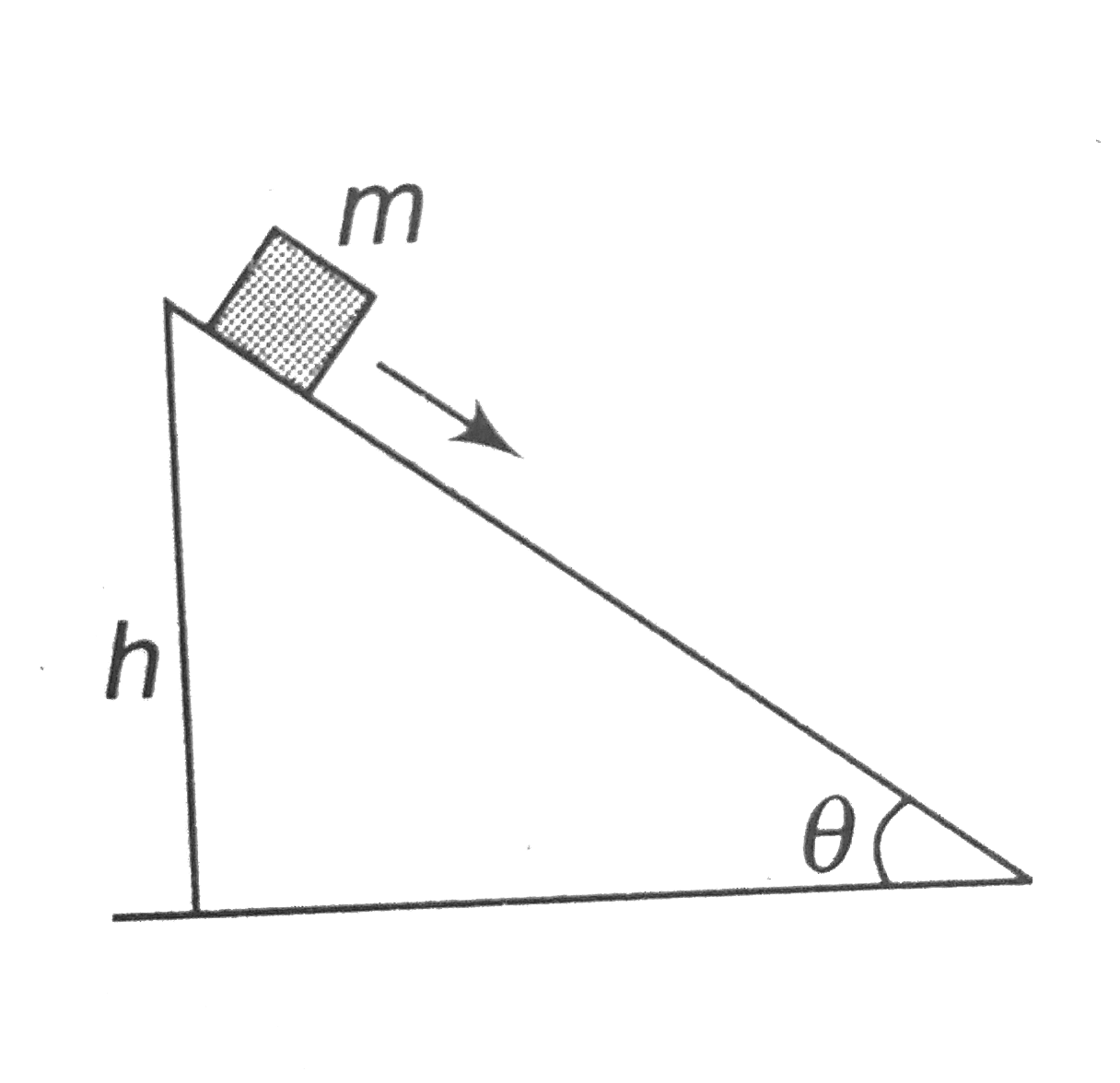
A block of mass `m` sliding down an inclined at constant speed is initial at a height `h` shown the ground as shown in the figure above . The coefficient of kinetic friction between the mass and the inclined is `mu` . If the mass constinues to slide down the inclined at a constant speed how much energy is displaced by friction by the time the mass reaches the bottom of the incline?

Promotional Banner

Similar Questions

Explore conceptually related problems

A block of mass m is sliding down an inclined plane with constant speed. At a certain instant t0, its height above the ground is h. The coefficient of kinetic friction between the block and the plane is mu . If the block reaches the ground at a later instant t_g , then the energy dissipated by friction in the time interval (t_(g)-t_(0)) is -

A body of mass M starts sliding down on the inclined plane where the critical angle is angleACB=30^(@) as shown in figure. The coefficient of kinetic friction will be

A body of mass M starts sliding down on the inclined plane where the critical angle is angleACB=30^(@) as shown in figure. The coefficient of kinetic friction will be

A block slides down a curved frictionless track and then up an inclined plane as in figure. The coefficient of kinetic friction between the block and incline is mu_k . Find the maximum height reached by the block.

A block slides down a curved frictionless track and then up an inclined plane as in figure. The coefficient of kinetic friction between the block and incline is mu_k . Find the maximum height reached by the clock.

A block is placed on an inclined plane. The angle of inclination of the plane is such that the block slides down the plane at a constant speed. The coefficient of kinetic friction is