

Home
Class 12
PHYSICS
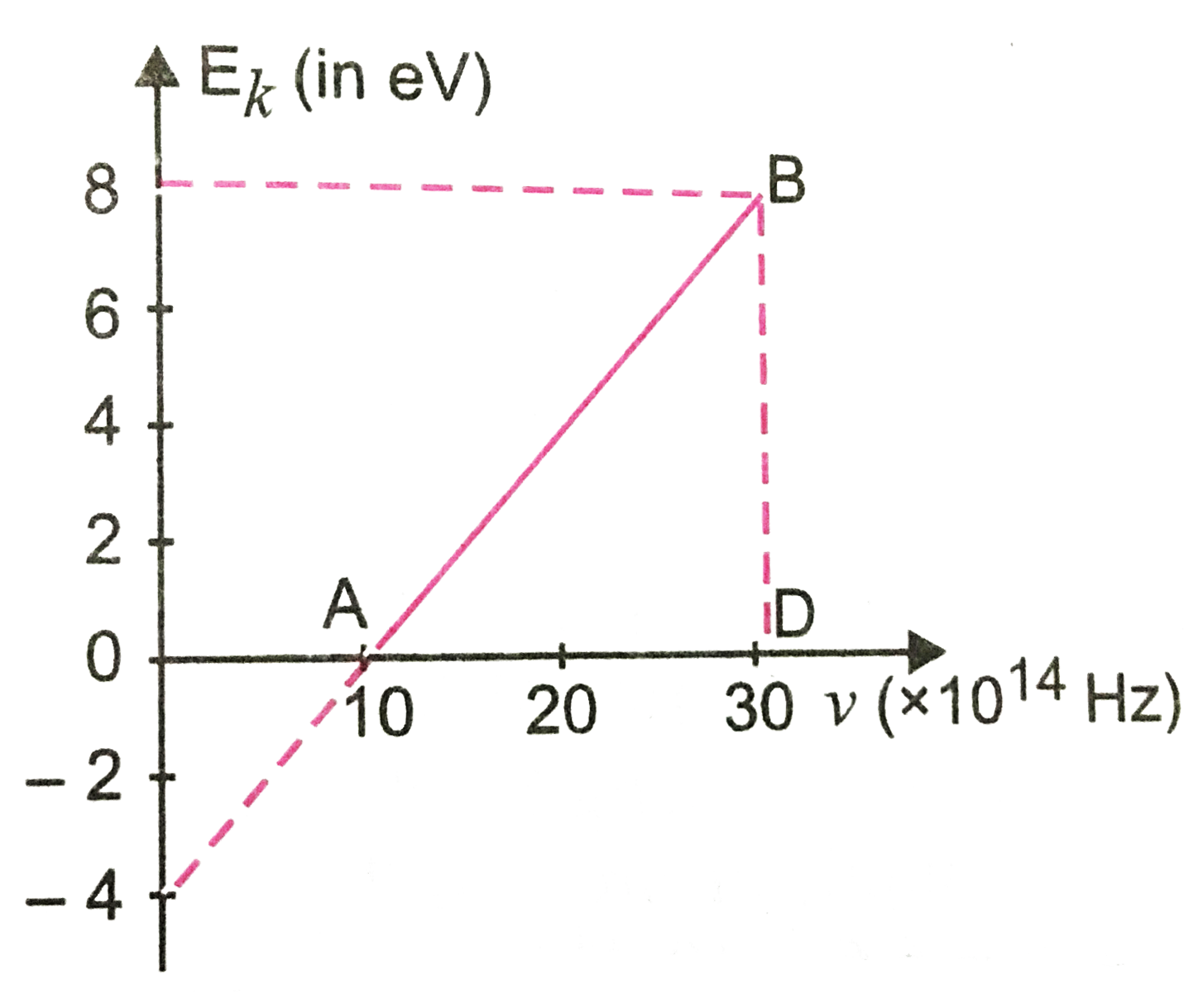
Given in fig. is the graph between frequ...

Given in fig. is the graph between frequency v of the incident light and maximum kinetiec energy `(E_(k))` of the emitted photoelectrons. Find the values of (i) threshold frequency and (ii) work function form the graph.

Promotional Banner

Similar Questions

Explore conceptually related problems

Given below is the graph between frequency (v) of the incident light and maximum kinetic energy (E_k) of emitted photoelectrons. Find the values of threshold frequency.

What will be the kinetic energy of emitted photoelectrons if light of threshold frequency falls on a metal?

Maximum kinetic energy (E_(k)) of a photoelectron varies with the frequency (v) of the incident radiation as

Maximum kinetic energy (E_(k)) of a photoelectron varies with the frequency (v) of the incident radiation as

The maximu kinetic energy (E_(k)) of the photoelectron varies with frequency (v) of the incident light as shown by the curve:

Light of frequency 4 v_(0) is incident on the metal of the threshold frequency v_(0) . The maximum kinetic energy of the emitted photoelectrons is

The kinetic energy (E_(k)) of a photoelectron varies with the frequency (v) of the incident radiation as which of the following graph ?

In an experiment on photoelectic effect, the graph between maximum kinetic energy (K_(max)) and frequency of emitted photoelectron from metal surface is found to be a straight line as shown in fig. Calculate (a) thereshold frequency. (b) work function of metal in electron volt. (c) Planck's constant and maximum kinetic energy of the emitted electron by light of frequency v=8xx10^(14)s^-1 .

In an experiment of photoelectric effect, the graph of maximum kinetic energy E_(K) of the emitted photoelectrons versus the frequency v of the incident light is a straight line AB as shown in Figure below: Find : (i) Threshold frequency of the metal. (ii) work function of the metal (iii) Stopping potential for the photoelectrons emitted by the light of frequency v=30xx10^(14) Hz.