

Home
Class 11
PHYSICS
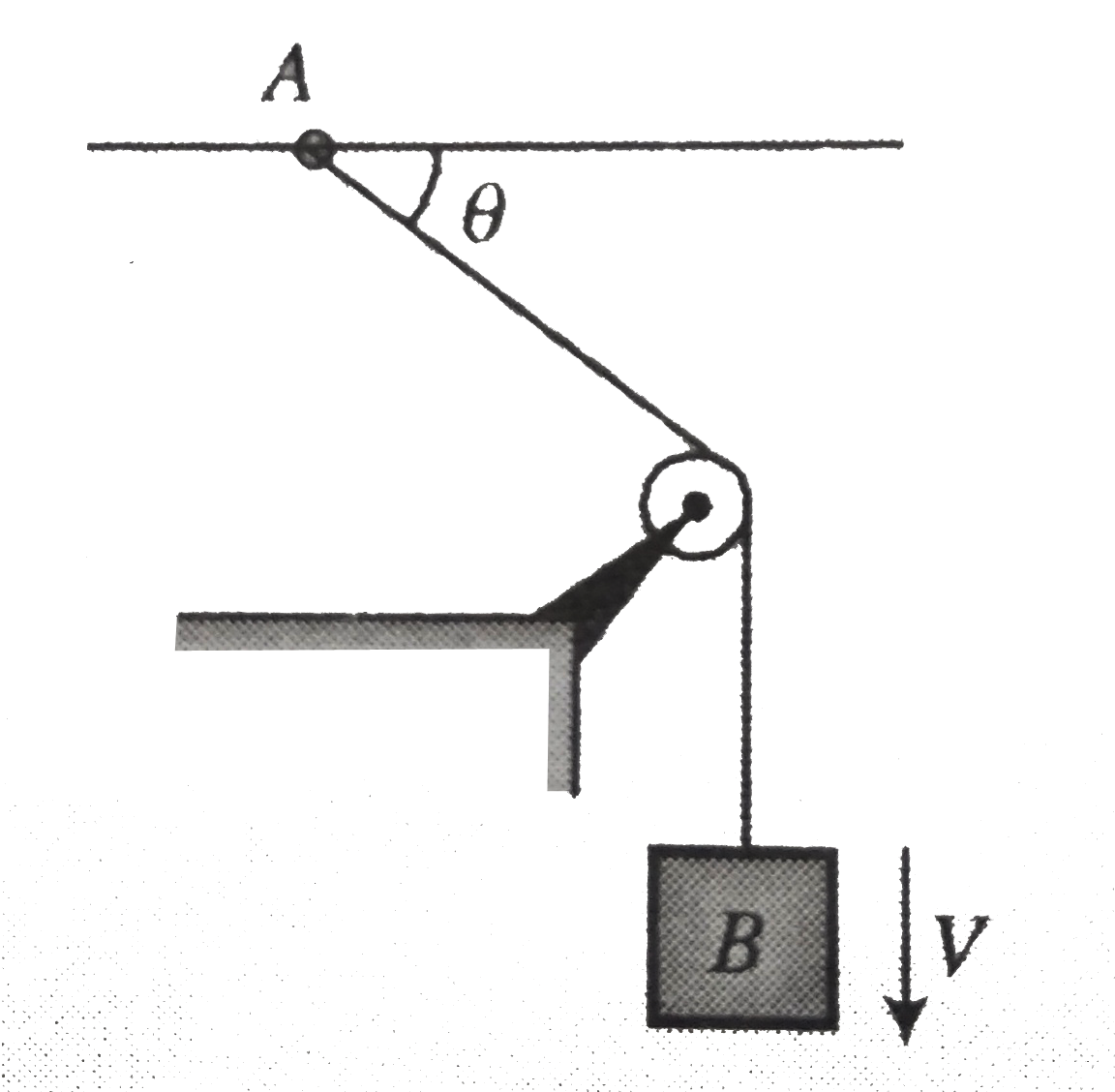
A ring A which can slide on a smooth wir...

A ring A which can slide on a smooth wire is connected to one end of a string as shown in fig. Other end of the string is connected to a hanging mass B. Find the speed of the ring when the string makes an angle `theta` with the wire and mass B is going down with a velocity v.

Promotional Banner

Similar Questions

Explore conceptually related problems

A ring of mass m can slide on the vertical smooth rod. Ring is connected by block with string as shown in figure. Pulley is of mass-less and smooth the system is released from reast. Initial tension in string is

A ring of mass m can slide on the vertical smooth rod. Ring is connected by block with string as shown in figure. Pulley is of mass-less and smooth the system is released from reast. Initial tension in string is

Two masses of 20 kg and 10 kg are connected to the ends of a string, hanging on a smooth and frictionless pulley. Find the acceleration of the two masses and tension in the string.

A bead can slide on a smooth straight wire and a particle of mass m attached to the bead by a light string of length L . The particle is held in contact with the wire and with the string taut and is then let fall. If the bead has mass 2m then when the string makes an angle theta with the wire, the bead will have slipped a distance.

A bead can slide on asmooth straight wire and a particle of mass m attached to the bead by a light string of length L. The particle is held in contact with the wire and with the string taut and is then let fall. If the bead has mass 2m then when the string makes an angle theta with the wire, the bead will have slipped a dsitance.

A bead can slide on asmooth straight wire and a particle of mass m attached to the bead by a light string of length L. The particle is held in contact with the wire and with the string taut and is then let fall. If the bead has mass 2m then when the string makes an angle theta with the wire, the bead will have slipped a dsitance.

A disc of mass m lies flat on a smooth horizontal table. A light string runs halfway around it as shown in figure. One end of the string is attached to a particle of mass m and the other end is being pulled with a force F. There is no friction between the disc and the string. Find acceleration of the end of the string to which force is being applied.

A block of mass m can slide freely in a slot made in a bigger of mass M as shown in fig. There is no friction anywhere in the system. The block m is connected to one end of a string whose other end is fixed at point P. system is released from rest when the string at P makes an angle theta with horizontal. Find the acceleration of m and M after release.

Find the speed of the block B when the wedges A and C are moving toward each other with speed v and the strings connected to block make and angle theta with the vertical, as shown in figure